The use of wine terms and allusions for tea has become more popular in the past few years. While I'm not a linguist, my guess is wine terms are increasingly adopted in tea talk because they have a higher likelihood of being understood by those uninitiated in tea but are more familiar with the wine culture (I'll refer to them as "wine-people" for the sake of brevity). Also, perhaps, wine terms lend to teas a certain charm that wine-people can relate to. Simply put, it's good marketing.
The word "terroir", for example, is brought up in conversations about teas, which like wines, are unique to the place where they were grown in. The French word terroir, after all, was coined by wine makers of old to convey a sense of origin and uniqueness of the grapes and the resulting wines. It is a concept with such universal application that it can be used for everything that grows and exists under the sun. So why not tea.
The most popular wine allusion, probably, is the claim by producers of Darjeeling teas that their products are the Champagne of Teas. I can see the intent, and again, it's marketing. Attaching one's identity with Champagne's venerated image is a good way to relate to a broad range of consumers. Beyond its marketing propaganda, however, I don't quite see any similarity between the two.
There is one wine term that I believe can not be adopted for tea, as it would create a misnomer. The word is sommelier. Tea sommelier just does not make any sense. A sommelier by itself means a "wine steward" or a person who is in charge of the wine provision and the service of it. Is a tea sommelier, then, a person who is highly knowledgeable in and serves both tea and wine? I think those who call themselves tea sommeliers in their profession should reconsider the word's meaning.
Consider the etymology of sommelier:
"Middle French. From somm(er)ier (one charged with transporting supplies), from somier (beast of burden), from somme (burden). From driving a pack animal to drafting wine lists, a sommelier has come a long way. A sommelier is to wine as a cicerone is to beer, though the latter has recently been introduced and is not widespread."
Another version says:
"French, from Middle French, court official charged with transportation of supplies, pack animal driver, from Old Provençal saumalier pack animal driver, from sauma pack animal, load of a pack animal, from Late Latin sagma packsaddle."
I think it's safe to say that a sommelier has got nothing to do with tea in the historical and etymological contexts. Are there any other misapplied wine terms used for tea, or vice versa?
[Edit] PS: In the back of my mind, while writing the post above I vaguely remembered having expressed the same opinion about the use of "sommelier" in conjunction with "tea". Searching for that comment made in the past, I found that Corax of Cha Dao had also expressed the same sentiment in his post "Flavor Hedonics: Pleasure and the Physiology of Taste" dated July 17, 2007. And my agreement to his sentiment was recorded under that post's comment section.
Showing posts with label Ramblings. Show all posts
Showing posts with label Ramblings. Show all posts
Monday, September 8, 2008


Wednesday, September 3, 2008
Negative Outlook By a U.S. Tea Wholesaler
I always welcome with delight the latest quarterly catalog from Upton Tea Imports when it arrives in my mailbox. Even though I rarely order from them, the catalog itself is a good read. It is written like a gazette on tea history accompanied with a broad list of tea and accessory selections.
What caught my attention in the Fall 2008 catalog is the short note to the customers on page 3. As a well-established wholesaler and mail-order tea company in the US, their view on the tea industry -- though understandably it may not be free of subjectivity due to their position -- let us peek into the changes and the current condition within the trade. The note reads as such, and I quote:
(Bold format by me)
"A Note to our Valued Customers:
We continue to see challenges in the procurement of top-quality teas from virtually all of the major producing countries. A late start to the growing season was followed by rather warm weather, adversely affecting the quality of the teas from northern India, China, and Japan. With few choice lots being produced, and with sustained pressure on the value of the U.S. dollar, the best teas fetched record prices once again. For the first time we have seen select Assam teas selling at prices formerly attainable only by the best Darjeeling teas!
China Yunnan teas continue to be disappointing. There is hope that the late season will produce better teas than last year's selections, but the proof will be in the samples, yet to arrive."
It's followed by a more upbeat tone...
"But rather than focus on the negative, I must say that we have been enjoying some outstanding new arrivals here at Upton Tea Imports, and we will be receiving several excellent teas over the coming weeks. And even as loose tea prices have been increasing by leaps and bounds, we note that the world's finest teas are still an affordable luxury.
As always, new arrivals are posted on our website as soon as they have been received and checked for quality."
Then it mentions about 3 recent arrivals from Taiwan, which I am leaving out, before the note is concluded.
Altogether, it's realistic but not an inspiring note for tea drinkers, if you ask me.
Left out by the writer of the short note above is any mention of the recent political unrest in Darjeeling (also here) and the effects on the quality of the region's teas. Also, the writer gave no hint as to the causes of Yunnan teas' poor quality, which in the case of Pu'er it was most likely from overproduction, a lack of standard control and the rampant speculation of the commodity. But there are other types of tea produced in Yunnan. What causes the poor quality of non-Pu'er teas from that province remains elusive for now.
As consumers, we are already being pummeled by high gas prices, increasing food costs, weak U.S. dollar, and the poor economy as a whole. Unfortunately, in the scheme of things, what goes on with tea is not at all surprising. We are being forced to pay more and settle for less.
What caught my attention in the Fall 2008 catalog is the short note to the customers on page 3. As a well-established wholesaler and mail-order tea company in the US, their view on the tea industry -- though understandably it may not be free of subjectivity due to their position -- let us peek into the changes and the current condition within the trade. The note reads as such, and I quote:
(Bold format by me)
"A Note to our Valued Customers:
We continue to see challenges in the procurement of top-quality teas from virtually all of the major producing countries. A late start to the growing season was followed by rather warm weather, adversely affecting the quality of the teas from northern India, China, and Japan. With few choice lots being produced, and with sustained pressure on the value of the U.S. dollar, the best teas fetched record prices once again. For the first time we have seen select Assam teas selling at prices formerly attainable only by the best Darjeeling teas!
China Yunnan teas continue to be disappointing. There is hope that the late season will produce better teas than last year's selections, but the proof will be in the samples, yet to arrive."
It's followed by a more upbeat tone...
"But rather than focus on the negative, I must say that we have been enjoying some outstanding new arrivals here at Upton Tea Imports, and we will be receiving several excellent teas over the coming weeks. And even as loose tea prices have been increasing by leaps and bounds, we note that the world's finest teas are still an affordable luxury.
As always, new arrivals are posted on our website as soon as they have been received and checked for quality."
Then it mentions about 3 recent arrivals from Taiwan, which I am leaving out, before the note is concluded.
Altogether, it's realistic but not an inspiring note for tea drinkers, if you ask me.
Left out by the writer of the short note above is any mention of the recent political unrest in Darjeeling (also here) and the effects on the quality of the region's teas. Also, the writer gave no hint as to the causes of Yunnan teas' poor quality, which in the case of Pu'er it was most likely from overproduction, a lack of standard control and the rampant speculation of the commodity. But there are other types of tea produced in Yunnan. What causes the poor quality of non-Pu'er teas from that province remains elusive for now.
As consumers, we are already being pummeled by high gas prices, increasing food costs, weak U.S. dollar, and the poor economy as a whole. Unfortunately, in the scheme of things, what goes on with tea is not at all surprising. We are being forced to pay more and settle for less.
Wednesday, June 25, 2008
Funny Bumper Stickers
I think most bumper stickers say stupid things. But once in a while I see some funny and witty ones, like this one that I saw this morning on the 405 FWY on my way to work -- stuck on the butt of a beat up Toyota.

[Update] Which reminds me (in fairness to both parties) of another one that I saw quite a while ago:


[Update] Which reminds me (in fairness to both parties) of another one that I saw quite a while ago:

Saturday, June 7, 2008
Some Sugar With Your Tea, Papa?
 The two greatest natural assets that Southern California has are, to me, its weather and the Pacific coast. And today was a great day to enjoy them with my wife and our princess. To combat the slight late afternoon wind chill, I brought along my tea set and a canister of high-fired Taiwanese Dong Ding oolong1.
The romantic notion of having a peaceful and enjoyable tea session at the beach, however, did not quite come true. Being a loving parent sometimes mean knowing not to be an idealist (fortunately, maybe, I have never been one) and knowing which battle to choose. Today the princess had the upper hand and she relished her triumph fully.
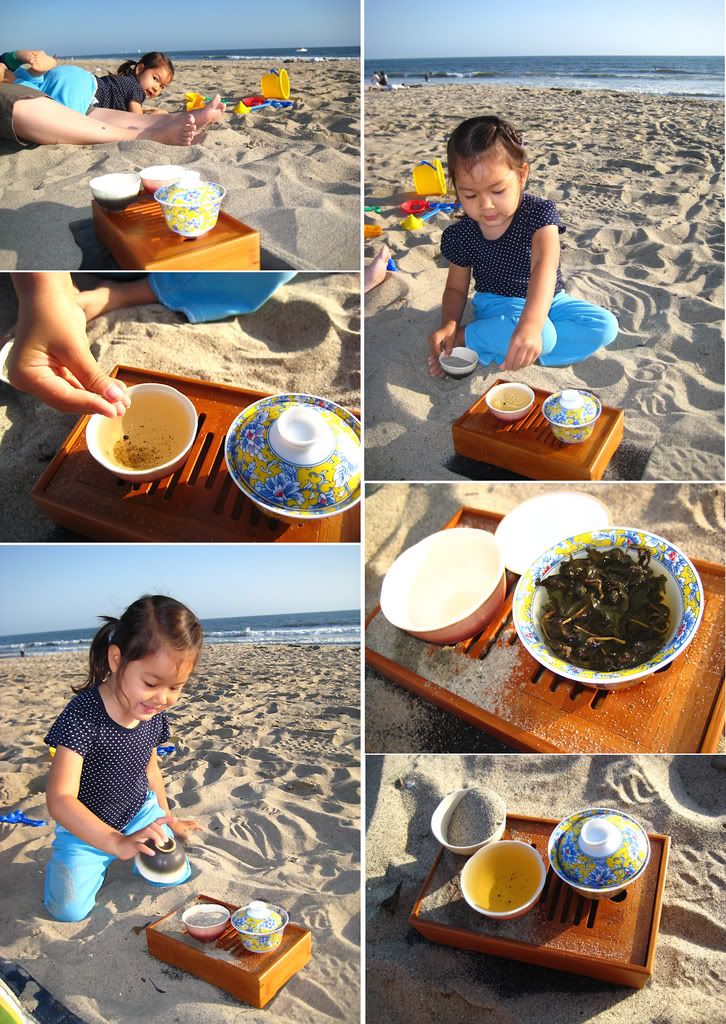
My girl: Papa, can I play sand with your teacup, please?
Me: Nooo! (too late)...oh well, I guess papa and mama will have to share a cup now.
(a little later)
My girl: Do you want some sugar (sand), Papa?
Me: Please nooo! (too late, again)
1The tea was a highly aromatic and excellent Spring 2007 Fenghuang Dong Ding oolong purchased from M. Stéphane Erler. We did manage to have a few infusions before she courteously sprinkled some "sugar" into the tea. Must be grandma who taught her that!!!
Tuesday, June 3, 2008
Say What?
I had a business phone call this morning with someone in Worcester, Massachusetts. Throughout our 15-minute conversation, I kept pronouncing the name of the city as wor-chess-ter (the business entity we were discussing about adopted the name of the city as part of its name, and so it had to be mentioned many times). Towards the end of the call, the guy on the other side sheepishly told me: "Well, just to let you know, but the correct way to pronounce the name of our town is woss-ter, as in woss-ter-sheer sauce." Feeling silly, I thanked him for correcting me, and I mentioned that I have had to learn the hard way to pronounce some US cities the way the locals do.
So I learned today how to correctly pronounce Worcester and Worcestershire. I feel like a better cook already. Some others that I had to learn directly from the locals:
Lodi, CA (low-die. Previously pronounced by me as low-dee)
New Orleans, LA (naw'lins or new'awlins. Previously pronounced new-or-leens...made sense, right? Europeans should refrain from pronouncing it as new-or-lay-yon or new-or-lay-ans if they want to avoid voodoo curses.)
Newark, NJ (noork or nyoo-rk. Previously pronounced new-ark)
Buttzville, NJ (beau-ville. Previously pronounced butts-ville...who would have thought otherwise?!)
On the other hand, no one from New Jersey would say new-joi-see, except for my law professor and jerks from New York.
Any more tricky city names in the USA or other English-speaking countries that I should know how to pronounce like the locals do?
So I learned today how to correctly pronounce Worcester and Worcestershire. I feel like a better cook already. Some others that I had to learn directly from the locals:
Lodi, CA (low-die. Previously pronounced by me as low-dee)
New Orleans, LA (naw'lins or new'awlins. Previously pronounced new-or-leens...made sense, right? Europeans should refrain from pronouncing it as new-or-lay-yon or new-or-lay-ans if they want to avoid voodoo curses.)
Newark, NJ (noork or nyoo-rk. Previously pronounced new-ark)
Buttzville, NJ (beau-ville. Previously pronounced butts-ville...who would have thought otherwise?!)
On the other hand, no one from New Jersey would say new-joi-see, except for my law professor and jerks from New York.
Any more tricky city names in the USA or other English-speaking countries that I should know how to pronounce like the locals do?
Sunday, June 3, 2007
Retasting "Glad I" Pu'er From MarshalN
I guess to enjoy or to dislike a tea is easy; To know a tea is harder; To understand a tea takes time; And to be indifferent is the easiest.
I learned a simple yet useful lesson: tasting multiple teas side-by-side, if done hastily, may not reveal the character of each fully. If the goodness of one tea is only revealed a few moments after swallowing the liquor, then the forthcoming sensation will get lost or muddled if another tea is tasted too soon. It is a common sense that I need to remind myself with whenever there are multiple teas (or wines) being tasted in one sitting.
I re-tasted Glad I sample from MarshalN, which turns out to be a 2003(?) Quanji Bulang Mountain Pu'er. In my previous post, I slammed this tea as being "not good, not bad". So I sat down this time with no pen, paper or camera until after I was done drinking 12 or so infusions of it. It was a one-on-one date.
This time around, I couldn't find any obvious flaw with the tea. Yes, it was bitter like a vegetable concoction from an over brewed green tea, and the bitterness lingers for a while. But then, as others noticed and I didn't before, the bitterness "melted" to become a subtle sweet sensation on the fore-throat and the very back of the throat. It was a nice feeling. Yes, the astringency was present, yet it was present in a similar way that other well regarded young pu'ers are also astringent (ex. the 2004 Yan Ching Hao Yiwu Chawang, which I re-tasted a few hours later, also with no pen, paper or camera). The yun and the body of this Bulang pu'er was good. The chaqi was quite apparent, with energy circling my body slowly but surely after 3 infusions or so (calming, with no sudden attack).
Everything seemed to be in good balance without any flaw or merit that deserved a wow at present, yet there was a certain presence and understated sophistication about this tea that was noticeable only when I observed carefully and patiently. Perhaps such a pu'er tea is one that will stand the test of time. I am inclined to concur with several others who opined that this tea has a good aging potential. Everything seems to be just there without over-exertion.
A lesson learned. With tea and wine, to drink slow is a virtue. And a re-taste is warranted on those that get overly bad or good impression for less obvious reasons the first time around. After all, a debatable crap today may be a debatable gem later, and vice versa. My revised score, as if it matters: 3.5 stars (g - vg), with good potential for long-term aging.
Related notes:
MarshalN's note on sample 1
Other participants' notes on sample 1
 Photo: Wet leaves. Camera set at "neutral color", which somehow gives an unnatural grey hue to the picture (to my eyes). For reference and comparison with the pictures in the previous post, which were taken with "vivid color" setting.
I learned a simple yet useful lesson: tasting multiple teas side-by-side, if done hastily, may not reveal the character of each fully. If the goodness of one tea is only revealed a few moments after swallowing the liquor, then the forthcoming sensation will get lost or muddled if another tea is tasted too soon. It is a common sense that I need to remind myself with whenever there are multiple teas (or wines) being tasted in one sitting.
I re-tasted Glad I sample from MarshalN, which turns out to be a 2003(?) Quanji Bulang Mountain Pu'er. In my previous post, I slammed this tea as being "not good, not bad". So I sat down this time with no pen, paper or camera until after I was done drinking 12 or so infusions of it. It was a one-on-one date.
This time around, I couldn't find any obvious flaw with the tea. Yes, it was bitter like a vegetable concoction from an over brewed green tea, and the bitterness lingers for a while. But then, as others noticed and I didn't before, the bitterness "melted" to become a subtle sweet sensation on the fore-throat and the very back of the throat. It was a nice feeling. Yes, the astringency was present, yet it was present in a similar way that other well regarded young pu'ers are also astringent (ex. the 2004 Yan Ching Hao Yiwu Chawang, which I re-tasted a few hours later, also with no pen, paper or camera). The yun and the body of this Bulang pu'er was good. The chaqi was quite apparent, with energy circling my body slowly but surely after 3 infusions or so (calming, with no sudden attack).
Everything seemed to be in good balance without any flaw or merit that deserved a wow at present, yet there was a certain presence and understated sophistication about this tea that was noticeable only when I observed carefully and patiently. Perhaps such a pu'er tea is one that will stand the test of time. I am inclined to concur with several others who opined that this tea has a good aging potential. Everything seems to be just there without over-exertion.
A lesson learned. With tea and wine, to drink slow is a virtue. And a re-taste is warranted on those that get overly bad or good impression for less obvious reasons the first time around. After all, a debatable crap today may be a debatable gem later, and vice versa. My revised score, as if it matters: 3.5 stars (g - vg), with good potential for long-term aging.
Related notes:
MarshalN's note on sample 1
Other participants' notes on sample 1
 Photo: Wet leaves. Camera set at "neutral color", which somehow gives an unnatural grey hue to the picture (to my eyes). For reference and comparison with the pictures in the previous post, which were taken with "vivid color" setting.
Thursday, April 26, 2007
Making Sense of Tea Collecting
I finally did what I have procrastinated from doing until last Saturday. I recorded and labeled my pu’er stash. The main goal was simple: to keep track of what I have, the quantity, when I bought them, who or where from, and the price I paid.
When the tea dust settled, my spreadsheet said I have about 48 kilograms (~106 lbs) of pu’er. Assuming a standard beeng weighs 357 grams, then I have the equivalent of 134 beengs or 19 tongs. By all means mine is a small stash when compared to the collection of some other pu’er enthusiasts I know. Nevertheless, I probably have slightly more tea than many tea drinkers have in their cabinets. Showing off how hefty or how little I have is not my intention here.
After knowing exactly how much tea I have, one question loomed over my head: just exactly how much tea do I have? Being a wine lover and a small time collector, I tried to make sense of my tea collection the way I know how. So I calculated how many standard 750ml bottles my tea – the brewed liquor, mind you – can fit into. Here is how my mind works:
Conservatively speaking, 7 grams in a vessel that pours out 100 ml of tea can be infused for 10 times. That is saying 7 grams of dried pu’er leaves can produce 1,000 ml of non-alcoholic libation. With this logic, I have 9,143 bottles of tea.
Some would say that my computation is too conservative because one really can infuse them up to 20 times or more. Well, if that is so, then I have the equivalent of about 18,259 bottles of pu’er tea.
Yikes!
I like pu’er. However, I also love my oolong of different types, my Darjeeling, my wine, my whisky and, yes, plain water, too. I estimated that if I drank 2 sessions of pu’er per week on average, then the 48 kilograms stash will last for 66 years!
I have often heard about wealthy individuals who own an upward of 10,000 bottles of wine in their private cellars, and I have always thought they must be mad. Those few people who own 20,000 or more bottles for their “personal consumption”, well, the roads will be much safer without them. And here I am, sitting on top of 9,000 to 18,000 plus bottles of tea.
The moral of this post? I should buy tea (and wine) with my consumption habit and future plan in mind because they really are just for personal use.
When the tea dust settled, my spreadsheet said I have about 48 kilograms (~106 lbs) of pu’er. Assuming a standard beeng weighs 357 grams, then I have the equivalent of 134 beengs or 19 tongs. By all means mine is a small stash when compared to the collection of some other pu’er enthusiasts I know. Nevertheless, I probably have slightly more tea than many tea drinkers have in their cabinets. Showing off how hefty or how little I have is not my intention here.
After knowing exactly how much tea I have, one question loomed over my head: just exactly how much tea do I have? Being a wine lover and a small time collector, I tried to make sense of my tea collection the way I know how. So I calculated how many standard 750ml bottles my tea – the brewed liquor, mind you – can fit into. Here is how my mind works:
Conservatively speaking, 7 grams in a vessel that pours out 100 ml of tea can be infused for 10 times. That is saying 7 grams of dried pu’er leaves can produce 1,000 ml of non-alcoholic libation. With this logic, I have 9,143 bottles of tea.
Some would say that my computation is too conservative because one really can infuse them up to 20 times or more. Well, if that is so, then I have the equivalent of about 18,259 bottles of pu’er tea.
Yikes!
I like pu’er. However, I also love my oolong of different types, my Darjeeling, my wine, my whisky and, yes, plain water, too. I estimated that if I drank 2 sessions of pu’er per week on average, then the 48 kilograms stash will last for 66 years!
I have often heard about wealthy individuals who own an upward of 10,000 bottles of wine in their private cellars, and I have always thought they must be mad. Those few people who own 20,000 or more bottles for their “personal consumption”, well, the roads will be much safer without them. And here I am, sitting on top of 9,000 to 18,000 plus bottles of tea.
No, I have nothing against wealthy people. I inspire to be one, in fact.
27 of the 48 kilograms that I own are of vintage 2005. It’s the year my daughter was born in. My hope and wishes are that one day, when I’m dead from pu’er overdose, she will inherit these teas in addition to a sizable, generation-skipping, non-taxable trust fund. While the trust can easily be arranged, who can really know how the tea will fare. The aging potential of pu’er is still a big mystery to me, even after having downed many types and soaked myself with all the information I can get ad nauseam. Here is to planning and hoping that she will like the taste of pu'er in the first place.The moral of this post? I should buy tea (and wine) with my consumption habit and future plan in mind because they really are just for personal use.
Subscribe to:
Posts (Atom)