Showing posts with label Sheng Pu'er. Show all posts

Tuesday, September 13, 2016

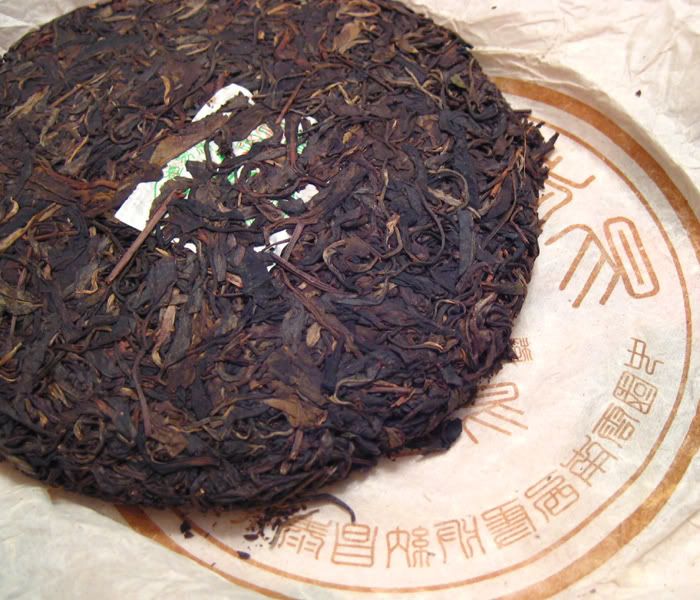
Notes and Visual References on the Late 1980's Menghai Factory # 7542 (aka: 88 Qing Bing)

This post is about 88 Qing Bing, thin wrapper version.

§ A BIT ABOUT 88 QING BING
The 88 Qing Bing ("88QB") tea in this post was obtained from a trusted tea collector extraordinaire in Malaysia. It has been stored naturally by the collector since the early 1990’s.

There are 2 important key elements to 88QB:
  1. They are Menghai Factory-produced 7542 tea cakes from 1989-1992, and
  2. They are dry-and-naturally stored † (see endnotes for more information)
Once authenticity can be confirmed (point # 1), the next challenging and interesting part will be to determine the tea’s storage (point # 2). Due to storage differences by various owners, 88QB comes in many different expressions. Some of these expressions are exceptional, while others are lesser in quality.† According to Mr. Chan Kam Pong, author of “First Step to Chinese Puerh Tea”, a significant amount of Best Tea House’s 88QB stock had been sold to buyers worldwide as of 2003.† As such, the change in provenance will have subjected much of the worldwide supply to storage differences, and therein lies the rub.

§ TASTING NOTE
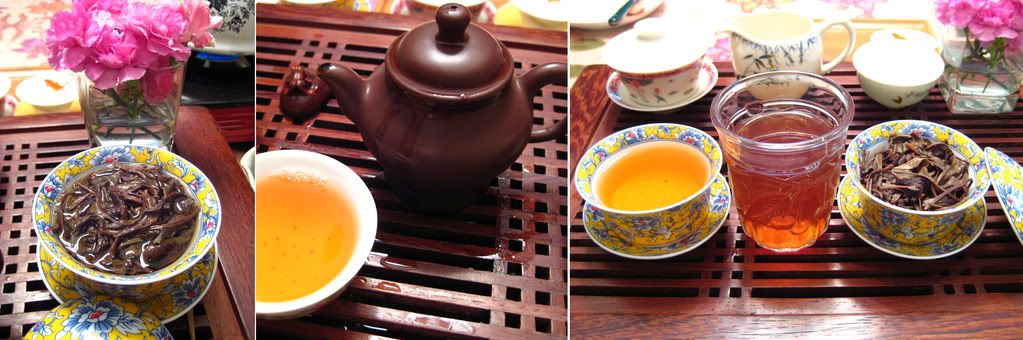
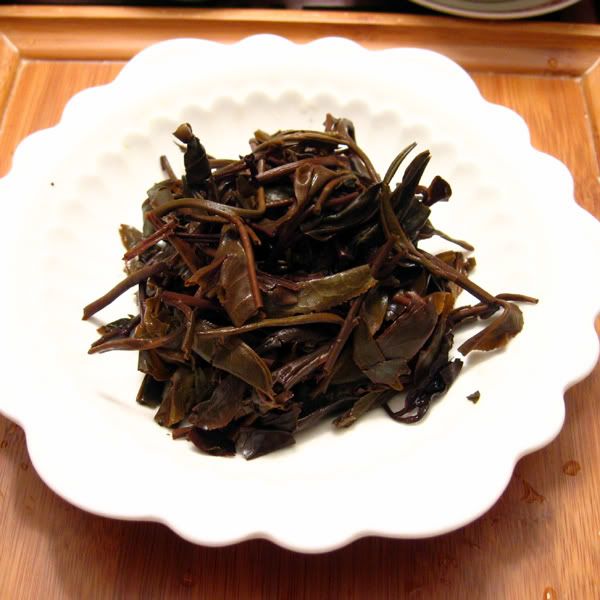
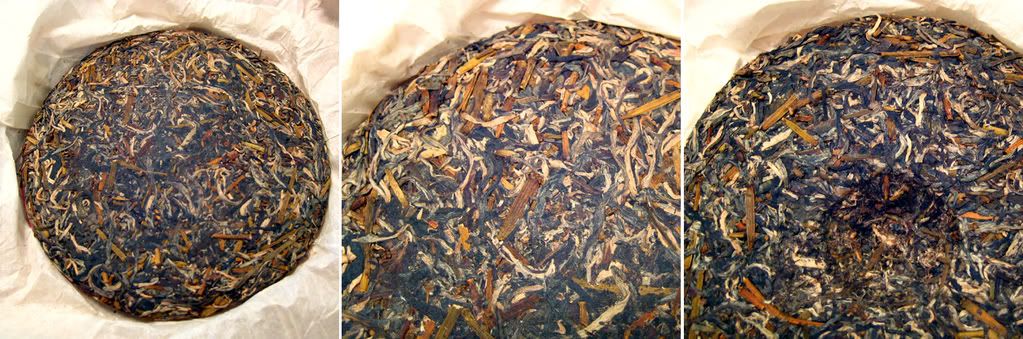
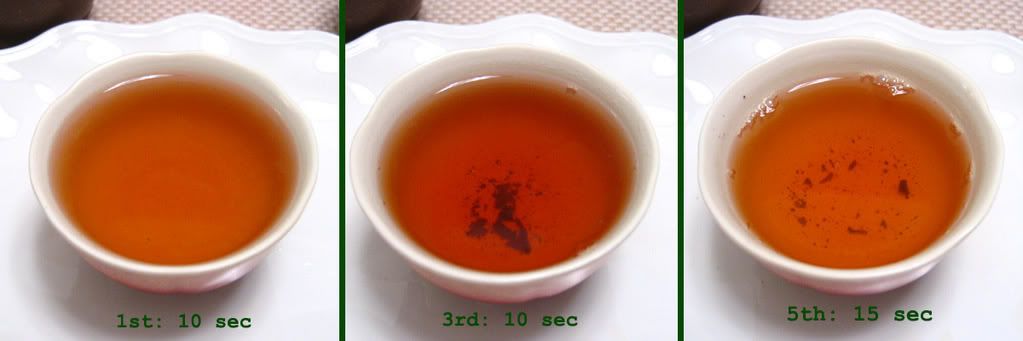
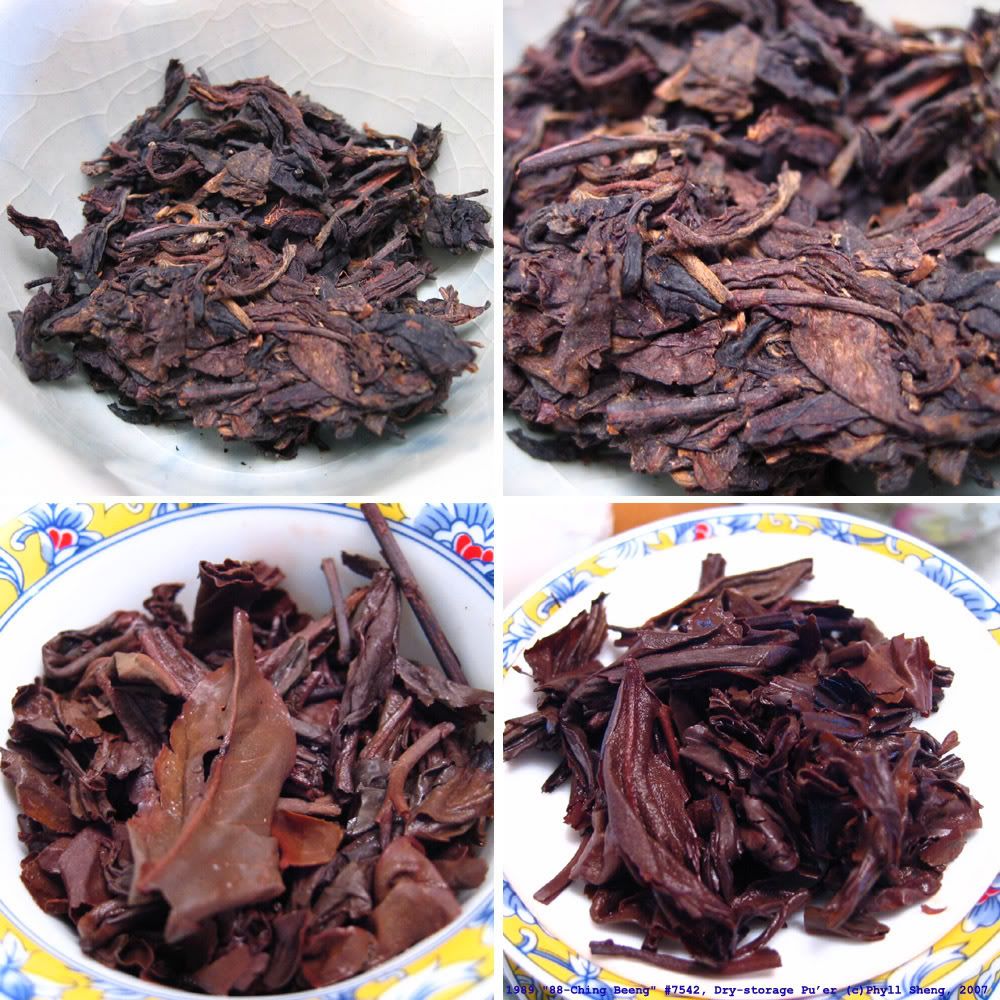
For the sake of brevity, I will defer all visual observation and description to the accompanying photographs.

Basic parameter: ~5.5 grams in a 110ml Yixing pot; Volvic spring water at 100°C/212°F.

A true powerhouse in taste and energy! The scent of the tea cake radiates far and robust with attractive medicinal/herbal scents, preserved dates or plums and a sort of oriental spices that is mildly sharp. It’s quite a wonderfully intoxicating perfume. There was no hint of smoke or wet-storage smell. The tea soup feels thick and oily, yet it still possesses a finely-textured astringency that forms a necessary backbone for further aging. Of its taste, the phrase “iron fist in a velvet glove” fits the bill accurately. It packs power and punch! The concentration of flavors and aromas is very dense…herbal/medicinal, spicy, plummy, extremely cooling, numbing of the mouth cavity, all in an explosion of activities before it goes down smooth. It’s never bitter in the slightest. The aftertaste is sweet and long with impressive staying duration. The energy (chaqi) feels clean and powerful.

After 8 steepings, there is an unmistakable feeling of euphoria. It’s unlike that of being tea drunk. The tea continues to steep well for about 15 steepings before I transferred the leaves into a large pot with a tea warmer underneath for an extended extraction. 2 days and 25 generously-sized cups later, it still refuses to give up.

§ CONCLUSION
In 2007, I had the opportunity to taste the 88QB, albeit one with a very different expression. I was not impressed by the tea to say the least. It was unpleasantly smoky, very woody and the aftertaste was metallic and somewhat akin to cigarette smoke. According to my old notes the tea was thin-bodied. That tasting session many years ago made me feel unwell and disappointed. Ever since that tasting, I hardly ever thought of 88QB with much regard. I assumed (wrongly) that it was just another overrated and overpriced tea.

In more than 20 short years of tea learning, I can only count a handful of times -- spaced over many years apart -- when I encountered a tea so singularly exceptional. These are the kind of teas that shook one’s understanding of what great tea is all about and why we make such a great fuss about them. This particular 88QB is one of them. The learning never stops.

===================

ENDNOTES:

1. Because dry and natural storage is a key aspect to 88QB, any example that exhibits wet storage exposure would deviate from the intended expression that is responsible for 88QB’s high acclaim.

2. An 88QB that has been humidly-stored (i.e. traditionally or wet) for most of its existence may not exhibit the same power and punch that a dry-stored specimen would.

3. Dry-storage does not mean bone-dry conditions, but rather an environment where moderate to high levels of humidity and temperature are natural without any artificial means.

4. Best Tea House in Hong Kong is the original proprietor of many well-known dry-storage pu’er teas. 88QB is considered to be the epitome of such storage practice.

5. Kam Pong, Chan, First Step to Chinese Puerh Tea, Taipei: Wushing Books Publication Co. Ltd., 2006. Print.

6. The photos of the wet leaves are less than ideal. Much of the leaves for this first session were from those that have fallen off of the cake and trapped inside the wrapper. For all intent and purposes, however, they clearly show all the necessary visualization for aged and dry-stored tea leaves. I will provide better photos of wet leaves next time.

7. External links and references on 88QB:

===================

§ IMAGES
With the intent of providing a useful reference for everyone and myself, the photographs that accompany this post have been captured by using strict product photography standards to ensure accurate color representation.


Saturday, August 30, 2008

Durable Morning Tea

While reading the woes of the world and the bleak financial news on the papers this morning (not to mention Sen. John McCain's puzzling choice for VP), I sipped on what most likely the 20th infusion of 2005 Yichanghao "Ji Pin" sheng pu'er (Houde). Maybe it was the 19th or the 21st brew...I lost count. This last cup was steeped for a good 12 to 13 hours from the evening before. Its aroma and taste were still enjoyable, and the tea was drunk at room temperature.

For a vintage 2005, the dry leaves of this Yichanghao look interestingly darker than most other -- if not all -- 2005 sheng pu'er I have or tried. The beeng gives off a mild whiff of floral and straw notes. It made me wonder: is this one of those '04 - '05 Chang Tai tea that went through, as Danny Samarkand mentioned on CHA DAO, a "slight pre-processing fermentation"? [click here for the excellent 2nd installation on proper storage consideration for pu'er teas, written by Mr. Samarkand and MarshalN, as well as the ensuing discussion in the comment section, which touched briefly on the subject of Chang Tai teas]. Unless I misunderstood Danny's meaning, this '05 Yichanghao fits his opinion: the leaves are darker compared to similarly young teas, and the liquor is orange.

A very pleasant fragrance emanated from the tea liquor, which reminded me of straw, bamboo shoot, and of sweet smelling flowers. It's so fragrant that it almost felt unnatural for a young raw pu'er. Again, it made me wonder: is this more oolong or more pu'er? I couldn't be exactly sure.

The taste was smooth and astringency was hardly present, unless I pushed the steeping time exceedingly long. It's sweet-ish in the mouth and throat from the get go (as in no ku -- bitterness that turns to sweet sensations that one might expect from some young pu'er). The chayun and the huigan were all rather weak, but the overall package was very pleasant, actually.


On its chaqi: I felt a certain energy flow that first warmed my lower back and then it moved towards my stomach area, shoulders, chest and neck. The effect was calming and relaxing.

Conclusion: For a young pu'er, it is already approachable and ready to be enjoyed. I would think that anyone who hasn't acquired a taste for young raw pu'er should find this tea pleasant [enough].

Ageability, however, is hard to predict. There was not much strength or concentration of taste, aroma, chayun and huigan, all of which are necessary attributes that every candidate for a long-term storage should possess (or so I read). Certainly not lacking, however, is its good brewing durability. Therefore, it will be interesting to see what this tea has in store a few years from now. I should think that an investment in a few beengs could be warranted...some for immediate enjoyment and a few for a bit longer down the line.

Good compression -- not too tight or too loose. The wet leaves are healthy and intact.

What do you, dear readers, think about its aging prospect given my long-winded descriptions above?

Monday, August 25, 2008

Crab's Feet Pu'er

Drinking tea in a Guangzhou (Canton) teashop, one is bound to be shown many novelty teas by the shopkeeper. I was a newbie at Pu'er back in 2005 (still am today). It was in November of that year during a visit to the old city when I first got introduced to Crab's Feet Pu'er at a teashop on Yue Hwa Road.

I was a soft target: a tourist, even though I wear the skin of a Chinese man. Furthermore, my command of the Mandarin language was flaky, probably the level of a native 3rd grader at best. I got by, though barely. A conversation ensued, more or less, as such:

"This crab's feet tea is popular with the Taiwanese people," the lady shopkeeper said.

"Oh, how come?" I asked.

"They find the taste appealing, and the crab's feet supposedly have good medicinal properties for the stomach," she explained.

"What is it, actually?" I inquired curiously.

"It grows on Pu'er trees as a parasite. It gives a slight suān (酸 -- sour) taste to the tea. Here, let's try it, shall we?" I didn't have "parasite" in my Mandarin vocabulary at the time, so I went "huh?"

She then broke an ample amount from the beeng and brewed the curio with a gaiwan. I still remember her rather well to this day because, in addition to being young and pretty, she was very adept and gracious with the gaiwan. Watching her hands move about and pour tea out of the gaiwan was quite hypnotic in itself.

I was a very soft target.

By the time I left the shop, I owned 2 beeng's of this Crab's Feet Pu'er, which according to my records I paid RMB 150 per (~ USD $19 at that time). Back in Los Angeles, I chucked them, along with some other pu'er I obtained during the trip, in my off-site cellar cabinet. They have been sleeping in cool darkness ever since until their retrieval yesterday.

On the tea's wrapper and the inner ticket, the characters 螃蟹脚 (pángxiè jiǎo) are written, which literally translates as "crab's feet". I am not quite sure why some refer to it as crab's "claw", because as far as I know (and that's not much, mind you), the character jiǎo () literally means foot / feet. Toki of The Mandarin's Tea blog has pictures of this parasitic vines growing on an old Dancong tea tree.

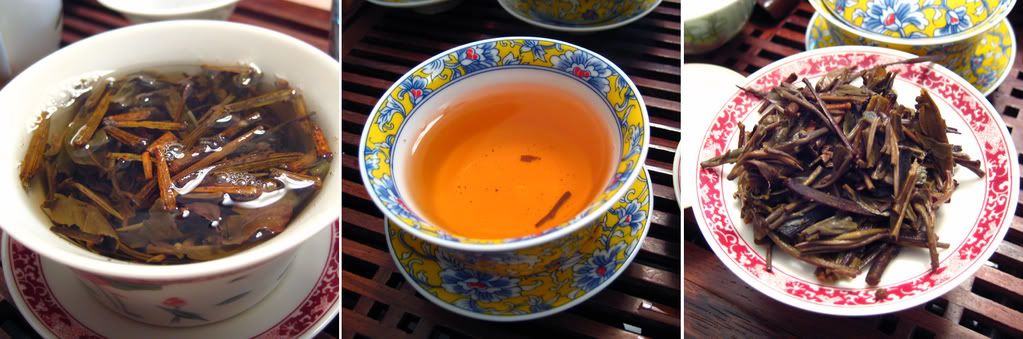
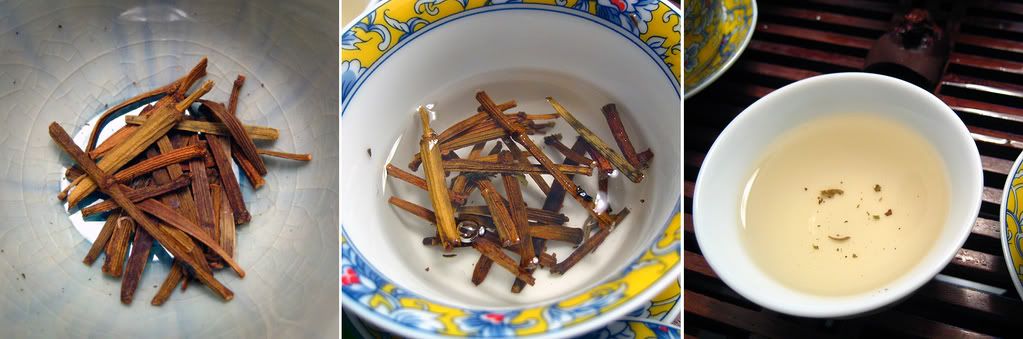
The tea is a vintage 2002 made by Spring City Tea Factory in Menghai. As you see from the pictures below, the beeng was compressed with leaves of different colors. The orange-brown things, which are more like stems than leaves, are the crab's feet.

The tea itself was ordinary tasting. It had sour plum and dried wood notes. Overall its taste was rather boring, lacking any character or depth. Its brewing durability suffered, too, when its taste began to subside significantly after a mere 5 rounds or so. Had I been offered this tea today, I would never have bought it (except if the shopkeeper was Gong Li, perhaps).

Curious about the crab's feet, I separated the orange stem-like substances from the compressed tea and was able to obtain enough for a tasting experiment. I brewed the small amount of the crab's feet in just-boiled water (98-100' C) for about 2 minutes. The liquor was almost colorless with a light tinge of orange. It almost had no taste at all. What it had, however, was a creamy mouthfeel and aftertaste...almost milky (edit: umami is the word I've been looking for to describe the taste of the crab's feet liquor). It's quite interesting by itself, actually. However, it did not taste sour at all, as the shopkeeper had claimed. I should note again that this pu'er seems to be mixed only with the stem-y part of the crab's feet, and it does not contain any of the leafy parts. Maybe it's the leaf of this parasitic vine that is sour tasting?


Conclusion: For this particular Pu'er specimen, I think it serves the purpose of satisfying my curiosity, but largely a waste of time and money.

Tuesday, August 12, 2008

A Promising Prospect -- 2001 Mengku Yuanyexiang

The one tea that I've been drinking quite often lately is the 2001 Shuangjiang Mengku Yuanyexiang (YYX), thin paper version. It is now 7 years of age, which supposedly marks the end of the 1st and the beginning of the 2nd stage of its fermentation process. At least that's what they say, although I haven't really grasped the theory behind this concept.

The more I drink the YYX, the more I feel how promising this tea has become as it ages a bit more. The redness of the liquor and its clarity is great. The taste is complex, lively and "active". It may not be as smooth as an older sheng, but I think given enough time it will acquire that characteristic eventually. One can only hope. What I like best about this tea, though, is the way it makes me feel after drinking it -- it rejunevates and focuses my mind, and it soothes the stomach, too.

The cake / beeng that I've been breaking from has been stored in a closed book cabinet at home with an un-capped bottle of water to help with the moisture level. Generally, however, the storage environment at home is much drier than the off-site cellar where I keep most of my wines and teas. This makes me wonder if the several cakes of YYX (thin and thick paper versions) that I keep off-site have progressed differently than the ones I have at home. I should like to fetch some and do a taste comparison soon.

Saturday, September 1, 2007

2001 Mengku "Yuanyexiang" of Mengsa Mtn.-- Dry and Wet Stored

The following is a side-by-side comparison of the popular 2001 Mengku Shuang Jiang Factory's "Yuanyexiang" (also spelled "Yuan Yieh Xiang" or simply “YYX”). The leaves of this compressed tea came from the Mengsa Mtn. Proper (Mengsa Zhengshan) in Yunnan Province.

Yuanyexiang is another successful project by a well-known Hong Kong tea merchant, Mr. Chan Kwok-yee of
Best Tea House, who popularized the the dry storage method of storing pu'er. With this tea, Mr. Chan decided to store some in a dryer condition and some in a more humid environment. Upon introduction into the market, the Yuanyexiang were distinguished by the 2 methods under which they were stored in. The dry-stored version is identified by the thinner paper used as its wrapper, while the wet-stored version by its slightly thicker paper wrapper. (See pictures below for more details).

As the term implies, dry storage is literally a method of storing teas in a dryer environment, though not exceedingly dry either. Wet storage, on the other hand, is the storing of teas in an environment of increased humidity. The main objective of wet storage is to accelerate the fermentation of the leaves so as to produce mellower, sweeter and smoother tea (generally more approachable to drink) in a shorter period of time. The 2 methods create significantly different end-products, and it shows very clearly by tasting the Yuanyexiang teas. The majority of opinion seems to indicate that the dry-stored Yuanyexiang is the better of the two versions. I agree to a certain extent, though with a slight reservation, which I will elaborate further in the second last paragraph of this post.

Side note: the wet storage (Shicang in mandarin) treatment is perhaps also referred to as "traditional storage" to dispel the negative connotation associated with the term. The general consumers tend to misconcieve the term "wet storage" as something shoddy and unhealthy, partly (and fairly) because many shoddy teas are produced through a poorly controlled wet storage method. This in turn lend the term an ill-interpretation to the everyday consumers. In reality, however, a well-controlled wet storage by knowledgeable tea professionals can yield wonderful results that is harmless (and perhaps beneficial) to one's health. (Disclaimer: I am not a health professional and, therefore, can not back my opinion with hard scientific facts)

The popularity of the Yuanyexiang is partly borne out of a publicized tea tasting session in Tokyo, Japan, where 3 very highly regarded pu'er were tasted and judged against each other (as featured in the Puerh Teapot Magazine vol. 16). The story goes that the Yuanyexiang came second after the 1999 Yi Chang-hao and bested the excellent 1999 Menghai "Green Big Tree" black label (personally, I think the Menghai "Green Big Tree" is slightly better than the YYX).

Echoing the general pu’er market and Yuanyexiang’s own growing popularity among tea aficionados, collectors and investors alike, the price of the Yuanyexiang has moved up quite significantly in the past months. In early January of 2007, Best Tea House in Hong Kong sold the dry-stored version for RMB 650 per 357gr beeng (USD $86 at the current exchange rate) and for RMB 500 each if you buy 10 jians (840 beengs). The same tea currently is priced at RMB 880 (USD $117) per beeng and RMB 600 at wholesale quantity. This translates to a 35% and 20% increase per beeng and wholesale, respectively, over the past 8 months. The online Chinese auction site Taobao listed the dry-stored version for RMB 600 per beeng back in early January, and it is currently offering the same tea for RMB 900; a 50% increase! On the contrary,
MarshalN, who has a closer touch with the tea market in China, informed me that the dry-stored YYX can still be had for much less than RMB 600 per beeng.

Let's take a look at the teas -- the tea porn, as they say. I hope the following observation will be a useful reference for your buying and collecting decision.


^ The wrappers. The dry-stored version uses a much thinner wrapper than the wet-stored version. The neifei (inner ticket) is clearly visible through the thinner wrapper, while the opacity of the thicker wrapper hides the neifei better.

^ The pictures above probably do not very clearly show the differences between the dry and the wet-stored versions. By naked eyes, however, the wet-stored version is noticeably redder / browner. The most obvious indication that one of them was subjected to a wet storage condition is the presence of very thin, white coating throughout, but most obvious on the top-middle section around the neifei (inner paper ticket).

^ A close up of the neifei and surrounding. Notice that the wet-stored version's neifei is generally browner as if it is tea-stained. The dry-stored version's neifei, on the other hand, is much cleaner and whiter. Although the leaves of the dry-stored tea is almost as red-brown in color, there is a certain freshness and crispiness to its overall look.


TASTING NOTES

The 2 teas were tasted one after another; meaning that I finished a session of 10 infusions, rested for an hour or so, and then continued with the other tea. I thought this would provide a fairer impression of each tea. The parameter applied were exactly (or very nearly) the same for both teas.


Dry-stored (thin wrapper)

Parameter: ~ 8gr in an 100ml gaiwan. 10 sec. rinse. 10s, 15s, 15s, 20s, 20s, 30s, 45s, 2m, 4m, 10m.

Dry leaves: the nose is sweet, mellow, plumy, woody, incense-like with a mushroom-y note on the lower strata of its aroma.

Wet leaves: woody (bark), mushroom-y, slightly medicinal and clean.

The clarity of the liquor is crystal, which is very promising (all the high caliber pu'er teas that I have tasted consistently had crystal clarity). Earlier infusions (1st and 2nd) exhibits a mild Chinese medicinal qualities. It is slender bodied, clean-tasting with a smooth texture.

The tea started to sing melodiously by the 3rd infusion and continue on until the 7th, providing ample complexities. The medicinal, woody, mushroom-y, and the slightly greenish qualities are lively and balanced. Medium body, extremely smooth, and almost non-existent astringency (feels like thick water in the mouth). The camphor-like nose started to appear around the 4th infusion.

Around the 8th infusion, the tea turned rather watery, and it was downhill from then on. In retrospect, I employed rather long infusion time to achieve a concentrated ("nong") result in evaluating both teas. I think with a 50% shorter infusions, as I usually employ with other pu'er, I should be able to get a few more infusions out of the tea.

For what it's worth, this tea reminds me very much of the excellent 1960's Bazhong Huangyin, especially the Chinese-medicinal taste.

4 stars (vg), with great potential to improve with age and proper storage.


Wet-stored (thick wrapper)

Parameter: as applied to the dry-stored tea.

Dry leaves: aroma of damp wood and earth and slightly medicinal. Simpler and rather one-dimensional.

Wet leaves: smells rather bookish, woody, earthy and mellow-sweet.

The brews throughout the 10 infusions I had were much deeper reddish-brown (as you can see from comparing the pictures above). The taste of this tea was rather simple overall and significantly less complex than the dry-stored version. However, this tea had a rounder body and thicker overall mouthfeel, as wont wet-stored teas. Surprisingly, the tea felt a bit more astringent on the tongue and mouth than its dry-stored cousin, which was very clean-tasting. The camphor-like aromas also appeared around the mid-infusions.

The 2 advantages of this tea over the dry-stored one is its better brewing durability and fuller overall body. This tea was able to brew well beyond its 10th infusion with the same brewing parameter as the other one.

I mentioned above that the consensus of opinion seems to indicate that the dry-stored version is the better of the two. While I agree, I also think the wet-stored one has the potential to improve in a good way, too. To draw a parallel, I am quite certain that at some point the 1960's Bazhong Huangyin that I enjoyed very much went through a period of traditional storage. So why won't it be beneficial for the Yuanyexiang in the long run, too? Granted that it does not taste as complex as the dry-stored one today, it may still show itself up later down the line with proper storage. Who knows until then?

At this moment, however, I am giving the wet-stored version a 3-star rating (good) with my sincere hope that it will age with grace and improve.

Wednesday, June 27, 2007

1950's Hongyin Pu'er & 2007 Spring Meghma Estate Oolong

While I am drafting Part V (post-event happenings) for the next installment, I thought I'd share with you some pictures of the 1950's Hongyin pu'er. A 10 gr sample of this very tea is now available at Houde for a decent sum of $355.

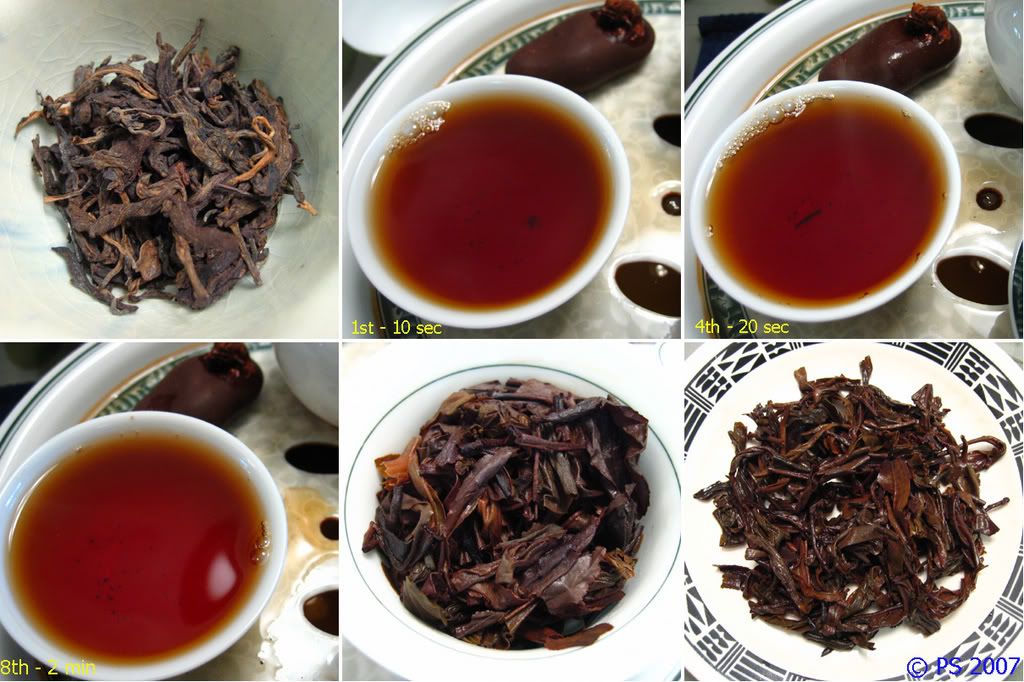
At the Event, we were only able to brew 6 or 7 infusions of the Hongyin as we ran out of time. This tea should be durable enough to last 15 to 20 infusions, depending on the brewing method. For the first infusion, I gave it a 5 sec rinse and then a 20 sec initial steeping. Gradually I moved up to about 1 minute long for the sixth infusion. Since the leaves were still inside my Yixing pot, at home I pushed the infusion time to 2 minutes and longer.


The resulting liquor was quite amazing. It’s thick, sweet and refined. The clarity of the intense red-brown liquor is impeccably crystal. The texture is milky smooth, almost resembling the feel of a half-and-half cream. It has a woody (camphor) and earthy quality to it, yet very clean tasting with a soft, sweet aftertaste. Though personally I feel this tea is less impressionable than the 1960's Bazhong Huangyin, it is a very elegant and easy going tea to enjoy.

4+ stars (vg - ex)


I have also been enjoying
Madan Tamang's freshest batch of 2007 spring Meghma Estate Nepalese oolong. I received a 1oz sample from The Simple Leaf (sold under the name "Honeybee") and I brewed the tea using the gongfu method and then later by the "English" method in a 32oz Bodum glass teapress pot.

It is a wonderfully aromatic tea! When brewed in a gaiwan using high leaf to water ratio and short steeping time (3s, 7s, 15s, 30s, 1m, 1.5m), the tea reminded me of sweet Oregano spices, white pepper and cumin, all wrapped in a honey-like fragrance and taste. The English style of brewing yielded a more rounded taste that is honey-like and floral, almost.

As you may notice from the infusion time progression I employed, I learned that this oolong packs a punch in its earlier infusion but the taste tends to diminish quickly in later infusions. As such I employed a very short 3s and about doubled the previous steeping time. This way, I was able to get 5 to 6 brews before the tea turned watery.

Good stuff! What's more, this tea possesses a unique sense of place and character. 4+ stars (vg - ex)

Sunday, June 3, 2007

Retasting "Glad I" Pu'er From MarshalN

I guess to enjoy or to dislike a tea is easy; To know a tea is harder; To understand a tea takes time; And to be indifferent is the easiest.

I learned a simple yet useful lesson: tasting multiple teas side-by-side, if done hastily, may not reveal the character of each fully. If the goodness of one tea is only revealed a few moments after swallowing the liquor, then the forthcoming sensation will get lost or muddled if another tea is tasted too soon. It is a common sense that I need to remind myself with whenever there are multiple teas (or wines) being tasted in one sitting.

I re-tasted Glad I sample from MarshalN, which turns out to be a 2003(?) Quanji Bulang Mountain Pu'er. In my previous post, I slammed this tea as being "not good, not bad". So I sat down this time with no pen, paper or camera until after I was done drinking 12 or so infusions of it. It was a one-on-one date.

This time around, I couldn't find any obvious flaw with the tea. Yes, it was bitter like a vegetable concoction from an over brewed green tea, and the bitterness lingers for a while. But then, as others noticed and I didn't before, the bitterness "melted" to become a subtle sweet sensation on the fore-throat and the very back of the throat. It was a nice feeling. Yes, the astringency was present, yet it was present in a similar way that other well regarded young pu'ers are also astringent (ex. the 2004 Yan Ching Hao Yiwu Chawang, which I re-tasted a few hours later, also with no pen, paper or camera). The yun and the body of this Bulang pu'er was good. The chaqi was quite apparent, with energy circling my body slowly but surely after 3 infusions or so (calming, with no sudden attack).

Everything seemed to be in good balance without any flaw or merit that deserved a wow at present, yet there was a certain presence and understated sophistication about this tea that was noticeable only when I observed carefully and patiently. Perhaps such a pu'er tea is one that will stand the test of time. I am inclined to concur with several others who opined that this tea has a good aging potential. Everything seems to be just there without over-exertion.

A lesson learned. With tea and wine, to drink slow is a virtue. And a re-taste is warranted on those that get overly bad or good impression for less obvious reasons the first time around. After all, a debatable crap today may be a debatable gem later, and vice versa. My revised score, as if it matters: 3.5 stars (g - vg), with good potential for long-term aging.

Related notes:
MarshalN's note on sample 1
Other participants' notes on sample 1

Photo: Wet leaves. Camera set at "neutral color", which somehow gives an unnatural grey hue to the picture (to my eyes). For reference and comparison with the pictures in the previous post, which were taken with "vivid color" setting.

Tuesday, May 29, 2007

Two Pu'er Samples From MarshalN

Dear MarshalN:

Thank you for the pu’er samples! I have tasted them side-by-side, and I hope my findings are relevant to the collective opinion of those who also received these same samples. Please find my tasting notes and comments below. As with the tea samples that you have generously shared with me in the past, you have again challenged my taste buds and knowledge. This has been a relevant exercise, and if I am mistaken in my opinion, I can only attribute that to my lack of experience and shallow mental references.

Many thanks again and I hope to reciprocate in the near future.

Your friend in tea,

~ Phyll

I am very glad to have received MarshalN’s pu’er samples, which traveled all the way from China to me in Los Angeles. It took its time getting here, however. Double glad that they arrived intact. Inscribed on the bags that hold the samples are letters A and I, separately. Purely on account of how I feel, I will refer to them as Glad A and Glad I below :)

As of writing this note, I have absolutely no idea about the vintages, producers and the exact origins of these samples.

[Brewing parameter for both samples: Crystal Geyser spring water, about 7gr in 100ml gaiwans, boiling water. 10s rinse, and then 10s, 10s, 10s, 15s, 15s]

Glad I
Dry leaves are dark green-colored with streaks of white, downy leaves. There are a little amount of brown leaves intermixed as well. It seems to me that the oxidation of the leaves is a bit inconsistent throughout. It looks like a one or two-year old tea. It smells fresh, plummy, fruity and a bit smoky. Quite inviting. After rinsing however, the aroma of the wet leaves becomes ashy…as in cigarette ash. Not a pleasant nose for me.

Excellent clarity. The brew comes out medium yellow-greenish color. It tastes bitter! From the 1st until its 5th infusion (I stopped after that), the tea tastes like a bitter vegetable concoction. In more ways than one, the taste reminds me of the time when I over brewed some cheap Taiping Houkui green tea, actually. The body is thin to medium and it has a mouth coating astringency. Not a pleasant tea to drink and I suppose this is an example of green tea parading as pu’er, although I am not 100% sure.

The spent leaves look quite appealing; mostly fresh green with some showing reddish hues. Most are half-chopped. Plantation leaves? 1 star (not good, not bad).


Glad A
Dry leaves range from being reddish-brown to very deep brown with some hairy white streaks here and there. I suspect that this tea was lightly “cooked” or at least mixed with some lightly cooked leaves. The aroma, when still dry, is like a deeper tone of smoke and plum, especially when compared to Glad I. And it also has a hint of light shu smell. Maybe my nose is playing a trick on me? After rinsing, the wet leaves give off the smell of talcum and tobacco.

The brew comes out slightly foggy, but still quite clear overall. Medium brownish-red color. This tea is certainly mellower, smoother and less green tasting than sample Glad I. In fact, there is hardly any bitterness in its taste. Each brew has soft astringency and plummy qualities to it. The aftertaste is quite pleasant and sweet, which further persuades me to attribute the tea to being the semi-shu kind.

Overall, though, the tea is rather simple, boring and lacks any character. Weak chaqi. It certainly is more enjoyable to drink this than sample Glad I, however.

Spent leaves look brownish-red overall. I set aside several leaves and stems that look the darkest among the bunch…and the more I inspect these few dark leaves/stems, the more convinced I am that this tea is a mix of lightly cooked leaves or contains cooked leaves for added smoothness and approachability for earlier consumption. 2 stars (mg).

Saturday, May 26, 2007

1960's Guang Yun Gong Pu'er, Liquid Jade Preview

Yesterday, after a simple lunch, I prepared the water to brew the 1960’s Guang Yun Gong. It was to be a handsome treat after an entire morning of running errands and shopping for groceries.

With the very little sample I got, I inspected the dried leaves carefully. I have apparently received a small chunk from the rim of the beeng and some loose leaves, which were intermixed with stems and twigs. A thin film of whiteness and some white spots here and there were present, an indication of wet storage. Then again, Guang Yun Gong is a "lightly cooked" type of pu’er, so perhaps this was expected. I could detect little smell, almost none. When thrown into the warmed up gaiwan, the heated dry leaves gave off faint aromas of earth, wood, black licorice and herbs. It was neither expressive nor impressive, but such is the nature of old pu’er. The reward often lies within its liquor, if the tea was any good.

I gave it a quick 5 seconds rinse and the tea water looked very promising indeed. Its color and clarity were excellent throughout. I let the leaves rest inside my gaiwan, lid closed, for a minute or slightly more, allowing the steamy banya to wake them up from their 40+ years slumber before the first infusion.


[Parameter: 5gr, 100ml gaiwan, 5s rinse, 10s, 10s, 10s, 10s, 15s, 25s, 25s, 35s, 45s, 1m, 1.5m]

I had a total of 11 brews, by which time it was on the brink of giving up. Not very durable, in retrospect. Throughout all the infusions, the tea tasted rather simple, clean and smooth. In fact, I can’t say that there was anything special from its taste. A little bit of earth and wood, thin bodied, with a slight sweetness in the mouth and finishes a bit mint-y. To sum, it tasted ordinary.

What it lacked in taste, however, was very well compensated by its strong qi and the way it made me feel physically. The first brew shot tingling sensations around my lower back and neck. The second warmed my shoulders and front. The third hit my head pretty hard. And by the fourth and fifth, I was sufficiently swimming in clouds. I felt quite tea drunk and high! It was a sensation I rarely get from merely 5 infusions, especially with a filled stomach after lunch. Conventional wisdom says that tea should not be drunk on an empty stomach. Should anyone have the desire to break this rule, be forewarned that this is not the tea to do it with.

I savored each cup slowly. On and off, I wandered about the events surrounding the decade in which the leaves of this tea were harvested. China was at the beginning of the cultural revolution, while in America, the sexual revolution was hitting high (wonder what Woodstock was like). The Indonesian communist party, allegedly supported by the Chinese embassy, unsuccessfully attempted a coup d'état against the then-present government, which resulted in the discriminatory anti-Chinese legislation. By the directives of the government of Indonesia, the country cut all ties with China. The Chinese diplomats were "deported" and the embassy shut down, no flights were allowed to and from China, Chinese schools were closed, Chinese books and publications were banned, and most out-reaching of all, I think, Chinese names were no longer allowed in the birth certificates of the children of Chinese immigrants. And then there were the war in Vietnam, The Beatles, the assassinations of JFK, Malcolm X and MLK, man on the moon (faked?),….


It is pretty amazing to think I was sipping a tea that came from an era I know only through stories that my elders told me, from books and from films.

At the end of the second cup, I grabbed from the bookshelf a book that arrived a few days ago: Liquid Jade by Beatrice Hohenegger. I skimmed through the Acknowledgement and the Preface sections quickly, and by the time my third brew was in the cup, an old tea poem greeted the first chapter:

On the peaks of Mount Ling,
a wondrous thing is gathered:
It is tea.
Every valley and hill is luxuriously covered
with this wealth of the Earth,
blessed with the sweet spirit of Heaven.
In the month of the harvest moon,
the farmers get little rest.
Couples at the same task, searching and picking.
take water from the flowing river Min,
drawn from its pure currents.
Select vessels and choose ceramics
produced from Eastern Ou.
Emulate the example of Duke Liu:
Serve tea with a gourd ladle;
In only this way can one begin to perfect
thick froth, afloat with the ‘splendor of the brew:’
Lustrous like piling snow,
resplendent like the spring florescence.

~ Tu Yu, Ode to Tea, 4th century C.E.

Four pages later, a quote from the Pen T’sao Ching, a medical book touted as one of the earliest in China:

“Tea is better than wine for it leadeth not to intoxication, neither does it cause a man to say foolish things, and repent thereof in his sober moments. It is better than water for it does not carry disease; neither does it act like a poison, as does water when the wells contain foul and rotten matter.”

Hmm, the very tea in my cup had leadeth me to intoxication.

That quote compelled me to stop reading at the moment. Another pro-tea, anti-wine opinion in a tea book within the first chapter, much like Okakura's The Book of Tea. I’ll pick Liquid Jade up again soon – for it has piqued my interest – perhaps with a glass of Chateau Musar in one hand.

Reviews and references
Review of 1960's GYG:
Half-Dipper by Hobbes
Background notes on the 1960's GYG:
Clouds on LJ Puerh Community, Hou De Blog
Review of Liquid Jade:
Cha Dao by Corax

Wednesday, May 2, 2007

TN: 2001 Menghai Yiwu Zhengshan & 2004 Kurt Darting Riesling

Embarking on a memory trip, last September Davelcorp sent me a generous sample labeled simply as "Mystery Yiwu". This was soon after I tasted M. Erler's 2003 Yiwu Pu'er. The "Mystery Yiwu" turned out to be the 2001 Menghai Special Production Yiwu Zhengshan "Collectible Leaf of Precious Grade".

Having enjoyed M. Erler's tea using the little-leaves-long-infusion brewing method, my 1st attempt with Davelcorp's sample was to employ the same technique. Somehow, I didn't like the resulting tea. This was my email to Davelcorp, dated September 14, 2006:
"Hi [Davelcorp], I just tried your mystery Yiwu Pu'er tonight for the first time (btw, thank you very much for the tea!). I used the "little-leaves-long-infusion" method. I hope you won't mind me being candid with you. It is my own very subjective assessment (I'm still learning, so forgive me if I'm off base).

Brewed this way, I think this tea is quite unremarkable in its overall quality. From the dry leaves, it looks like it is about 6-7 years old...but I'm not sure. The taste itself overall was like drinking a red tea...a cross of English Breakfast, 2nd flush Darjeeling and a hint of Red Keemun. Not complex...rather monolithic and unchanging from one infusion to the next, actually. Some woody-ness and an almost noticeable (but present) tingling. A bit cooling on the throat, especially when inhaling. Unfortunately, I found this tea to be a bit coarse. Somewhat astringent too.


In my very humble opinion, I'd give this tea at most a 2 stars (moderately good), if not less."

To which Davelcorp responded that he had never tried brewing this tea in such a way, and he recommended me to use about 7 gr of leaves with ~120 ml of water and shorter infusions. So I did that and got back to him saying:

"Hello [Davelcorp],

Remember the mystery Yiwu pu'er that you sent me?...So I played with lots of leaves short infusion time, and the tea came out pleasant and complex. Classic Yiwu taste in that the taste is mellow and unassuming, yet complex. Smooth liquor, but later I felt the fine dusty texture. Medium body. There is a just a tiny bit of astringency in the finish that makes it taste a bit fruity. The liquor is already quite red and I can taste the aging. What do you think about the finish on this tea? I thought it's a bit short.


I learned something new again. Not all pu'er should be treated the same way. While Stephane's 2003 Yiwu worked well with using little leaves short brew time method, your pu'er works better with the opposite brewing method."


In hindsight, a long infusion time extracted coarseness and astringency, which are detrimental characters if found in excessive amount.
I later learned that he acquired this tea from Jing Tea Shop for $45/beeng. Most recently, however, with the mad pu'er price increases in Guangzhou, JTS re-offered this tea again at $165/beeng, while Houde Fine Tea was able to offer the same tea for $80/beeng. Needless to say, this created quite an excitement within the LJ Pu-erh Community blog. Add the fact that Houde was about to increase its pu'er prices across the board by as much as 25%, the result was a buying frenzy. The '01 Menghai Yiwu was sold out within days at both Houde and Jing Tea Shop.

2 days ago was my 3rd visit with this tea (purchased from Houde). I used about 7-8 gr in a ~100ml gaiwan and employed short infusions of 10s, 10s, 15s, 20s, 30s, 45s, 1m,...

The experience strongly reminded me of my previous 2 attempts. The dry leaves look great and smell a bit herbal. The color and clarity of the liquor is excellent. The wet leaves gives a lively and energetic aromas. In the mouth, it is rather thin and with a dusty/sandy texture. Further aging should improve its taste and texture. The overall taste is quite assertive and bold for a Yiwu. Good chaqi. There is a bit of astringency in the finish.

A good tea overall but not quite there yet. I have high hopes that it will improve with further proper storage. 3.5 stars (g - vg).

Other reviews
:
Half-Dipper, LJ Pu-erh by Davelcorp and Xcuseme_sg, and MarshalN.


2004 Kurt Darting Durkheimer Nonnengarten, Kabinett, Pfalz
(9.5%. $14/1 liter)

Shimmering golden yellow color. A rich and expressive kabinett that comes across rather heavy despite its merely 9.5% alcohol level. Quince, lychee, peaches and honey. A bit too sweet and not lithe enough for my taste. 3 stars (good).

Thursday, April 19, 2007

Miscellaneous Catching Up

My prayer and thoughts go out to the families and friends of those who were senselessly slain at Virginia Tech. I am particularly moved by the braveness of Professor Liviu Librescu who went towards and blocked the deadly threat in order to save many and sacrificed his own life. May they rest in peace and be remembered lovingly forever.


Though my blog has been static lately, I have actually been quite active within the tea and wine blogospheres. I enjoy visiting other blogs to leave some thoughtlessly written comments just because. The collective online knowledge and wisdom of those who are passionate about tea and wine are immense! I've learned so much from consuming their writings and personal opinions. They never fail to freshen my perspectives.

Some of the interesting happenings lately within the tea and wine blogospheres:
1. Bearsbearsbears
made his own pu'er tea cakes (35kg of them!)...
2. And
he wrote an article for the 2nd issue of The Art of Tea magazine, too!
3. Brent, a
Tea Nerd (like me!), made me realize that, unlike in wine, tannins is not what makes tea feels puckery. Mr. Sanwar M. Changoiwala's excellent article on Chadao about tea and polyphenols confirmed this as well. So I guess it will be "polyphenolic" instead of "tannic" from now on when I describe tea.
4. Imen of
Tea Obsession is opening a tea lounge!
5. Houde Asian Art
raised their pu'er prices...again.
6. Various discussions about the current state of pu'er price inflation (
MarshalN, LJ, Tea Drunk).
7. Eric Asimov, the chief wine critic for the NY Times, contemplates on the topic of how
technology changed the art of winemaking (is it still natural?)


As a result of my blogger's block (as in writer's block and nothing to do with China's overzealous censorship), this piece of news had likely become stale. But here it is anyway.

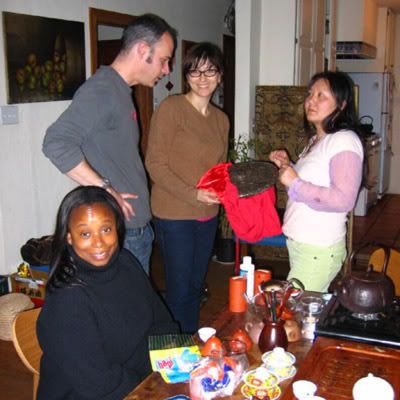
Two Saturdays ago I met three new tea friends: "Estif", who came down from San Francisco for the Easter weekend, Imen, who I have communicated with many times before, and T, who is a friend of Danica. The gracious host was Danica, again.

I think we managed to come across as quite fanatical to T in how we discussed, slurped and comment about the teas we drank that day. Fortunately, she was very open to the new experiences, and all of us could tell that she has got a taste for fancy teas! Another convert?

[Photo (L-R): T, Estif, Danica and Imen holding a 3kg Xi Zhi Hao Lao Banzhang pu'er tea disc]
Teas we tasted:
  • '07 Ming Qian (pre-Ching Ming) Shi Feng Long Jing from Jing Tea Shop
    Lovely. Nutty and buttery with a long sweet and buttery aftertaste. 4 stars.

  • ’07 Early Spring Biluochun from Jing Tea Shop
    Good. Nutty and floral, but seemingly short on the aftertaste. I can’t say that I’m a big biluochun fan yet. 3.5 stars.

  • ’07 Spring wood-fired Nantou oolong, Taiwan from Houde
    Light, thin and not expressive enough. Floral, grassy with a soft roasted taste. Came rather short of our expectations. 2 stars.

  • '06 Highly roasted Dong Ting oolong, Taiwan from Teamasters
    Delicious, complex and balanced. One of the better roasted Taiwanese oolongs I have ever tasted. 4 stars.

  • '06 Lincang Sheng Pu’er from Teamasters
    Expressive and charming. Brewed with little leaves and long steeping time in the silver teapot. Best tea of the day for me. Alas, its very pricey for a young 2006 tea. 4.5 stars.

  • Banzhang Pu’er (tightly compressed squares), source unknown
    Strong tasting. Don't remember much else. 3 stars.

  • ’06 Hai Lang Hao Banzhang Sheng Pu’er from YSLLC
    Strong and kicked everyone's head pretty quickly. 3 stars.


  • Reverse Osmosis Water Is Not That Bad

    We used three types of water that day: Fiji (artesian), Trader Joe's New Zealand (artesian), and reverse osmosis. Danica added about six drops of some
    ionic mineral supplement into the RO water in the 1.5 liter tetsubin to an excellent result! The supplemented reverse osmosis water was actually as good as or better than the expensive Fiji and New Zealand artesian water. More testing and comparing still need to be done, however.


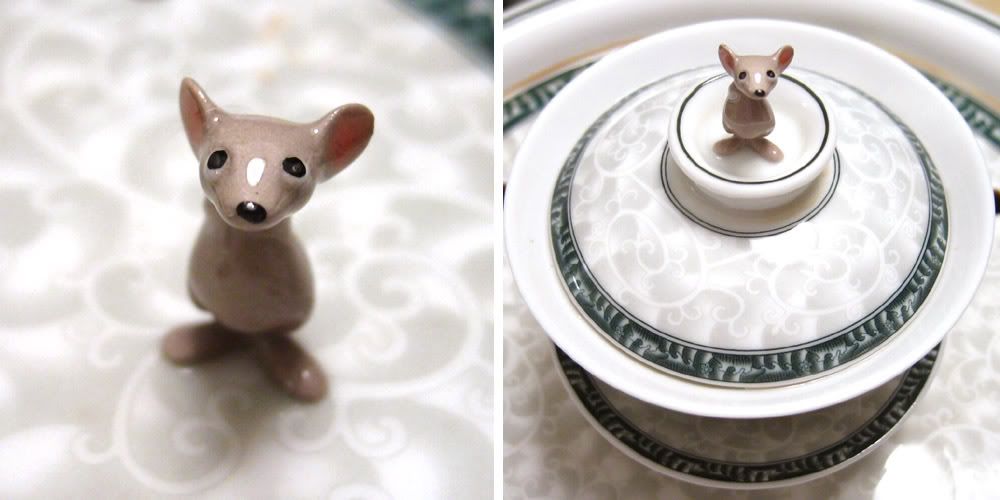
    Lastly, please meet my new ceramic tea friend. It's made by a miniature specialist company called Hagen-Renaker.

    Wednesday, March 21, 2007

    TN: Chen Guang -- He Tang Yiwu Pu'er

    Mr. Chen Chih Tung is a renowned tea personality, a rock star in the Asian world of Pu'er. He is, after all, the author of the authoritative compendium on Pu'er titled "The Profound World of Chi-Tse", and he has collaborated with various big name pu'er producers. Some of the teas that bear his validation (through his personal supervision of the production process) are the Chang Tai South East Asian Puerh Trade Memorial Cake series and, more recently, his own Chen Guang-He Tang Yiwu series (autumn harvest).

    When a tea bears his name or is associated with him, you have to think that the product is as good as it gets.

    Several enthusiasts got together online and exchanged honest opinion on the two 2006 Chen Guang - He Tang teas that recently became available in the U.S. through Houde Fine Tea. Click here to read other participants' tasting notes posted on LJ Puerh Community (lots of pictures).

    Tasting Notes

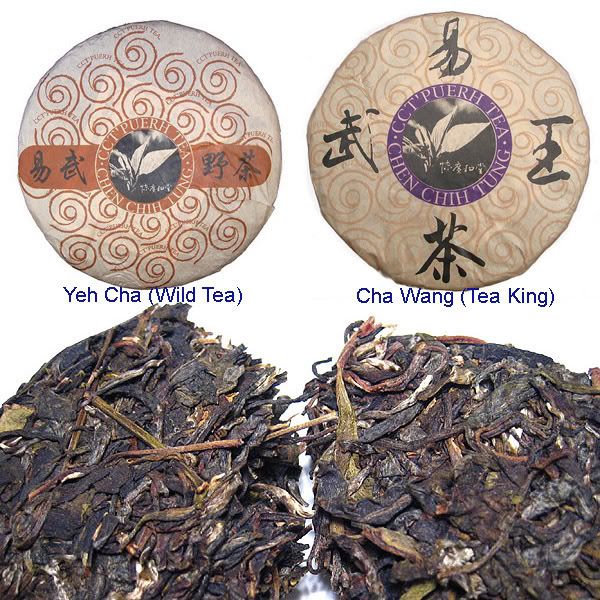
    2006 Chen Guang-He Tang “Yeh Cha” ("Wild Tea")

    Parameter: just boiled water, filled gaiwan 1/3 full of dry leaves, flash rinse, then 15s, 10s, 15s, 25s, 30s, 45s...

    Seaweed, green vegies and salty plums from the wet leaves. The tea itself is rather thin and monotone. The chaqi is weak and the aftertaste is uninspiring. Nothing interesting about it in the mouth. Liquor is rather cloudy. Weak, dusty tannin for such a young tea. I have my doubts in this tea’s ability to age well. Boring overall. 1 star (not good, not bad)

    2006 Chen Guang-He Tang “Cha Wang” ("Tea King")

    Parameter: just boiled water, filled gaiwan 1/3 full of dry leaves, flash rinse, then 15s, 15s, 15s, 25s, 30s, 45s, 1m, 1.5m, 2m,...

    Quite the opposite of the Yeh Cha. This tea is complex with overtones of yellow fruits, sweet plums and some smokiness. I particularly like the conservative amount of smoke in this tea that blends well with the overall fruity characteristics. Lively in the mouth with lots of infusions to offer (I had 8 before stopping, but the tea still could go for more). Good chaqi, full mouthfeel and with an aftertaste that persists. Abundant fine dusty tannin (this should be a good backbone for aging). The mellow complexity of the Yiwu shines through quite prettily in this tea. It should be interesting to find out how it ages, and it has a lot of potential given how it is today. 4+ stars (vg+)

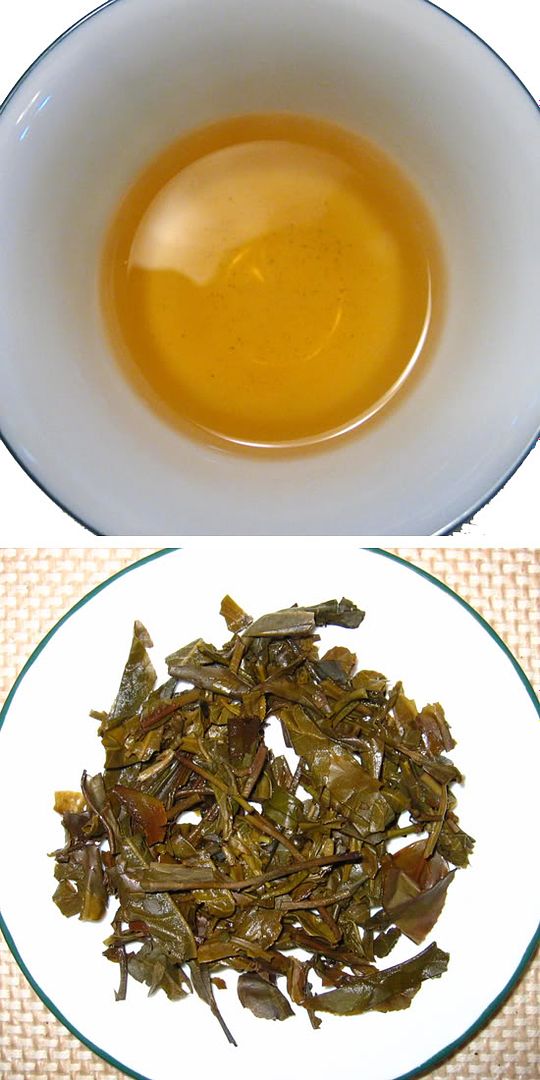
    The difference between the two teas, taste-wise, is quite significant, in my humble opinion. It is hard to differentiate their quality just by looking at the dry leaves alone -- both look almost identical. The Cha Wang does have more leaves that are covered with white fur than the Yeh Cha version. Both teas are nicely compressed (not too loose, not too tight).


    [Photo: discs (top) by Houde Fine Tea; tea leaves (bottom) by Phyll Sheng]

    Wednesday, January 17, 2007

    2003 Silver Dayi (Menghai) Pu'er

    Thanks to Mr. Chan Kam Pong (Managing Editor of The Art of Tea magazine) for sending a 10gr sample of this tea to many people worldwide, including me. The organized online tasting was, I think, a success.


    Parameter: Boiling filtered water, 5-10s rinse, 10s rest, then 10s, 10s, 10s, 10s, 15s, 15s, 20s, 45s, 1m…

    Dry leaves: Dark brown-green with downy silver buds strewed sparsely. The sample that I received was quite broken up. In a warmed gaiwan, the dry leaves gave off a pleasant floral whiff and sweet-sour plum note. A bit of smoke came through, though it was not unpleasant. Excellent nose overall.

    Wet leaves: Smokey, plummy, woody, and floral. Bright and uplifting. Smoke was quite dominant.

    Liquor: Amber-brown color with varying intensity, depending on the steeping time given. Clarity was decent, though not crystal clear throughout all infusions. The first brew came off fruity – it mostly reminded me of yellow plums and ripe, sweet apricots – and also a bit of smoke. The brews thereafter were assertive and intense, with bitter gourd-like taste. The caffeine buzz hit me pretty hard at around the 4th infusion. On the 6th brew, the camphor/woody aroma showed up, as if it had been hiding behind the intensity and bitterness all along. Brewed nicely for 9 infusions before going downhill.

    Medium bodied. Good, wholesome mouthfeel. Went down quite smoothly, leaving a mouth-coating dusty tannin and a cooling effect, which was then followed with a bitter-sweet aftertaste that turned sweet on the back of the tongue and far down the throat for a long time. Pretty impressive.

    An excellent tea all around, though it is still too primary and brutish for immediate enjoyment. I can imagine it being a good candidate for long term aging.

    More about this tea (warning: a long post with many pictures...slow download)

    Thursday, January 4, 2007

    Happy New Year 2007!

    Happy New Year everyone!

    Since I last updated this blog, I enjoyed some excellent as well as not so satisfying teas and wines.

    1997 Beringer Cabernet Sauvignon Private Reserve, Napa Valley ($100)
    It seemed like this wine had gone over the hill -- though still palatable -- like the previous 2 bottles I opened in 2005. It was oaky and only a shadow of the fruits remained. I was quite dissapointed, again. Either this wine was improperly stored by the supplier, by Costco -- where I got 3 bottles from in 2004 -- or that this particular vintage and bottling was short-lived by nature or by craft, despite coming from a very good year. 1-2 stars.

    2004 Seghesio Old Vines Zinfandel, Sonoma County ($26)
    Nice. Lively acidity with good flavor intensity of red/black fruits and that classic zinfandel's peppery finish. It's still a bit too primary (young) and the tannins was tight. In 2 years or so this wine should sing better. I think its 2001 and 2003 siblings were slightly better, but the 2004 was delicious, too. 3.5 stars.

    N/V Billecart-Salmon Rosé Champagne ($55)
    As always, a delicious and classy rosé Champagne. When in the mood for a good and [relatively] affordable rosé bubbly, you can't go wrong with this baby. Yum! 4 stars.

    Magnum of N/V Dampierre Cuvee de Ambassadeur, Champagne ($75/magnum)
    Also a good bubbly that had a talcum-like taste and texture. Fine mousse and bubbles. 3 stars.

    I had these excellent teas:

    Anji Baicha
    Despite the word “Bai” (白: white) in its name, I've been told that it is technically a roasted green tea. Anji Bai Cha hails from the Anji county in Zhejiang province.

    I love this tea! The thin grass-like leaves are full of life and health. Its bright green color is almost luminous and lend it a delicious appearance. Surprisingly, it manages to not smell grassy. This tea is vibrant with aromas of white flowers, sweet almonds and a hint of basil undertones. The aroma of the brewed liquor reflects fairly the aroma of the dry leaves. Its excellent mouthfeel is subtle, yet round, supple and mouth watering. Finishes with an impressive sweet aftertaste that lingers on. 4 stars (vg)

    Parameter: 165 – 175 F spring water. About ¼ full of dry leaves in a gaiwan. Start with 30 seconds then adjust to taste.

    Anji Baicha (a slightly higher grade than the one above)

    Dry leaves are of medium to dark green with some yellow tint. When steeped, each shoot opens to reveal a one-bud-one-leaf or one-bud-two-leaves system. The liquor gives a sweet taste and a pleasant floral, peanut, honey, and fresh cut grass aromas. This tea somehow reminds me of a fragrant rice / mealy concoction. It finishes sweet in the back of the throat with a long lasting hui gan. The rice-y character becomes more pronounced with each subsequent brew up until the 4th or 5th, when the leaves are spent. Medium bodied with a smooth and sweet finish. 3.5 stars (g – vg).

    Parameter: 165 – 175 F spring water. About ¼ full of dry leaves in a gaiwan. Start with 30 seconds then adjust to taste.

    Zhenpin Lu Xue Ya

    The dry leaves look very appealing and are similarly shaped to the bamboo tea leaves of Mount Emei (aka: Emei-shan Zhuyeqing), except that the leaves of this Lu Xue Ya are slightly larger, darker and meatier. Some are coated neatly with white down. This tea’s mealy characteristic along with bamboo, oatmeal, honey, hay, and sweet floral aromas is wonderful! The soymilk-like texture of the liquor and its wholesomeness add to the complex beauty of this tea. A pleasure to drink! 5 stars (outstanding).

    Parameter: 165 – 175 F spring water. About ¼ full of dry leaves in a gaiwan. Start with 30 seconds then adjust to taste.

    And a tea that I wished I could enjoy:

    1989 Menghai #7542
    aka: "88-Ching Beeng" #7542
    10gr sample from Houde Asian Art


    The 1989 "88-Ching Beeng" pu'er is regarded as a benchmark of excellence among quality "older" pu'er that have been stored under the so called "dry storage" environment. The story goes that Mr. Chan of Best Tea House in Hong Kong was offered a boatload of this tea at an affordable price, he took them and store them in a dry-condition warehouse (read more). At US$450 per 357gr, I expected it to live up to its reputed good taste. Unfortunately, however, I didn't find it enjoyable. Whether it was due to my personal taste or other reasons, my 2 attempts to brew this tea -- each time with a different parameter and water -- did not produce something that I could regard as enjoyable.

    For my first attempt, I used Glacier filtered water and the following parameter: boiling water, approx. 5 grams of dry leaves in a 100ml gaiwan, 10 sec rinse, 30 sec rest, then 15s, 10s, 15s, 15s, 30s, 1m, 2m.

    The wet leaves were pleasantly and vividly woody with some white pepper aroma. Exceptional liquid clarity. Taste wise, there was some of mustiness that dissipated by the 3rd brew. The aroma of tobacco / cigarette smoke and a slight metallic taste was quite offputting. They were mostly gone by the 6th brew. By that time, however, it was already rather difficult to enjoy or think positively of the tea. The overall body was between thin to medium. The aftertaste was generally that of cigarette smoke / tobacco. Tannins, though present considerably, was more sateeny than dusty.

    For my second attempt, I used Volvic spring water and approx. 5gr of dry leaves in a 100ml gaiwan. 10s sec rinse, 30 sec rest, then 5s, 8s, 8s, 15s, 30s, 30s, 1m, 2m.


    As in my first attempt, the smell of the wet leaves was appealingly woody and peppery. My tasting note from this session was mostly consistent with the note from the first session, except that (1) Volvic water provided a slightly better mouthfeel and body and (2) by the 6th brew, when the aromas that I didn't enjoy had mostly dissipated, the tea gave a hint of sweet aftertaste.

    Overall, however, I felt uneasy and unsatisfied throughout the 2 sessions with this tea.


    PS: I have shortened the title of this blog. Though the intended meaning might have changed somewhat, I thought the shortened title sounds more concise and it still retains the gist and focus of this blog.

    Monday, December 11, 2006

    1970's Guangyun Gong Sheng Pu'er

    A Brief Background
    Guangyun Gong, or Guangdong – Yunnan Tribute tea, is the name given to this production to commemorate the trade relationship between the two provinces. Produced by the China Tea Co.’s Guangdong branch (中茶), the first batch of Guangyun Gong was released in 1958. Up until the end of the 1960’s, only raw Yunnan arbor leaves made up the series. Starting in the 1970’s, however, tea leaves from other provinces such as Sichuan, Guizhou and Guangdong, among others, were used in the production of Guangyun Gong. This was due to changes in the inter-province tea distribution structure in the 1970's when the Yunnan tea industry was given the rights to distribute their own teas and, as such, they were no longer required to send raw materials to the central distribution hub in Guangdong. Consequently, Yunnan arbor tea leaves became harder to obtain in Guangdong, so China Tea Co. began mixing raw materials from other abovementioned provinces.

    Per
    Mr. Chan Kam Pong, Executive Editor of the Art of Tea publication, the 1970’s version is referred to as “Guangyun Tea Cake” and it is regarded as inferior to the highly sought after 1960’s “Guangyun Royal Tea Cake”.

    (Photo: Houde Asian Fine Art)

    (Source of background: Houde Asian Fine Art, Mr. Chan Kam Pong, and various tea fora, especially the LJ Puerh Tea Community)

    I do not know how the 1960’s Guangyun Gong tastes like compared with the 1970’s version, which I thought was an interesting education piece. I wonder whether Yunnan arbor leaves really are/were superior to leaves from other provinces (I mean the leaves used in Guangyun Gong), or if it is merely a puristic perception.

    Tasting Note
    Dry leaves: dark red-black. A patch of white mold and many tiny white dots are visible (
    click here for a higher resolution picture).

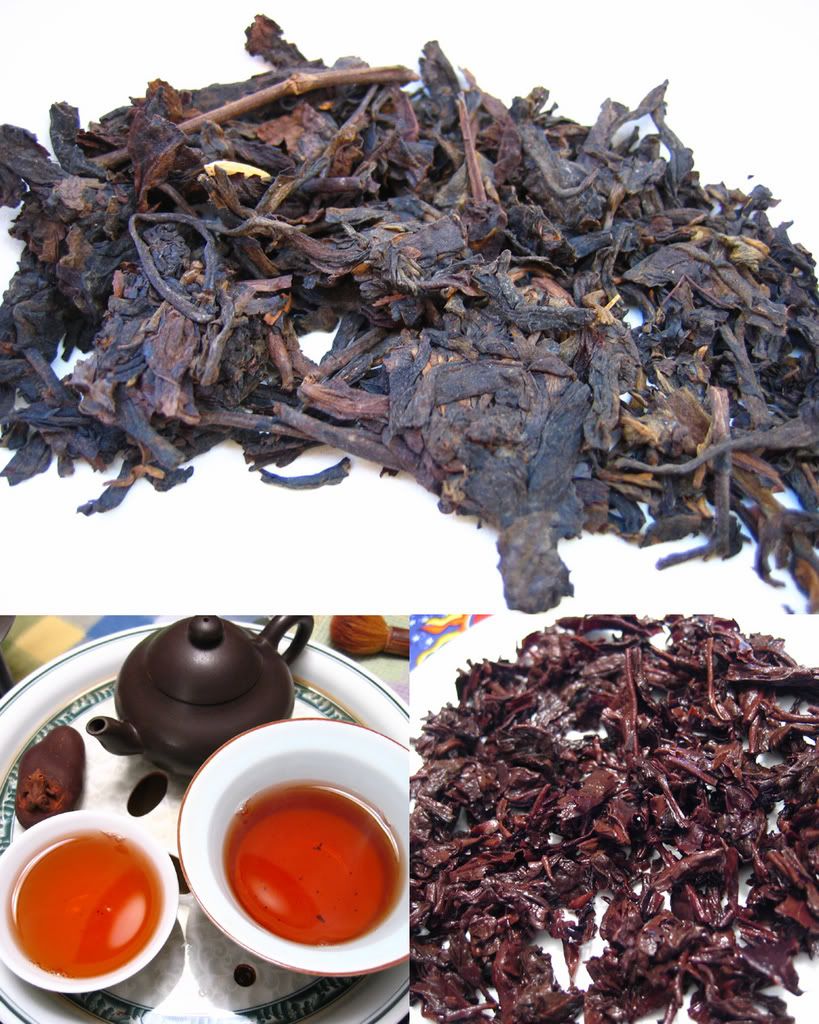
    Brewing parameter: 3 sec rinse, repeat rinse, 10s, 10s, 10s, 15s, 15s, 20s, 20s, 20s, 25s, 25s, 40s, 45s, 1m, 2m (total 14 drunk infusions)

    Color: medium brown at 1st and 2nd infusions, then becomes darker brown until the 8th infusions, when its color descends to become lighter. “Bao guang” (yellow halo surrounding the red-brown liquor) is present throughout.

    Exceptional clarity from the first to the last infusion. This, I believe, is one of the characteristics that sets an aged sheng pu’er apart from a shu pu’er. As dark as the liquor becomes, it retains its crystal clear clarity, whereas a shu pu’er tends to get opaque and/or cloudy.

    A whiff of Chinese herbs…ginseng being the most recognizable. This is accompanied with an earthy, mushroom-y, and toffee-like nose. A subtle sweet sensation is well integrated and felt on the side and back of the tongue. This is not the same kind of sweetness that a decent shu pu’er gives, which tends to be more obvious. Nor this is the sweetness that one gets from a black tea, which tends to be bitter at first then turning to a sweet finish. A hint of metallic taste (iron?) is present. This tea doesn't turn bitter even with prolonged brewing. Medium body at first, and later infusions are fuller (as the color of the liquor became darker). This tea is very smooth with tannins that is almost non-existent.

    There is an obvious cooling sensation in the mouth and throat. A soothing feeling also goes down to the stomach and lasts for a few hours.

    I felt a blanket of warmth by the 4th infusion, and the sensation grew warmer especially on my back, shoulders and neck. By the 8th infusion, my body felt sufficiently hot. It’s a very relaxing and calming experience. I’d attribute this sensation to good cha qi.

    This tea may be a turn off to those who dislike the smell and taste of Chinese herbs/medicine, but I mean it in a pleasant way. I generally dislike the taste of Chinese medicine, too. However, the herbal / medicinal quality of this tea is inviting and soothing. An excellent tea all around.


    The 1970's Guangyun Gong is available at Houde Fine Asian Art.

    Thank you, BBB, for the sample!

    Wednesday, June 7, 2006

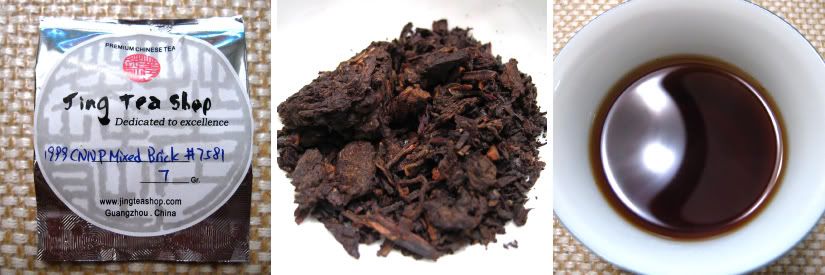
    TN: 1999 CNNP Mixed Brick # 7581

    Another sample sent by Jing Tea Shop, in Guangzhou.

    Dry appearance: Like dirt / soil.

    Opaque red, dark brown. Nothing much to write about its taste. Earthy, woody and slighly floral in the background. As with mixed and cooked pu-erh, it's smooth in texture...and this one goes down like drinking whole milk. A very pleasant mixed pu-erh, in my opinion.

    === / 5 (g)

    Sunday, June 4, 2006

    TN: 2005 Chang Tai Pure Ancient Tree Puerh, Yiwu Mtn.

    This is my first "test run" for the 2005 Chang Tai Factory Pure Ancient Tree, Yiwu, Pu-erh. The purpose of this tasting is to find out if I've just bought a lemon or something nice that I can keep long term. Purchased from Yunnan Sourcing LLC (see blog dated 5/10/2006).

    Dry appearance: large, long, whole leaves that are very dark green to blackish-green, many are hairy. A few leaves are silvery and hairy. Quite nice looking. When broken, the inside is filled with whole leaves too, indicating a consistent quality througout. Each beeng (cake) is 100gr small.

    TN: Bright orange-yellow liquor. The most obvious characteristics of this tea is the mélange of camphor, floral, pleasant green alfalfa (?) and some yellow fruits. A very nice perfume overall. It really opened up by the 4th infusion, when all aromas became better focused. The liquor itself is quite mellow and friendly -- it does not act like an uncivilized brute with the astringency or the coarseness often found in a newly released pu-erh. Light to medium body as well as cha-chi. Fine dusty tannin. A floral aftertaste, and it hasn't developed any sweet aftertaste.

    I wonder if this tea is going to age well or should be consumed when young. My feeling and evaluation from this tasting is that this tea is better consumed younger, though I plan to keep an ample amount for consumption beyond 7 years of aging. Somehow a few sips of this tea gave me an intense caffeine buzz that I usually get from 2 shots of espresso.

    ===+/5 (g - vg)


    From the Vendor's Text:

    Producer: Chang Tai Tea Factory
    Process: Picked, sun-dried, blended, and Compressed.
    Vintage: Spring 2005
    Production area: Yi Wu Mountain

    Chang Tai Factory has been producing Pu-erh tea cakes since the 1990's, most of which have been directly exported to Taiwan, Hong Kong and Singapore. A favorite among collector's of premium Pu-erhs and often voted "best of pack" in Pu-erh competitions.This cake is pure unblended ancient tree sun-dried pu-erh from the Yi Wu mountain in Xishuangbanna. In recent years the demand for pure ancient tree pu-erh (especialy from Yi Wu mountain) has grown exponentially. Consequently the price per kilo for "mao cha" (sun-dried pu-erh used for making compressed tea cakes) has risen quickly. his is an excellent cake and represents the unblended taste of Yi Wu.

    Wednesday, May 17, 2006

    TN: 2003 Xiang Zhu Aromatic Bamboo Pu-erh

    Finally...whew! I was able to split open the bamboo stick, get some of the leaves out, and brewed the 2003 "xiang zhu" fragrant bamboo pu-erh that is described by the vendor, Yunnan Sourcing LLC, as follows:

    "Another incredibly unique Pu-erh process that is particular to the Dai and Jingpo people living in Dehong Prefecture of Yunnan. This Bamboo Pu-erh is special because a species of Bamboo called "xiang zhu" is harvested at a special time once a year when the aromatic bamboo is still relatively young and imbued with an incense like smell. Raw Pu-erh leaves have been forced down in the the open end of the aromatic bamboo section, then bamboo sections are barbecued in a wood fire. As the bamboo dries in the fire the special aroma intermingles with the Pu-erh inside. A tasty and intoxicatingly aromatic Pu-erh! Unforgettable!"

    Unique? I think not. I honestly didn't detect any special fragrance from the bamboo itself (inside and out) or from the compressed tea leaves. Also, when brewed, neither the wet leaves nor the tea liquor give any "incense like smell" of the bamboo. In fact, this tea is of low quality (as expected), young, astringent, throat-scratching coarse, and unpleasant to drink in general. I've drunk quite a number of pu-erh to know what a good young pu-erh should taste like...and this is not one of them. To make things worse, it was very difficult to split the bamboo open to get into the leaves. I had to use a hammer, a screwdriver, and a lot of willpower. Unforgettable (in the worst sense)!

    zero / 5 (yuck!)

    Note: This is the same as item # D in my post dated 5/10/2006 below.