Showing posts with label oolong. Show all posts

Saturday, September 13, 2008

The Marathon Has Ended

On the 11th day (Wednesday, Sept. 10, 2008), I ended my tasting of a well-crafted 2004 Wuyi Shuixian oolong that was harvested from a 200+ years old tea bush. If my notes are correct, this prolonged session yielded 21 infusions in the first three days, using gongfu brewing method. And 16 additional lovely cups were extracted through long steepings (9 - 12 hours each) over the next 8 days. That brings the total to 37 infusions.

On the 11th day, the tea-water tasted thin and light, yet still fragrant and sweet. The last cup was the ghost of something beautiful...a testament of a great tea and the teamaster's skills.
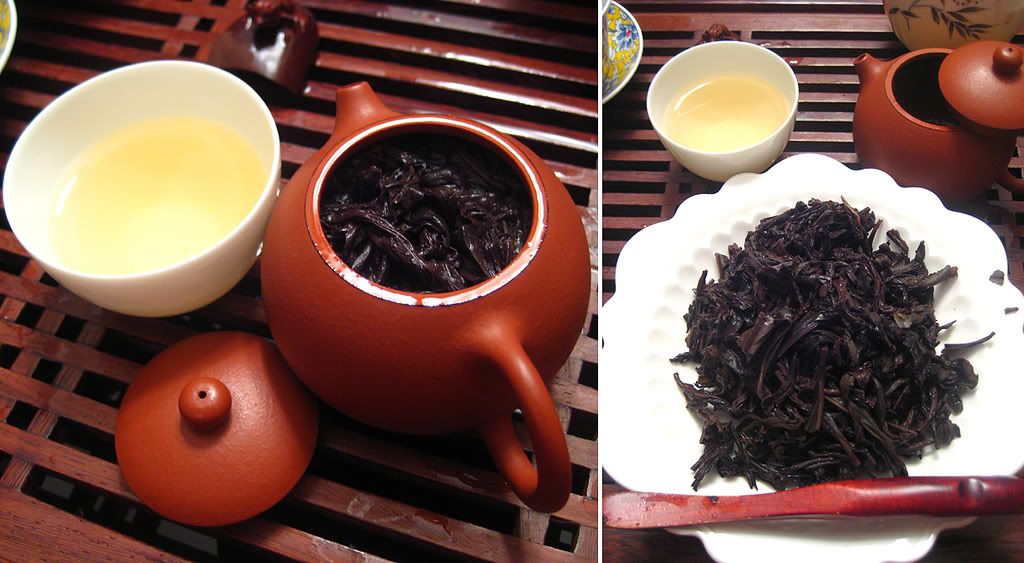

So, what does this extended tasting session accomplish, someone asked me (and called me "nuts")? I've pondered on that question for a bit longer, and I think as far as highly roasted Wuyi yancha oolong is concerned, I have learned the following...a great Wuyi yancha oolong:

(in no order of significance)
1. Has great brewing durability (the reason why it lasted 11 days for me)
2. Has impeccable balance of its roasty, floral, fruity, and sometimes woodsy characteristics
3. Has good active mouthfeel and a long aftertaste / "echo" (chayun and huigan)
4. Has good chaqi (yin or yang), and
5. Tastes great when lots of leaves is used (more than 1:2 ratio of the teapot's volume, up to 1:1)

Before this tea, my personal preference with highly-roasted Wuyi yancha had always been to use 1/2 a teapot full of dry leaves (compacted by tapping the teapot gently while filling it with dry leaves to settle them down). I had been somewhat averse to using more than 1/2. This was because almost each and every time I used more, I had always been rewarded with overly bitter brews, even with flash steepings. So this tea has changed my perspective on how to gongfu-brew a good quality yancha.

One thing that still makes me wonder is why this very tea brewed in a gaiwan can last more than 7 weeks at The Tea Gallery in NYC. When brewed in a Yixing teapot, however, it lasted only 11 to 12 days for all the participants involved (Toki, Salsero and myself). Does the porous nature of Yixing clay affect brewing durability...perhaps through absorption and oxidation? (Anyone?)

My utmost thanks goes again to Toki for this incredible experience and opportunity by providing the tea in question. I am in the opinion that such an superb tea is something that one only finds when armed with knowledge, understanding, passion and a spirit for adventure. Oh, and maybe lots of cash, too (Toki never revealed the price of this tea).


Related Posts

From The Mandarin's Tea Blog:
1. 7542 '88 Qingbing Ended, Vintage Qing Dynasty Brick Began (Aug. 21, 2008)
2. A Marathon Relay Continues (Sept. 1, 2008)
3. Second day of Kung Fu tasting (Sept. 2, 2008)
4. What is detail Tasting? (Sept. 5, 2008)
5. The Morning After (Sept. 12, 2008)

From Teachat:
1. A post by Salsero

From my own blog:
1. The Marathon Has Begun (Aug. 31, 2008)
2. And It Continues On (Sept. 1, 2008)
3. Into The 6th Day of Tasting (Sept. 5, 2008)
4. Elevated Expectations? (Sept. 6, 2008)

Saturday, September 6, 2008

Elevated Expectations?

Last night, after drinking Toki's yancha oolong brew du nuit (steeped from 9am to 9pm), I decided to look for another yancha tea among my stash to do a comparison tasting, sort of. Aha! I found a pack of vintage 2007 Baishuixiang (100 years fragrance -- BSX) oolong, still vacuum-sealed in its little mylar bag.

This tea, among others, was generously given to me by Will and Louise, two of my LA Tea Affair buddies. While visiting Wuyishan last year, they obtained a variety of teas from the local producers and vendors to be brought back to Los Angeles for their personal enjoyment. I am sincerely grateful to them for the potpourri of samples of their acquisitions.

My thinking was to drink Will's BSX and use my recent (and ongoing) tasting of Toki's Shuixian (SX) as a frame of reference for taste, quality and, most especially, firing technique. Granted that BSX tea is not the same variety as SX, I hope they are more or less comparable on the general level, as far as my tasting experiment is concerned.

So, as with Toki's tea, I placed about 3/4 full of the BSX, tightly compacting the leaves by tapping the pot's side gently, into my 80cc 1970's hongni shuipin Yixing pot. With boiling-hot water I flash-rinsed the tea once, and then flash-steeped the tea for 6 infusions. After the 6th cup, I felt that I've had enough impression of the tea for the night (will continue in the morning).


The differences between the two teas were strikingly noticeable. Although both teas have been deeply roasted, the SX managed to give out an upfront yet balanced sweetness and roastiness. The BSX, on the other hand, was skewed much more towards its roasty characteristics. It had thin layers of green and floral characters underneath all the strong, toasty flavors. Also, the BSX tasted rather chaotic in the mouth: burnt toast, some greenness, a bit floral, but highly astringent. I felt that the qi of this tea was also chaotic, giving me an uneasy feeling overall. The aftertaste lingered for quite a while, though unfortunately, it was sour and drying to the throat. I felt more thirsty than before I drank this BSX.

Should I not put as much leaves when brewing BSX tea? Or has my expectations been elevated somewhat by Toki's tea? If my overall expectations has indeed been elevated, then I reckon that I am doomed to spend a large sum of money whenever I shop for a decent Wuyi tea -- that is if I could find such high caliber teas to begin with.

[My utmost thanks again to Will and Louise! Despite my criticism, I am grateful for the lesson I learned from tasting your tea.]

Friday, September 5, 2008

Into The 6th Day of Tasting...

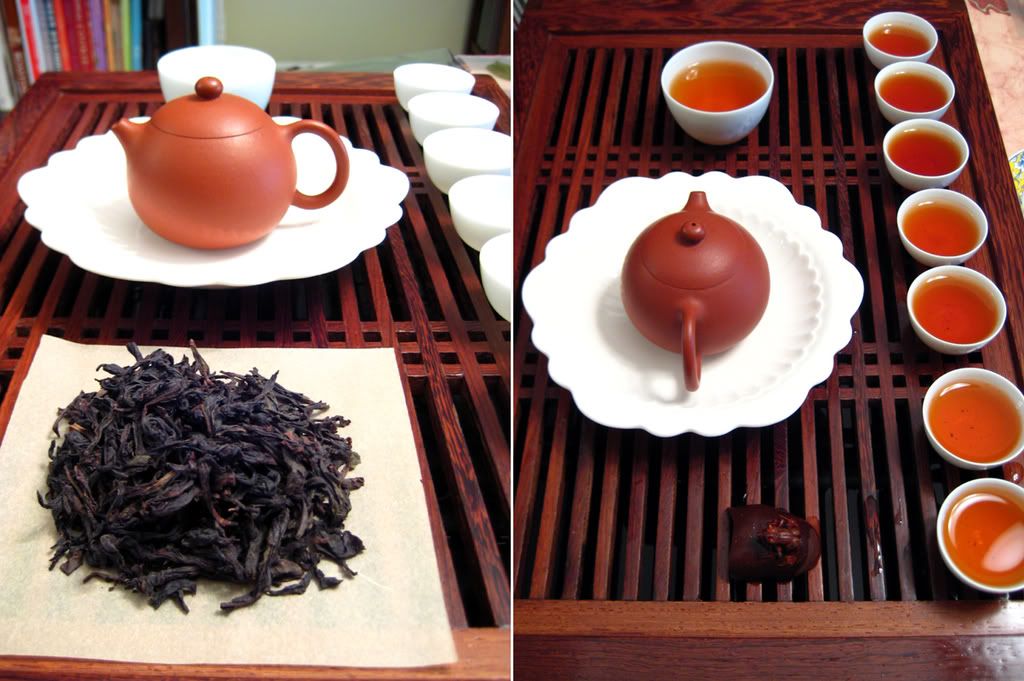
Today, I enter into my 6th day of tasting Toki's Wuyi oolong, which according to his blog was harvested from a 200+ years old Shui Xian bush, and then fired 4 times between May and September of 2004 by a talented tea master in Wuyishan, Fujian Province, China.

For the first 3 days (Sunday to Tuesday), I brewed this tea with regular gongfu methods until such point that I had to infuse the tea for 15 minutes or longer. From then on, I began to infuse it for hours on end. These are the steps I am taking, as suggested by Toki:

1. After concluding the last short-brew steep, pour boiling-hot water into the teapot up to the rim. Place the lid on, and pour hot water over the lid to "water-seal" the teapot.

2. After about 6 or more hours, pour the tea out (to be enjoyed). Then, pour boiling water into the teapot for about 5 - 10 secs before pouring the brew out into a cup (to be enjoyed). The purpose of this short steep is to re-heat the leaves in order to prepare them for the next extended steeping. The leaves must be as hot as possible. Then, I immediately pour boiling-hot water into the teapot again, up to the rim, put the lid on, and water seal it. I let it stand again for hours on end.

3. Repeat step 2. Increase steeping time as necessary, up to 12 hours.

The liquor from yesterday morning's 11-hour steeping was smooth and flavorful. It no longer had the roastiness and the astringency that this tea exhibited during the first 3 days. Rather, it tasted and smelled floral and subtly complex. I can't find the words to describe it. Somehow, it reminded me of drinking an old, top-notch Cognac.

I wonder if an extended tasting session that goes on for weeks is best (or better) done with a heavily-roasted tea. Since roasted tea had to go through the firing process, I would assume that the end product is "clean"...less bacteria, fungi and other creepy microscopic crawlies. Also, the fact that the leaves are always submerged in water inside a sealed teapot probably minimizes mold growth and other nasties from developing. Further, after the tea is poured out, re-steeping the leaves with boiling-hot water maybe helps kill any chances of unwanted stuff from growing too much, too quickly or at all. Lastly, perhaps the fact that tea has antiseptic properties helps keep it clean and safe to consume for much longer.

These are just hypotheses...I'm not sure.

Monday, September 1, 2008

...And It Continues On

Parameter: dry leaves 3/4 pot full , compacted by tapping the pot gently to settle the leaves down. Flash rinse. Gentle stream of boiling-hot water (99-100' C). All time measurement is an approximation, decided by the previous cup's taste and strength.

Day 1: brew # 1 - 4 flash steeped. Brew #5 +2 sec. Brew #6-7 +5 sec.

Day 2: brew # 8 (flash steeped to heat leaves). Brew #9 +5 sec. Brew #10-11 +7 sec. Brew #11-12 +10 sec. Brew #14-15 +15 sec.

...still going strong, ready for day 3!

Per Toki's instruction, keep brewing normally until the tea has to be pushed for up to 3 minutes. Thereafter, each steeping for hours on end will begin.

By the way, I'm not alone -- thank goodness! Salsero is in this, too.


All this tea made me thirsty for some wine...

2003 Saxon Brown Zinfandel
Casa Santinamaria Vineyards
Sonoma Valley
($25, 15% alc.)

Dark purple, almost opaque. Ruby on the rim. Very intense black and red berries, dark cherries, and coffee. Powerful and concentrated, without feeling too heavy. The finish has a roasted oak, coffee and a slight glycerin sweetness. Its high alcohol level (15%) is beautifully balanced by the just-right acidity level, which gives the wine a lively zing and dimension. For a zinfandel lover (me), I love it!

4 stars (vg)

Sidenote: Saxon Brown winery and the Casa Santinamaria vineyards are precious jewels of the Sonoma Valley. The vines in these vineyards are dry farmed, head-pruned and have low-yield (~1/2 ton per acre). Under the talented hands of Winemaker Jeff Gaffner. You've got to love Mr. Gaffner's wines!

Sunday, August 31, 2008

The Marathon Has Begun...

...a tea tasting marathon session, that is.

I am conducting my first drawn out, detailed tasting session, which may last for weeks (one tea) if I do it correctly. The tea is a vintage 2004 high-roast Wuyi oolong of undoubtedly top pedigree.


Today I brewed the tea for 7 times. It was lovely and full of energy! The vibrancy of the 7th cup left me with little doubt that this tea can endure the long haul. I'm reserving my tasting notes for later.

We hit the beach in the afternoon. It was cloudy and a bit chilly, though the water was nice and warm.

Friday, August 29, 2008

Beautiful Morning Tea

I make it a point to obtain some freshly produced Oriental Beauty oolong every summer. This seductive tea is one of my favorite seasonal indulgences. It's quite easy to fall in love with it. The best example that I ever tried made me swoon in adoration as she sang all the low, mid and high notes in symphony.

I think the mark of a superior Oriental Beauty oolong is the presence of acidic nose / taste (the high notes -- fruity, sweet and sour) that is the signature of summer, insect-bitten teas. At the other end of the scale, the high degree of oxidation should lend the tea its mid and lower notes (honey, floral, caramel). When all is well, the effect can be euphoric.

This 2008 summer harvest is among my recent purchases from Houde. I seemed to have underestimated the leaves' density in dry form, and as a result may have used too much leaves this morning. To compensate, I employed flash steepings in the beginning and add mere seconds to later infusions.


Floral and honey notes are more prevalent here, with only a hint of the high sweet-sour notes, which I was craving after. There is a slight bitter undertones, too. I still need to "play around" with it. For now, it lacks the higher notes. Next time I will use less leaves and longer steeping time to, hopefully, coax out its fruitier personality.

Friday, July 4, 2008

1950's Shui Xian Oolong

Happy 4th!

Something special deserves its own moment. When it comes to a unique tea, it means finding a calm and casual window of time to savor it. The morning of July 4th was such that I decided to open a small package from The Tea Gallery containing 25gr of 1950’s Shui Xian oolong. I’ve been meaning to try this old tea out since it arrived 2 weeks ago, but a calm enough morning has been a rarity these days.

Upon opening the packet, I dived my nose into the mylar bag and took a few short, successive sniffs. There wasn’t much to nose about, however. Whatever mild scent present was reminiscent of old parchments with a hint of something sweet.

The leaves were quite broken, with about equal amount of larger-sized ones and the small bits. Five or six decades of handling and storage tend to do that to lightly rolled tea leaves. There were also about an equal amount of brown and black leaves in the mix. The black ones have some sheen about them.

This was to be the oldest Wuyi oolong that I’ve ever tried to date.

I filled my small, thin-walled 75ml Yixing pot half-full of dry leaves (1/2 full is a personal preference when it comes to Wuyi teas). I did everything carefully, as one would when handling something so old and fragile. I poured the water gently, in small stream, aimed at the rim of the pot’s opening so as not roil the leaves within.

The pre-rinse was done in a flash, and the resulting liquor was muddy, dull dark-brown…not pretty, but it reinforced the perception of its antiquity somehow. I drank the pre-rinse and it felt clean, light and airy, with a taste of old parchments (again). It was very smooth, though not much else.

The next infusion yielded a less muddy tone, and subsequent infusions thereafter would yield redder and clearer tea soup. By the second brew (third, including the pre-rinse), I suddenly felt quite woozy. The force was strong with this tea, and so I stopped to take a bite of sustenance before proceeding further.

On the third brew, suddenly this tea seemed to have awakened from its long slumber. The liquor became tastier and the aftertaste more pronounced. Though I wouldn’t regard it as complex tasting, in its simplicity and straightforwardness hid something pleasant, and that is the chaqi and its ability to leave a lasting aftertaste. With each sip, after the liquor slid down the throat smoothly, the ghost of it produced an intense salivation effect that left a long, sweet aftertaste. It’s a wonderful sensation altogether.

As with the pre-rinse, all subsequent infusions remained light, airy and extremely smooth. Its subtle perfume was not found in the liquor, but rather on the bottom of the empty cup...there lies a treat for your nose!

The packet of 25 grams doesn’t go a long way. There is only enough left for 1 more session. Is it worth the price? Insofar discovery is concerned, I think so.

4 stars (VG. Good chaqi and lasting aftertaste)

Saturday, June 21, 2008

2007 Winter Dancong "Huang Jing"

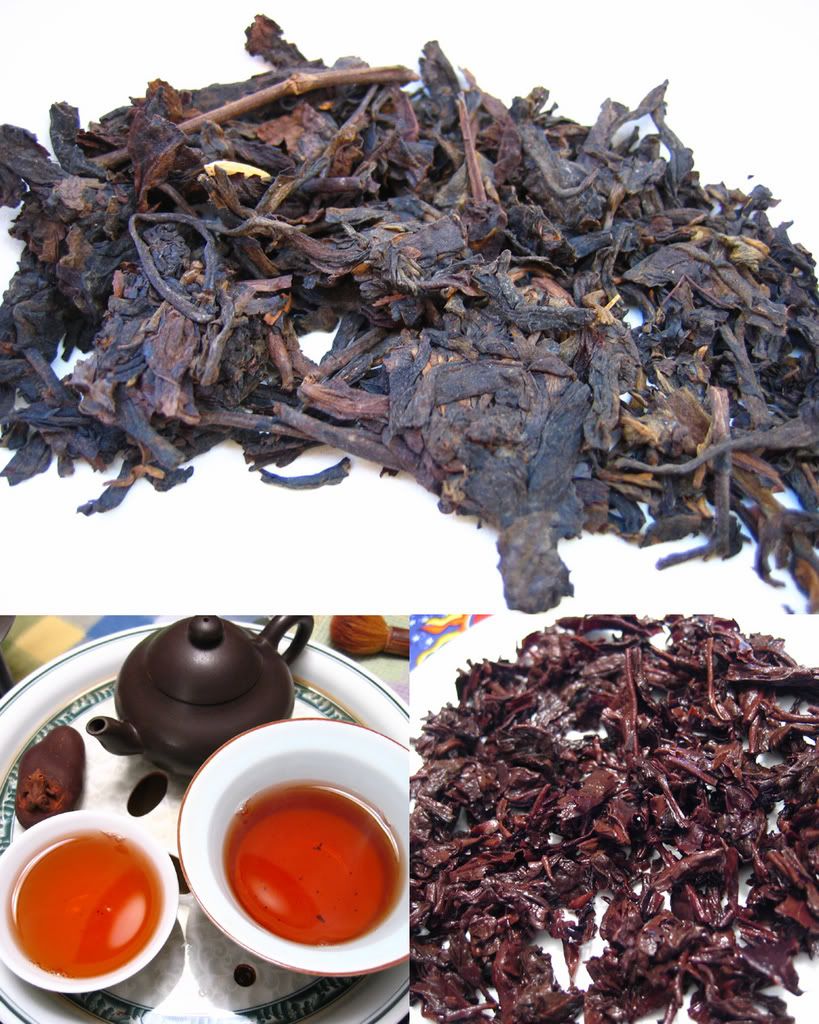
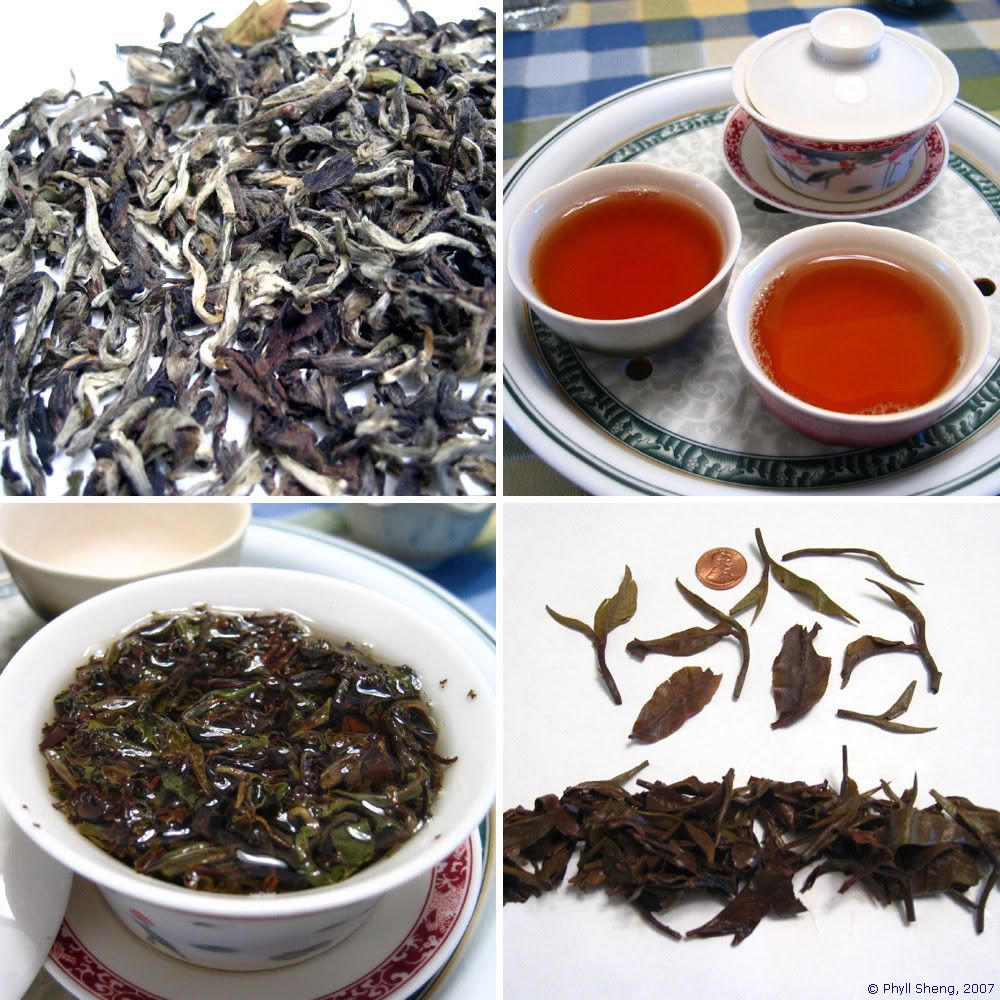
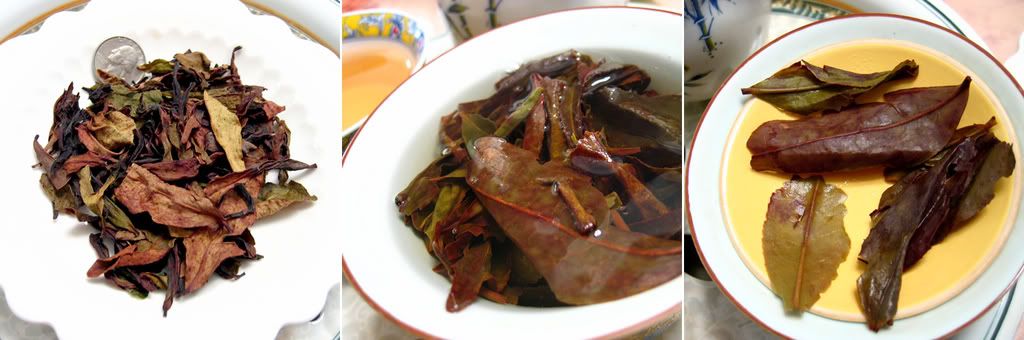
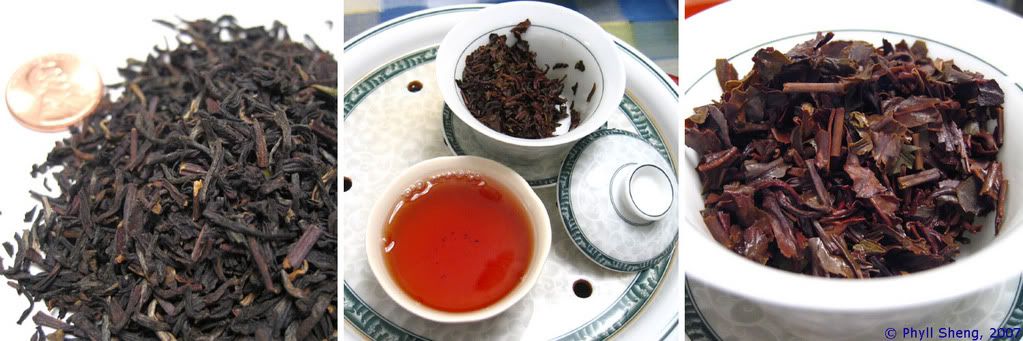
This is a Dancong oolong that is different -- in appearance and taste -- than all Dancong's that I have tried in the past. If I didn't regard Guang, the proprietor of Houde Fine Tea, as trustworthy, I would have thought that he is trying to profit from the fallen leaves in his yard. Such is the appearance of the leaves as you can see in the pictures below (with 25¢ coin as a rough scale). They are bold, open and unrolled with different shapes, sizes and colors. Quite a fascinating appearance, actually.

This tea yields a medium-yellow to light-orange liquor color, depending on the water temperature and steeping time. The aromatics is subtle and pleasant when brewed carefully, which reminded me of various yellow fruits (peach, mango, pineapple). It's also a touch floral and honey-like in the nose. All these pleasant aromas can become overwhelmingly concentrated, however, when the tea is over brewed, though it hardly ever gets bitter.

Light to medium-bodied, with sateen-y smooth astringency. For a medium - light roasted tea, it does not exhibit much of any roasty characteristics.

Very good and delicious. Pure and precise in taste.

Details from Houde's online store:
2007 Winter Dancong "Huang Jing"
Origin: Wu Dong, Feng Huang County, Guang Dong Province, China
Fermentation: 35%
Roast: Medium-light wood roasting


Product page (while still available)

Monday, June 2, 2008

Summer 2006 Guei Fei (Concubine) Dong Ding Oolong

I've been finding myself in the mood for Taiwanese Dong Ding oolongs these past few days. Rummaging through my tea canisters at home, I found a few Dong Ding oolongs from Stéphane Erler of Tea Masters that are long overdue for revisitations. Tonight, I decided to brew the Summer 2006 Guei Fei (Concubine) oolong from Fenghuang, Dong Ding, Taiwan, which I have never noted before in this blog.

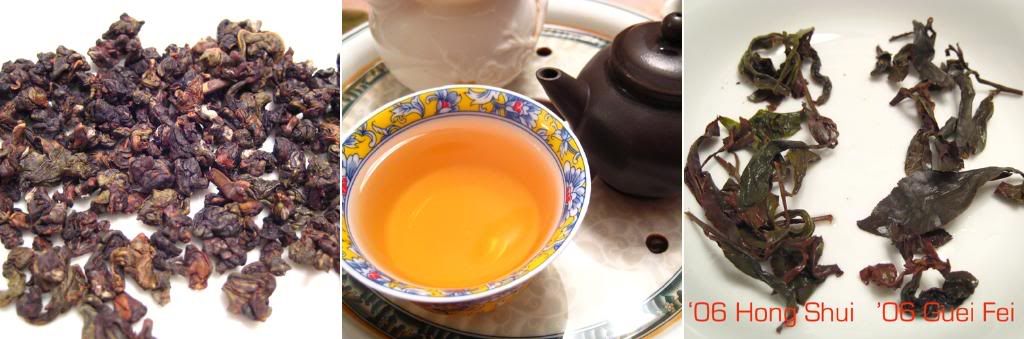
Tasting Note: The tea soup was medium amber in color and it has crystal clear clarity. The base perfume was of deep floral notes, accompanied by a fruity and acidic high notes that are commonly found in Oriental Beauty oolong. I thought the high notes reminded me of an unripe green mango or, to borrow Stéphane's accurate description, "sour pineapple." The mouthfeel was rather thin. This tea left a fruity and acidic aftertaste long after it's swallowed.

As noted in Stéphane's blog, this tea was still in the experimental stages, and therefore, its quality may be inconsistent from one vintage to another. I thought that given the amount of high oxidation that this tea received during its manufacture, it was worth comparing it to the 2006 Dong Ding "Hong Shui" (Red Water), which I noted quite some time ago. So I brewed the two teas one after another (with an hour of rest in between sessions). I found the Hong Shui to have a deeper and heavier overall perfume while lacking the high notes found in the Concubine tea. The Hong Shui, however, had a certain sweet, gingery warmth to its characters, which reminded me of entering a cozy home when gingerbread cookies are baking in the oven.

Notice the side-by-side picture of the wet leaves (left side is the Hong Shui): they are quite similar in appearances and colors. The green part of the Hong Shui's leaves is a bit greener than the Gue Fei's, which is closer to being black-green. I wonder if it's caused by varietal/clonal difference, the degree of sunlight exposure or human factors such as processing techniques.

Sunday, September 2, 2007

Southern California Heat Wave

Hot! The weather has been sizzling these past few days, managing to reach 110˚F / 43˚C in San Fernando Valley where I live. So yesterday we spent the whole afternoon at the beach in Santa Monica, where it was around 80˚F and lightly breezy. Sweet! Our Sophia had a great time playing in the sand and water.


The heat practically melted any desire to brew heavier teas. So I opted for last year's qingxiang tieguanyin oolong that I purchased from a tea store in Guangzhou back in March of 2006. The leaves are light green (very low oxidation) and unroasted. When I purchased 300gr of this tea, the sales lady was more than willing to separate the leaves to thirty 10gr batches and placed each in a small vacuum-sealed pack. A pack is enough for a single gongfu brewing session.

I lost interest in this tea and greener oolong's in general a few months after getting it. So I kept it in the fridge and it's been there ever since. Yesterday, I took one small pack out and placed it on the kitchen counter for an hour or so until it reached room temperature before ripping it open. The tea is still fresh looking and tasted fine, too. No sign of staleness.


It's refreshingly floral and grassy -- just great for the weather and my mood. The leaves are quite choppy on the edges, which makes me think that they were not hand-harvested...or that the processing of the leaves caused damage to the edges. If I remember correctly, I think I paid around $75 for the 300gr.

Wednesday, June 27, 2007

1950's Hongyin Pu'er & 2007 Spring Meghma Estate Oolong

While I am drafting Part V (post-event happenings) for the next installment, I thought I'd share with you some pictures of the 1950's Hongyin pu'er. A 10 gr sample of this very tea is now available at Houde for a decent sum of $355.

At the Event, we were only able to brew 6 or 7 infusions of the Hongyin as we ran out of time. This tea should be durable enough to last 15 to 20 infusions, depending on the brewing method. For the first infusion, I gave it a 5 sec rinse and then a 20 sec initial steeping. Gradually I moved up to about 1 minute long for the sixth infusion. Since the leaves were still inside my Yixing pot, at home I pushed the infusion time to 2 minutes and longer.


The resulting liquor was quite amazing. It’s thick, sweet and refined. The clarity of the intense red-brown liquor is impeccably crystal. The texture is milky smooth, almost resembling the feel of a half-and-half cream. It has a woody (camphor) and earthy quality to it, yet very clean tasting with a soft, sweet aftertaste. Though personally I feel this tea is less impressionable than the 1960's Bazhong Huangyin, it is a very elegant and easy going tea to enjoy.

4+ stars (vg - ex)


I have also been enjoying
Madan Tamang's freshest batch of 2007 spring Meghma Estate Nepalese oolong. I received a 1oz sample from The Simple Leaf (sold under the name "Honeybee") and I brewed the tea using the gongfu method and then later by the "English" method in a 32oz Bodum glass teapress pot.

It is a wonderfully aromatic tea! When brewed in a gaiwan using high leaf to water ratio and short steeping time (3s, 7s, 15s, 30s, 1m, 1.5m), the tea reminded me of sweet Oregano spices, white pepper and cumin, all wrapped in a honey-like fragrance and taste. The English style of brewing yielded a more rounded taste that is honey-like and floral, almost.

As you may notice from the infusion time progression I employed, I learned that this oolong packs a punch in its earlier infusion but the taste tends to diminish quickly in later infusions. As such I employed a very short 3s and about doubled the previous steeping time. This way, I was able to get 5 to 6 brews before the tea turned watery.

Good stuff! What's more, this tea possesses a unique sense of place and character. 4+ stars (vg - ex)

Thursday, June 7, 2007

Mr. Madan Tamang and His Meghma Estate Oolong

PREFACE

Back in October 2006, I had the pleasure of enjoying Meghma Tea Garden's autumnal oolong from the Eastern Nepal. A discussion on whether the tea was hand processed / rolled ensued under that post. The sample received and tasted then was too broken for proper observation.

I have had again the pleasure of drinking this tea (recently purchased, not the same order as last October's sample).


In Eastern Nepal, close to the border that separates it from India's Darjeeling district, Mr. Madan Tamang grows Camellia sinensis and rhododendrons. The tea estate, aptly named after his ancestral village of Meghma, produces one of the most natural and unique oolong teas in the world.

The words “remote”, “no road”, and “purest” have been used to describe Mr. Tamang’s Meghma estate and its production methods. That is understandable, considering that the tea processing facility is located at about 7,000 feet or higher. This is a place in Nepal where electricity (by public utility) has not dared reach and where “charcoal” has to be handmade to fuel the roasting of the tea.

Tasting Note: 2006 Meghma Tea Estate, Autumn Harvest Oolong, Khalikhop Valley, Eastern Nepal


Source: The Simple Leaf Tea under the name "Honeybee" ($13.95 per 4oz)

Dry leaves: bouquet of nuts, honey, very ripe mango and high notes of yellow tropical fruits' acidity. When thrown into a warmed-up gaiwan, the leaves exude deeper and sweeter aforementioned aromas. Lovely!

Brewing parameter (gongfu): 205 – 208 F (96 – 98 C) spring water, dry leaves filling 1/3 of the gaiwan, flash rinse, then 5s, 5s, 10s, 15s, 30s, 1m.

The liquor’s medium amber color and its crystal clear clarity remind me, somehow, of eau de vie that has slumbered for many decades in oak barrels. Nutty with honey-like taste and a touch of acidity that brings the tea alive. The texture is smooth and a bit oily. Medium bodied. Finishes with an earthy, dark mushroom taste that lingers. After swallowing, the tea’s astringency is felt and it produces a mouth-drying effect. I feel thirsty again quite instantly.

The leaves are decidedly larger and more whole than last October's sample. I say "more whole" because the steeped leaves are a mix of whole and chopped leaves as well as stems.

This tea is rather easily spent, however, managing to produce 4 delicious infusions before turning watery. A lovely and complex tea overall, while it lasts.

4 stars (very good)

Were the leaves hand processed and rolled, then? According to Mr. Tamang in his interview with Nikhil of The Simple Leaf Tea:

Yes, our tea is completely hand rolled. Our methods are actually very simple - after plucking the green leaf, it is manually hand-rolled and then spread out on a table and covered with a moist cloth for the semi-fermentation process to begin. This takes up to 4 hours.

The leaves are then placed on large pans with handles and charcoal-fired for about 10 to 15 minutes, depending on atmospheric conditions.

The leaves are then placed on a table for cooling - up to 3 or 4 hours. These unsorted, dried leaves are then passed through a series of meshes of varying sizes to separate the larger leaves from the smaller ones. In the industry, we call this grading. Finally, we pack the tea into plywood chests or paper sacks and the production process is complete."

Every time I brew Mr. Tamang's oolong, it enchants me with its exquisite bouquet and taste. He has got a fan in me. His latest 2007 spring oolong will soon be available for sale, and I look forward to tasting the fresh crop.

References:
Rajiv Lochan
discussed briefly about Mr. Tamang’s biodynamic farming approach at T Ching.

Nikhil Roychowdhury of The Simple Leaf Tea conducted a
one-on-one interview with the man himself. Find out who Madan Tamang is, his agricultural approach and his vision.

(Photo of Madan Tamang provided by The Simple Leaf Tea)

Thursday, April 19, 2007

Miscellaneous Catching Up

My prayer and thoughts go out to the families and friends of those who were senselessly slain at Virginia Tech. I am particularly moved by the braveness of Professor Liviu Librescu who went towards and blocked the deadly threat in order to save many and sacrificed his own life. May they rest in peace and be remembered lovingly forever.
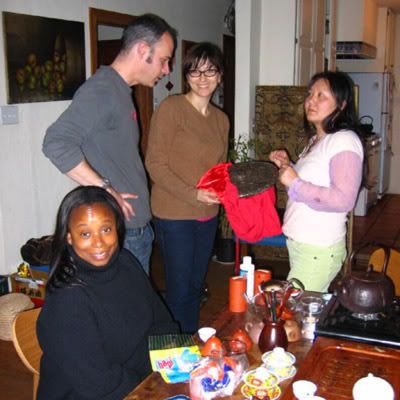


Though my blog has been static lately, I have actually been quite active within the tea and wine blogospheres. I enjoy visiting other blogs to leave some thoughtlessly written comments just because. The collective online knowledge and wisdom of those who are passionate about tea and wine are immense! I've learned so much from consuming their writings and personal opinions. They never fail to freshen my perspectives.

Some of the interesting happenings lately within the tea and wine blogospheres:
1. Bearsbearsbears
made his own pu'er tea cakes (35kg of them!)...
2. And
he wrote an article for the 2nd issue of The Art of Tea magazine, too!
3. Brent, a
Tea Nerd (like me!), made me realize that, unlike in wine, tannins is not what makes tea feels puckery. Mr. Sanwar M. Changoiwala's excellent article on Chadao about tea and polyphenols confirmed this as well. So I guess it will be "polyphenolic" instead of "tannic" from now on when I describe tea.
4. Imen of
Tea Obsession is opening a tea lounge!
5. Houde Asian Art
raised their pu'er prices...again.
6. Various discussions about the current state of pu'er price inflation (
MarshalN, LJ, Tea Drunk).
7. Eric Asimov, the chief wine critic for the NY Times, contemplates on the topic of how
technology changed the art of winemaking (is it still natural?)


As a result of my blogger's block (as in writer's block and nothing to do with China's overzealous censorship), this piece of news had likely become stale. But here it is anyway.

Two Saturdays ago I met three new tea friends: "Estif", who came down from San Francisco for the Easter weekend, Imen, who I have communicated with many times before, and T, who is a friend of Danica. The gracious host was Danica, again.

I think we managed to come across as quite fanatical to T in how we discussed, slurped and comment about the teas we drank that day. Fortunately, she was very open to the new experiences, and all of us could tell that she has got a taste for fancy teas! Another convert?

[Photo (L-R): T, Estif, Danica and Imen holding a 3kg Xi Zhi Hao Lao Banzhang pu'er tea disc]
Teas we tasted:
  • '07 Ming Qian (pre-Ching Ming) Shi Feng Long Jing from Jing Tea Shop
    Lovely. Nutty and buttery with a long sweet and buttery aftertaste. 4 stars.

  • ’07 Early Spring Biluochun from Jing Tea Shop
    Good. Nutty and floral, but seemingly short on the aftertaste. I can’t say that I’m a big biluochun fan yet. 3.5 stars.

  • ’07 Spring wood-fired Nantou oolong, Taiwan from Houde
    Light, thin and not expressive enough. Floral, grassy with a soft roasted taste. Came rather short of our expectations. 2 stars.

  • '06 Highly roasted Dong Ting oolong, Taiwan from Teamasters
    Delicious, complex and balanced. One of the better roasted Taiwanese oolongs I have ever tasted. 4 stars.

  • '06 Lincang Sheng Pu’er from Teamasters
    Expressive and charming. Brewed with little leaves and long steeping time in the silver teapot. Best tea of the day for me. Alas, its very pricey for a young 2006 tea. 4.5 stars.

  • Banzhang Pu’er (tightly compressed squares), source unknown
    Strong tasting. Don't remember much else. 3 stars.

  • ’06 Hai Lang Hao Banzhang Sheng Pu’er from YSLLC
    Strong and kicked everyone's head pretty quickly. 3 stars.


  • Reverse Osmosis Water Is Not That Bad

    We used three types of water that day: Fiji (artesian), Trader Joe's New Zealand (artesian), and reverse osmosis. Danica added about six drops of some
    ionic mineral supplement into the RO water in the 1.5 liter tetsubin to an excellent result! The supplemented reverse osmosis water was actually as good as or better than the expensive Fiji and New Zealand artesian water. More testing and comparing still need to be done, however.


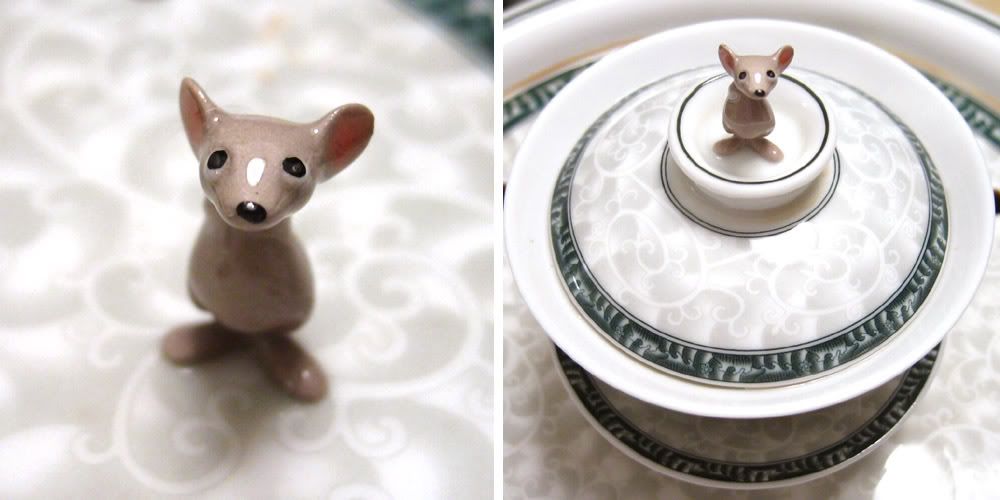
    Lastly, please meet my new ceramic tea friend. It's made by a miniature specialist company called Hagen-Renaker.

    Thursday, March 29, 2007

    Silver Dragon, Silver Phoenix, Oriental Beauty

    Sunday March 25th. I arrived late to be greeted by Danica, Jonathan, Louise and Will. They were already in mid-session of tasting a Wuyi rock oolong called the Thousand Sweet Miles. Feeling comfortable, I immediately slinked right in and joined the fun at the table. The tea was sweet smelling, floral and honey. It was also mellow and smooth with only a bit of roast. I liked it. This sample came from Best Tea House’s British Columbia (Canada) branch and costing C$112 per 100gr. Quite steep. We couldn’t figure out what this Thousand Sweet Miles is called in its original Chinese tea nomenclature (anyone?).

    And then there is Stéphane Erler’s silver teapot -- Now Danica's.

    Danica unleashed the silver beauty from its original packaging only moments before I showed up. It was its own feature debut! One side of it is embossed in dragon. The other side’s embossing is of a phoenix. Rather surprisingly to me, it felt very solid, thick, substantial and balanced! From all the pictures that I’ve seen in Stephane’s blog, I (incorrectly) assumed that the teapot is thin and light. A lot of sterling silver (995) went into the making of this pot. When I brewed a tea with it, the pour was smooth and it did not drool or leak from its lid. It is an excellently made teapot overall. Well, for the precious material used and the high price one has to pay for it, it better be.

    Tieguanyin Tea: Silver vs. Clay
    Having never been used before, Danica rinsed its inside – which looked matted and resembled more of white oyster pearl than silver – with boiling water straight from her tetsubin. Then she asked Will to take over the helm. Will decided to brew a Tea Gallery’s qingxiang tieguanyin. Nosing the first brew (second after rinsing), Louise’s sensitive nose detected a certain metallic smell and taste. Others concurred. Jonathan said it could be psychosomatic. We asked each other whether the pot ought to be washed thoroughly first under the sink. We decided not to, unless somebody dropped on the floor writhing in pain. The second brew did not have as much of that metallic taste. Probably it’s the tea.

    After 3 or 4 rounds, we decided to brew the same tea using a hongni clay Yixing pot. The result was noticeably different, although Louise again detected some metallic smell in the first brew. Must be the tea then. Coming out of the silver teapot, the tieguanyin had a hard and crisp edge to it. From the Yixing pot the tea felt more rounded and, well, not crisp. I remember Jonathan sharing this opinion and liking the tea from the Yixing better. So did I.

    As an amateur photography hobbyist, an analogy that I can think of is that of a person being photographed with a direct, undiffused strobe light vs. with a bounced and diffused strobe light. The former is what the silver pot would produce in a manner of speaking. If this analogy is correct, then only model teas can withstand the unflattering effect of this silver being and come out beautifully. In my opinion, this tieguanyin test suggests strongly that a Yixing or a gaiwan is not replaceable by a silver unless one only brews exceptional tea every time. It is a teapot that you whip out to showcase your best teas and/or to impress and honor your guests with. It works well as a status symbol, too. You get instant credibility as a tea connoisseur brewing with it.

    A Beautiful Oriental
    After Will, Danica gave me the high honor of sitting on the brewer’s chair to handle a very special tea. I politely declined but she insisted, so I relented. A gift from Stéphane to Danica was 4gr of a rare Oriental Beauty oolong, which he himself was only allocated a mere 25gr. Allow me to summarize by saying I would kill for his 21gr. I kid you not it’s that good. I would rate it 5 stars. It’s so exotically perfumed with an aftertaste to die for. An hour after my last cup I could still taste it in my mouth. Stéphane said in his email to me:

    “It was made by a farmer in Nantou: only 1.2 kg, if I remember well. It is the most precious tea from that farmer (a tea he did to push the limits of quality, not a tea made for sale). Extremely high quality and very expensive to make. A rather low oxidation for OB. The tea vendor I got it from said it was a white tea, but several tea friends/experts had a look at it and we all agreed it was an Oriental Beauty with low oxidation.”

    I was actually surprised by how greenish-white the resulting liquor was. I never had an Oriental Beauty with such a color before. The tea has a vivid spicy floral perfume and a lasting aftertaste. Looking at the leaves inside the silver pot, they were entirely made of dark green-colored buds (one flag, one spear).

    After only 3 cups of this memorable tea, I had to excuse myself and leave to pick my family up for a meeting at the Descanso Gardens with some relatives and friends. Any day I learn and experience something new is a good day. That Sunday was one of them. The only thing infinitely better than brewing with this exquisite shiny pot and tasting the special Oriental Beauty tea was the company I enjoyed them with.

    My huge thanks go to Danica and Jonathan for hosting the meeting and for the special memory of that day. I feel very fortunate and privileged.

    [Photo of wet leaves by Will]

    Sunday, March 18, 2007

    St. Pat's Weekend Notes

    Ah, spring is in the air! I’m sure you’ve noticed that tea vendors are offering the spring harvest already. Long Jing, Taiwanese oolongs, Mengding, etc. While I’m not a Japanese tea drinker, word on the street is that Shincha has already come out or about to. So much good tea…very tempting!
    Unlike tea plantations, however, the grape vines are only budding right about now…there is still 5 to 6 months before harvest time. That doesn’t mean wineries aren’t buzzing. The good people of the grapey clan are busy re-racking or bottling the harvest of yesteryear(s), not to mention tending the vines.

    I had a pretty nice weekend. Among other things, I dim-summed at the Empress Pavilion in Chinatown with the family (my younger sis joined). Loads of good dumplings! As usual, I brought my own tea…and this time instead of bringing some fisted oolong, I decided to take the Okayti Ivory Darjeeling oolong that I wrote about a few posts down. It was way much better than the restaurant’s tea to no one's surprise. I found out that this particular Darjeeling oolong is actually quite excellent when paired with dim sum dishes. Think of riesling or gewürztraminer with Chinese food, only this is tea. The fact that it is slightly more acidic (lively!), highly aromatic and it can take brewing abuse well, made the tea suitable in restaurants. When placed in a standard Chinese restaurant porcelain teapot and brewed over a long period of time, it didn’t get bitter and it remained pretty smooth.

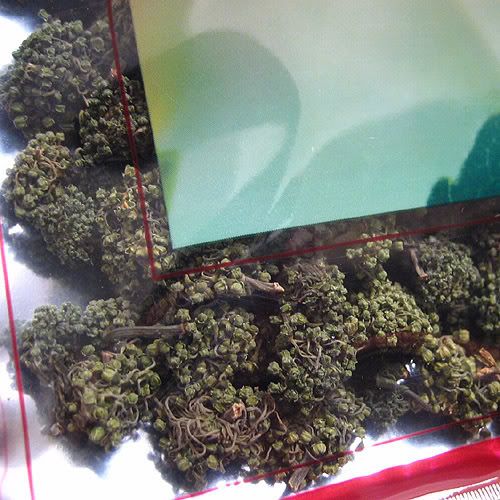
    After dimsum, we stopped by Wing Hop Fung where I bought 2 teacups to replace the broken ones. I also got some dragon pearl jasmine tea for my mom-in-law. While browsing around, something caught my interest. Among the Soumei and Baimudan teas, there was this green herbs that is labelled as "Yunnan Thien Ji tea" (it's not tea tea, but rather a type of herb). They look like tiny brocolli florets and fresh green in color. Two customers were chit chatting with the saleslady about this very thien ji. They were speaking in a Chinese dialect that I couldn't understand (Teochew?) when I approaced the saleslady, who recognized me from my prior visits and invited me to try the "tea" out. It's bitter-sweet in an herbal kind of way...almost like ginseng. I can't really describe it. It's not bitter like kudingcha and it leaves a certain pleasant aftertaste. The saleslady and the 2 customers proceeded to tell me to only put about 7 "flowers" if I want to drink it straight. It can be mixed with other teas as well, they said ("Don't put too much, though," they added). So I grabbed 2 oz of this herb, which cost me about $3.50. I took the photo above at home...haven't opened the sealed bag yet. I will write about it when I try it again. Does anyone know what this is and how to treat it right?

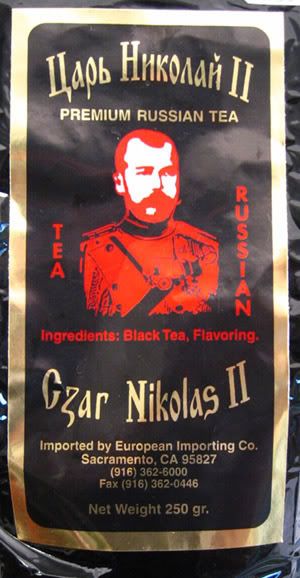
    On the way back we stopped by a Russian grocery store for some everyday staples (sosisky, kevir, kalamata olives, etc.) when I found this (see pic, click to enlarge). My curiosity cost me $4.99 for the 250gr bag. When I opened it at home, the loose smallish, black leaves reeked of menthol / eucalyptus / mint. Very strong! I kid you not when I say it smells like a mosquito or insect repellant that is made from a certain tree oil that you can apply on your skin. How does it taste? I am still summoning the courage to brew it. Somehow, I think it’s beter suited as a bathroom deodorizer or a closet moth repellant. It smells toxic to me.

    Hope you had a fun St. Pat's weekend!
    Wednesday, March 14, 2007

    More Darjeeling Oolong's

    Prior to hosting the online Darjeeling oolong tasting at T Ching (see Feb. 28 post), I purchased 2 teas of the same origin and genre. Call it a prep or research, if you will. They are named the Okayti Ivory and the Hillton Ebony.

    With these 2, I now have (only) tasted 5 different Darjeeling oolongs (3 with T Ching). Each one was quite different from another, which I found to be quite fascinating considering that they sprang from the same region. Still, there are common denominators among them. These are my impression and what I found to be the common characteristics among the 5 Darjeeling oolongs I tasted.


  • Incredibly lovely, complex nose. Of muscatel and various tropical fruits – the yellow types, such as mango, peach, and star fruits (I’m a big fan of riesling and gewürztraminer, by the way)
  • Brews an amber to brown / red-colored liquor
  • Impecabble crystal clear clarity
  • Soft(er) and smooth(er) than the 1st flush teas, yet less robust in taste than most 2nd flush teas
  • Short on the aftertaste

    The 2 oolongs below were purchased from Wild Orchid Teas. The vintage year is not mentioned by the vendor. My guess is they are 2006 teas, though I can’t be sure which season they were harvested in.

  • Okayti Ivory Oolong, Darjeeling, India

    Excellent looking dry leaves. Twisted lengthwise and mostly whole. Evenly and generously downed with white fur. Nose is complex but more subdued and subtler than the other 4 Darjeeling oolongs…of mango, muscatel, peach…a mix of tropical fruits (common Darjeeling nose). The tea also tastes subtle and quite fragrant. Light to medium body. Short aftertaste. Quite charming and especially nice when in the mood for a subtler tea. 3.5 stars (g - vg)


    Hillton Ebony Oolong, Darjeeling, India

    I have depleted my entire 100gr of this tea. I brewed it in many ways: in a small gaiwan (gongfu), in a large pot, straight in the cup, iced, not iced, etc. It is a good and pleasant tea for everyday, everyway. This is one tea that I consider having as a staple for fuss-free enjoyments.

    Closer to being a black tea (“red tea” in the Chinese tea category), it is highly oxidized. The nose resembles a fully oxidized 2nd flush tea, though slightly softer and fruitier. The liquor brews quite red when done in a gaiwan. (Otherwise, it is medium amber/brown in a 5-cups Bodum teapot with ~4 teaspoons of leaves). Tastes more robust than the other 4 teas. Quite smooth and not tannic. Refreshing and good tasting with ice! A very versatile tea that can withstand abusive brewing methods, yet delivers a pleasant enough taste. Does not break the bank ($12/100gr). 3 stars (g)

    Wednesday, February 28, 2007

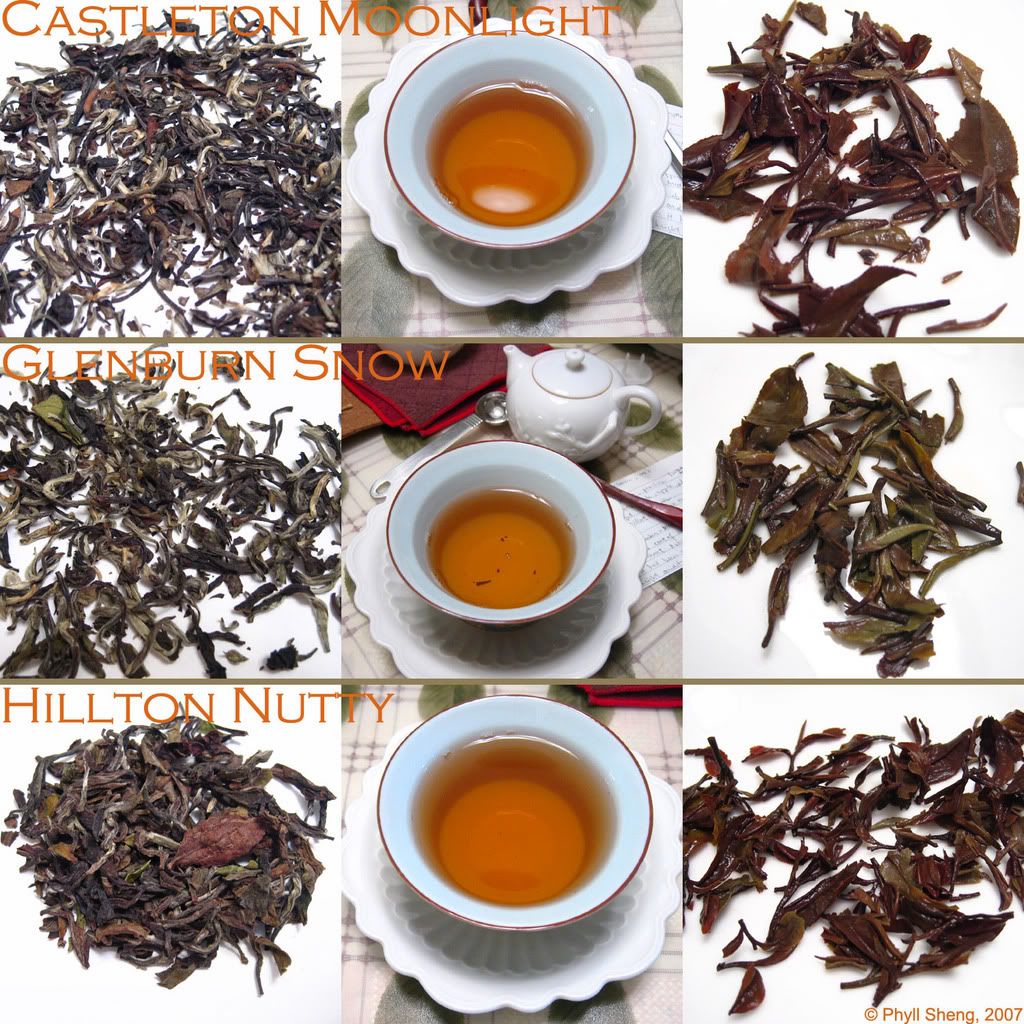
    T Ching's 1st Online Tasting: Darjeeling Oolongs

    CLICK ON THE IMAGE FOR TASTING NOTES

    Click here for the high resolution images.

    Thursday, February 15, 2007

    My First Darjeeling Oolongs

    In anticipation of the T Ching online tasting event, I purchased 100gr of Hillton Ebony and 50gr of Okayti Ivory -- both Darjeeling oolong teas -- to experiment with from Wild Orchid Teas in Sylvania, Ohio. Thanks to Mr. Ankit Lochan who recommended this excellent vendor.

    The Okayti is lightly oxidized, while the Hillton is highly oxidized. Both are only partially oxidized in order to achieve the "oolong" designation. Several sources recommend using 1-2 tsp of dry leaves with 6 - 8 oz of boiling water in a pot for 5 minutes. So I brewed the Okayti following the tea:water:time ratio recommendation in a small porcelain pot. Also, I used a small gaiwan filling it 1/2 full of dry leaves and brewed the tea in short (seconds), multiple infusions.

    How was the tea and which method yielded a better brew? I can't say for sure yet, though the Okayti Ivory is quite an aromatic and smooth tea by nature, whether brewed in seconds or in 5 minutes. More experimentation to be done with the Hillton Ebony as well.

    Friday, December 1, 2006

    Trip to San Diego

    Sorry for the recent lack of update. The blogger beta just went nuts on me for the past few days and it still is. The formatting feature is gone, somehow, so I'm posting this using html, which requires a bit of a learning curve on my part.

    The family (me, my wife, baby girl, and wife's parents) spent the Thanksgiving week in San Diego, which was nice. The weather is slightly cooler this time of the year in SD, but it could still pass as beach weather all the same. It was a casual trip with no preconceived mission for wine / tea drinking or any serious tasting notes.

    On the way to our hotel in Pacific beach (next to the famous La Jolla beach), we stopped by Carlsbad to lunch at the Bellefleur Winery and Brasserie. The restaurant is also a bonded winery that makes wines under their own label. Since I was driving, I didn't order or bothered to buy any of their wine to go. The restaurant/winery was serving their Sunday Champagne brunch buffet, so they poured for us refill after refill of semi sweet (oxymoron alert!) Californian Champagne. Technically, it was a Sunday Californian sparkling wine brunch, but that doesn't sound as catchy, does it? At first I didn't get why the waiter poured the "Champagne" only halfway the flute, until the unannounced orange juice came. Aha...Mimosa! Go on ladies and gentlemen, load up on sugar and alcohol before you head to the buffet tables! The buffet selections were wide and varied. At $20/head I thought it was quite a good deal...a buffet like this in Las Vegas would probably have cost more.

    We rented 2 cottages at the historic Crystal Pier Hotel where we literally slept above the lapping waves. The view from our private patio was just amazing, especially at sunrise and at sunset! The cottages are nice, too. Everything is clean and feel newly renovated with a comfortable large bed. The feature we liked best as young parents traveling with a kid is the full size kitchen. We could make food for our daughter in the comforts of our cottage before heading out to tour the city. And did I mention the view was great?

    (Click to enlarge picture of the view from our patio. My baby and dad-in-law.)

    I decided not to pack my tea set with me but just bring along 3 types of tea in stainless steel canisters: the Hong Shui oolong from Houde, the Spring 2006 Da Hong Pao from Teaspring, and the jasmine dragon pearls that my wife so loves. Since I brought with us a few bottles of wine in an ice box, and that we are not light travellers, the tea set had to give way, unfortunately. I should probably buy a small travelling set. It wasn't ideal, but I was able to improvise and managed to get decent cuppa every time.

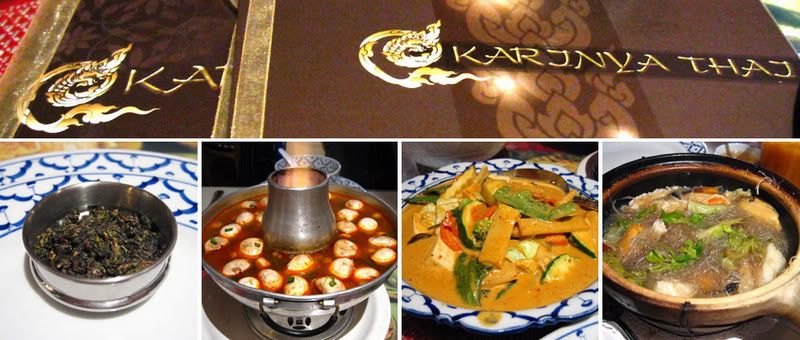
    On one cool, foggy night we dined at a Thai restaurant called Karinya nearby our hotel. The food was good and the spices was just what we needed to warm up our bodies. Every dish had a touch of homemade feel to it, which I appreciated. The price is a tad high since they are located in a high rent district (on Garnett Street, which is the main retail and commercial vein leading to the Crystal Pier). I forgo ordering from the wine list, though the Ch. Ste. Michelle Gewurztraminer would be a good match for the dishes we had. Instead I just asked for a large pot of hot water for brewing the Hong Shui oolong that I brought along in my backpack.

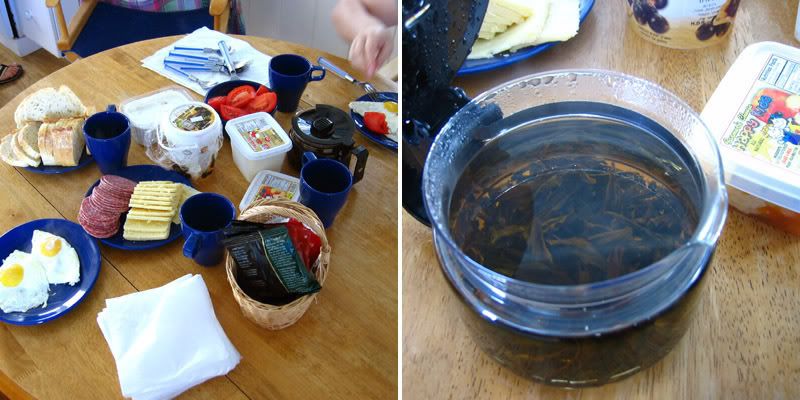
    For breakfasts in our cottage, I brewed mostly the Da Hong Pao in the hotel's coffee pot. As long as I was careful not to overbrew it, the tea was quite good. Everybody liked it and I thought the tea went quite well with the eggs, cheese, sausage, bread, jam and tvorak (a sort of Russian cottage cheese). Fellow tea purists, please don't crucify me for brewing DHP in such a way and for drinking it with food. :)

    After coming back from the zoo, the Sea World, and what not (yes, this trip was about entertaining and showing our baby "the world"...not really for the adults) we usually spent the rest of the day at the beach below our hotel or just hang out in our private patio with a glass of wine (or two or three). I'm glad to have brought the wines myself because we do spend a fair amount of our time in our cottage, with the little one's nap and meal schedule. I just didn't have time to look for a proper wine store in the area. Some of the wines I brought and opened:

    N/V Billecart-Salmon Brut Champagne
    ($40) Fine mousse and bubbles. The nose is of sharp citrus and grapefruit. A little tight and needed decanting to soften it a bit, but I didn't have any workable decanter with me. The taste reflects the nose plus a hint of green apple. It's a mezzo-soprano of a Champagne. The finish is rather swift.


    2004 Bodega Norton Reserva Malbec, Mendoza, Argentina
    ($15) We opened this one night while watching The Da Vinci Code on DVD in our cottage. Both the movie and the wine came up short. This Malbec bottling was mellow and rounded but lacked acidity, so it tasted flabby. An overall earthy wine with a somber note of blackberry. Rather depressing, actually, despite that it came highly recommended by some Winexilers.


    2003 Joh Jos Christoffel Riesling Spatlese, Urziger Wurzgarten, Mosel-Saar-Ruwer, Germany
    ($25) Simply lovely! All the characters of a balanced Mosel Riesling in play: yellow fruits, rocky slate minerality, acidity and sweetness. A polished, detailed, juicy and delicious wine. The sweetness is a bit high for a Spatlese, which is a typical character of the hot weather in 2003.


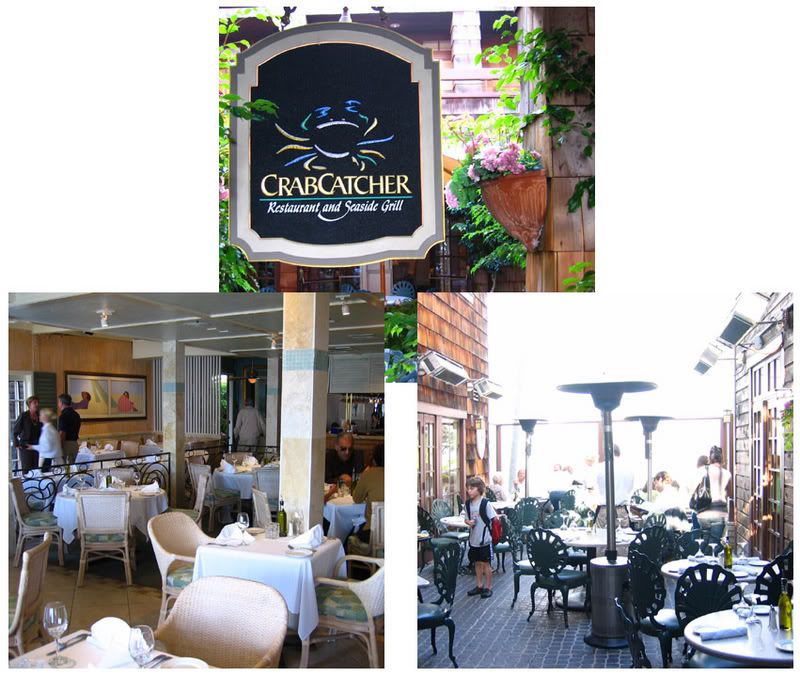
    On the way home to LA, we lunched at an upscale looking white-linen restaurant called The CrabCatcher. The restaurant looked very nice and expensive, and it came complete with a snobbish lady maitre'd (perhaps because I had a little baby with me...a sign of potential mess and noise, which exactly what happened). Anyways, we were sorely disappointed with the quality of the food given the price, location and the manicured look of the restaurant. We ordered the crispy calamari as an appetizer, and for the entree we had the shrimp scampi, a $10 burger, the fish of the day (sea bass) cooked with a spicy salsa-like sauce ($24) and the Cioppino. The premium pricing was expected given the ambience and location of the venue...too bad the food didn't live up to the expectation that they themselves created, however. The service was gracious, I should note, so I still at least left them a generous tip at the end of our meal.

    Their wine list was OK...they seem to have chosen their CA Pinot Noir and CA Cabernet Sauvignon selections with the recent trend in mind (Williams Selyem, Sea Smoke were 2 PNs I remember seeing on their list). The Champagne choices were good, too. Everything else other than those three wine categories felt like they are there only for the sake of having something on their wine list...not particularly exciting. As on the way to San Diego, I didn't order any wine again since I was the driver (I really wanted to order the Sea Smoke Pinot Noir, but nobody felt like having wine with their lunches, and it didn't come by the glass). So I just had two glasses of Anchor Steam beer, which was nice. After the dissapointing lunch, we walked around La Jolla a bit until the alcohol effect subsided before we headed back home; a journey that involved an excruciating 7 hours of heavy traffic.

    To be continued...Thanksgiving dinner and a picnic with friends.

    Thursday, October 5, 2006

    TN: 2006 Meghma Garden Oolong, Kalikhop Valley, Nepal

    2006 Meghma Esate Nepalese OolongSource: The Simple Leaf
    $15 / 4oz

    Here is a pleasant tasting and highly aromatic oolong from Nepal. It’s certainly a new kind of animal for me! From observing the dry leaves, this oolong looks and smells like a good second flush Darjeeling tea of BOP (Broken Orange Pekoe) grade mixed with some OP (Orange Pekoe) grade. It smells like a mix of tropical fruits (mango, peach, citrus, orange peel), muscatel and floral honeysuckle.


    I brewed this tea in several different ways to see how it reacts to different brewing methods: “gongfu” method with a gaiwan (lots of leaves, short infusions), “English” method in a porcelain teapot (little leaves, long infusion time of >3 minutes), as well as “office” method (vacuum thermos, little leaves, daylong brewing). I found the “middle path” method to be my personal choice for this tea. Middle path in this case is a method between the gongfu and the English styles where I use my larger (~400ml) Yixing pot, ~2 tablespoons of leaves, and medium infusion time of about 45 secs to 1 minute for each brew. Let me explain why.

    I felt that the gongfu method yields an intense brew but not quite an aromatic liquor, as if the tea’s perfume did not have enough time to infuse itself out. The English method yielded a tea that I thought was a bit too acidic for my taste, and so does the office style especially after several hours in the thermos (although the nose is very vivid and appealing). As such, the “middle path” brews a tea that is not too acidic, yet smooth, perfumy with a hint of honey aftertaste.

    The Simple Leaf provided this
    background information about the producer and the tea's characteristics.

    “It exudes the aroma of the native Daphne bholua and Rhododendron plants. With a light and smooth liquor and a trace of honeysuckle flavor …. Founded in 1999, Meghma Garden is in the Kalikhop valley in the Ilam District in the far northeastern corner of Nepal. Nestled in the lap of the mighty Himalayas, Meghma Tea Estate is situated at an altitude of 7,000 feet, far away from the modern world. This makes it one of the highest tea growing areas in the world. This small estate produces hand-rolled all-natural teas."

    What I still don’t understand about this tea is the description of “hand rolled” in the product information. Is this definition identical to when one refers to pellet-shaped (fisted) Chinese oolong leaves? The leaves of this Nepalese oolong certainly are not fisted. Or perhaps “hand-rolled” means differently when we are discussing Indian and Nepalese tea processing techniques? Does it perhaps mean the leaves were “bruised” by hand and not by a machine?

    Another observation is that the picture of the tea on The Simple Leaf’s website looks much greener and more colorful than what I received. Has it been further oxidized during storage and so it lost its color vibrancy? The Simple Leaf claims that the tea was harvested in early August of 2006, which is only 2 months since this tasting note was written.


    Overall, a pleasant tasting and aromatic everyday kind of tea. Due to its shape and size, this tea is quite sensitive to infusion time. I agree with whoever said it would make a very refreshing iced tea, though I think serving it warm brings out its charms better.