Showing posts with label Darjeeling. Show all posts

Sunday, June 22, 2008

Weekend Dim Sum & 2 Indian Teas

Going to a dim sum usually means a time out with the family, lots of dumplings, chicken feet (love 'em!), and light conversation over many cups of tea. Whenever we do that, I prefer to bring my own tea leaves from home to be brewed in lieu of the restaurant's, which is more often than not lower in quality (passable, but...).

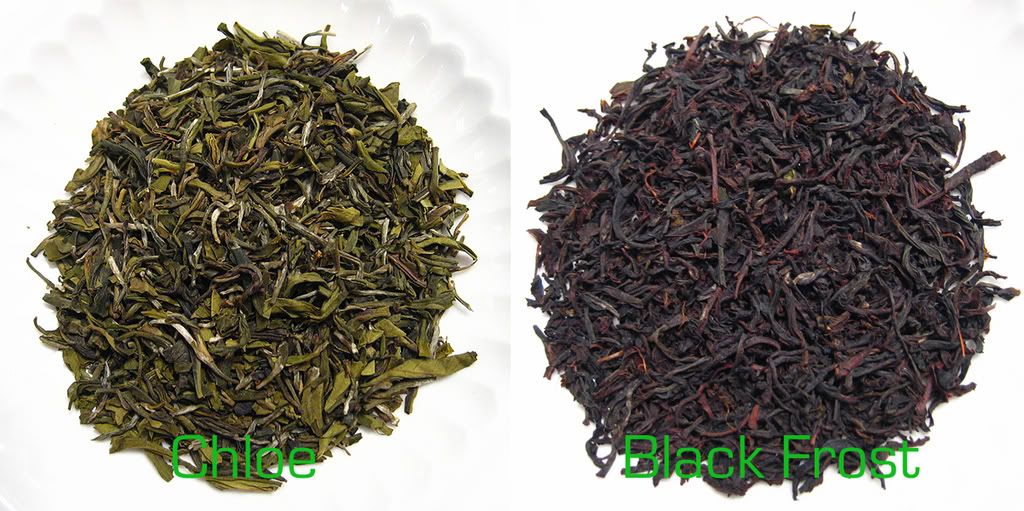
This morning, I brought along 2 tea samples that I received from The Simple Leaf (thanks Nikhil!). One is a single estate green tea from Darjeeling that is sold under the code name "Chloe". The other is called "Black Frost", a black tea from the Nilgiri Mountains in the Tamil Nadu state, South India.

I simply asked a waiter to bring two pots of hot water. Pre-rinsing the leaves, however, was a challenge without a lidded bowl, so I skipped that part and just tossed a handful of leaves straight into the pots. Now and then, I asked for more hot water to be added into the half-full teapots when I saw that the teas were getting too concentrated and starting to taste bitter.

Chloe, the green tea, is a rather different and interesting sort of Darjeeling for me. As far as I can remember, it's the first green tea I've had from Darjeeling. It’s subtle with spicy, minty qualities. An introverted sort, if you must, for one who has a sexy French name. The Black Frost, which I am partial of, is smooth and slightly malty with a bit of natural sweetness. In contrast, Black Frost is the extroverted masculine type. Of the two, I thought Black Frost was the more versatile one with the foods today.
(click to enlarge pictures)

In fairness, 1st and 2nd flushes Darjeeling teas do have pleasant acidity that makes them great companions of foods, especially spicy ones. Chloe, being a green Darjeeling, however, has completely different characteristics than its 1st and 2nd-flush relatives.

Reviewing the restaurant bill at home, I wonder why they still charged me $3.20 for my own teas!

Thursday, August 30, 2007

2007 Doke White Tea, Kashanganj, 2nd Flush

Doke Tea Farm

While I enjoy subtler teas occasionally, I often find myself shying away from most white teas because I find them to be too delicate for my taste. So when T Ching featured this Indian white tea as part of its August online tasting, I reserved my opinion until I tasted it.

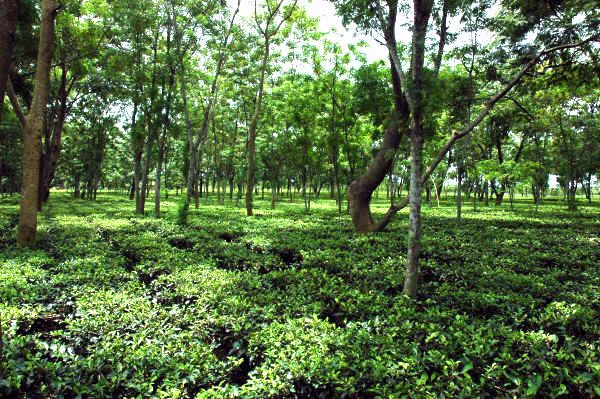
From Doke Tea in Darjeeling comes this 2nd flush white tea from the Kishanganj district of north eastern Bihar. This was to be my first white tea from the Darjeeling region, and it was a truly pleasant encounter.

The faces of Doke Tea (at least on the internet) have been its proprietor Mr. Rajiv Lochan and his nephew, Ankit Lochan. Before this tea, however, I have never known about Doke's own product line. This is partly because in addition to managing Doke, the uncle-nephew team is also in the wholesale business of other producers' teas through their Lochan Tea Limited enterprise. T Ching has in the past featured selections from the Lochan Tea Limited’s portfolio.

In addition to being in the tea business, they also manage a charitable organization, The Indus Foundation, which aims to improve the living conditions of the surrounding local districts.

Tasting Notes

2007 Doke "Kashanganj Snow Bud"
White Tea, 2nd Flush, Organic
Output: 50 kilograms per annum
Available for sale at T Ching Store

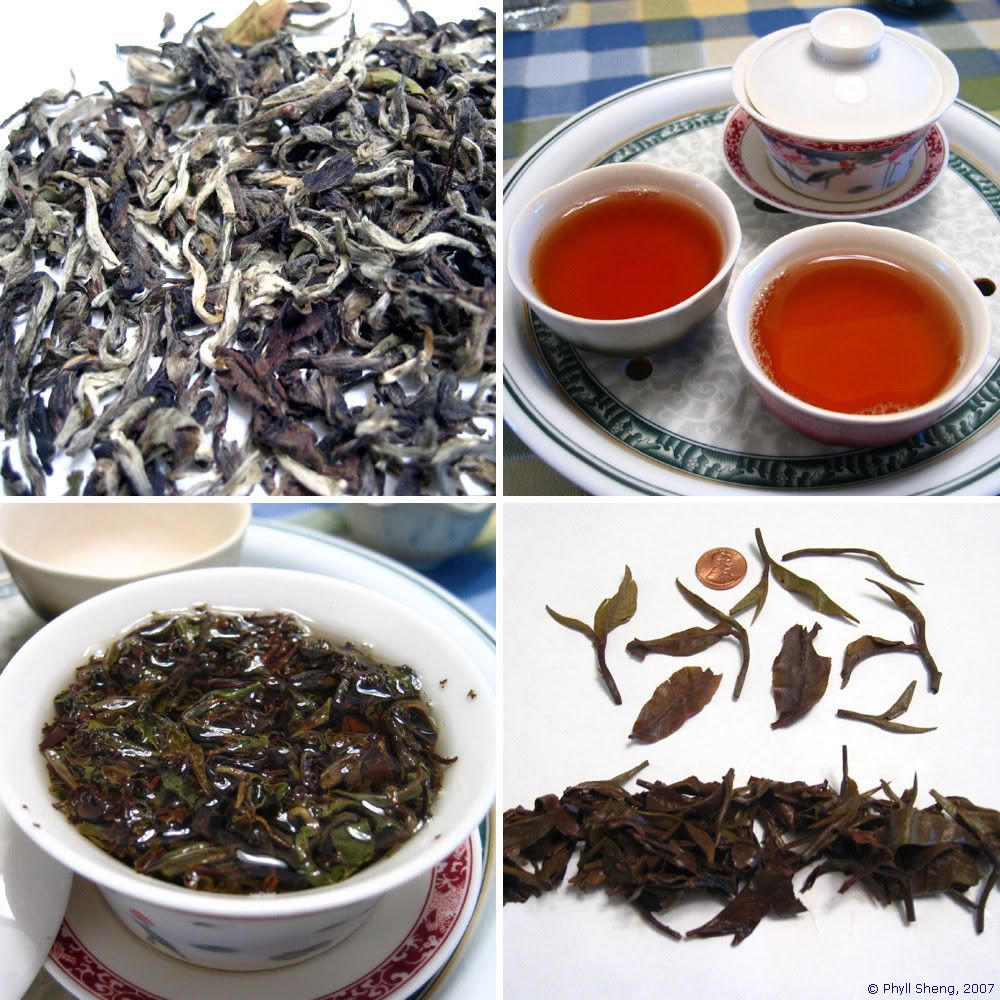
Dry leaf's appearance: Whole buds. Medium green and silver in color due to being covered in silvery down.

Nose: Refreshing. Of muscatel, passion fruits and exotic spices.

Taste: This Kashanganj white tea delivers a more upfront and assertive nose and taste than any Chinese white teas I have ever tasted. One smell and you can't miss that Darjeeling signature muscatel quality. Slightly grassy. The high notes and the judicious amount of acidity is refreshing and lively, giving oneself an energized feel after drinking it. It is medium to full bodied and smooth. Plenty of astringency and a touch bitter if brewed in a higher temperature water (90' C and above). The aftertaste is lingering and sweet in the back of the throat.

Wet leaf's appearance: Dark green with red streaks that indicates some oxidation was allowed to happen before halted.

Overall impression: This is a fine white tea with the unmistakable Darjeeling characteristics. It is also a white tea that stands well to high temperature brewing (> 90’C), as long as it is given a much shorter steeping time. Based on quality of the white tea sample that I received, I dare say that it is a tea worth pursuing and watching for in the future.

One of the attributes of Darjeeling tea that I find very pleasing is its acidity, which seems to bring liveliness to a tea. It also makes the tea highly compatible with many types of food, especially the rich tasting ones, by providing a juxtaposition of tastes.

4+ stars (vg - ex)

The following excerpt is by Mr. Rajiv Lochan:

On 1st June 1999 Indian Tea Board declared Kishangunj district of north eastern Bihar as a non-traditional tea growing area, though we had started planting tea little earlier in 1998 in Pothia block of this district.

Last month I was called by the Deputy chief minister regarding land and labour policy matters and came to know that Kishangunj was known as “poor man’s Darjeeling” since people who could not afford to go to Darjeeling in olden days could enjoy the beauty of Kanchenjunga from a little distance, that is Kishangunj.

Doke plantation, where these teas are grown is south of Jhapa and Illam districts of Nepal and south west of Darjeeling and snow capped mountains are about 25 kilometers as the crow flies, though the foothills are only 7 kilometers away. On a clear day one can have a panoramic view of Himalayas and if one is lucky evening setting sun lights up Mount Everest to be visible from Doke.

We have found burnt clay pottery broken pieces buried as deep as two feet all over the planting area and a legend says that during the ancient times of Virat kings who had Viratnagar as their capital and Thakurgunj as their river port on the banks of Mahananda river, there was a potters village in this location, which legendary Shrawan Kumar visited along with his blind parents and stayed overnight.

Bihar being the land of Buddha and full of ancient history, it seems history is repeating itself here in Doke and we wish to make full use of it."

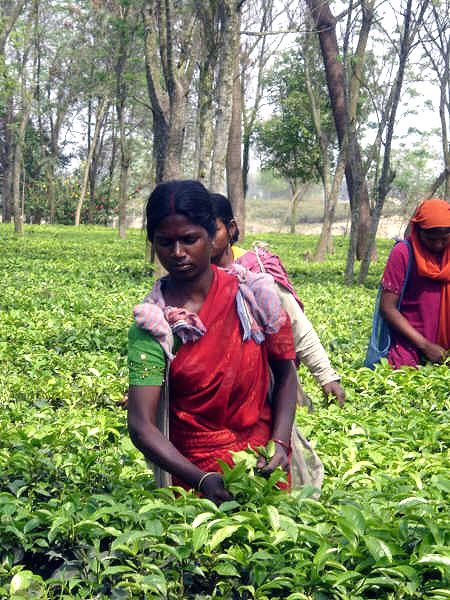
Images, with the exception of the tasting session photos, were provided by and used with prior permission from Mr. Ankit Lochan of Doke Tea.


Other excellent reviews at: MarshalN, PalatabiliTEA, Perplexitea, T Ching

Sunday, March 18, 2007

St. Pat's Weekend Notes

Ah, spring is in the air! I’m sure you’ve noticed that tea vendors are offering the spring harvest already. Long Jing, Taiwanese oolongs, Mengding, etc. While I’m not a Japanese tea drinker, word on the street is that Shincha has already come out or about to. So much good tea…very tempting!
Unlike tea plantations, however, the grape vines are only budding right about now…there is still 5 to 6 months before harvest time. That doesn’t mean wineries aren’t buzzing. The good people of the grapey clan are busy re-racking or bottling the harvest of yesteryear(s), not to mention tending the vines.

I had a pretty nice weekend. Among other things, I dim-summed at the Empress Pavilion in Chinatown with the family (my younger sis joined). Loads of good dumplings! As usual, I brought my own tea…and this time instead of bringing some fisted oolong, I decided to take the Okayti Ivory Darjeeling oolong that I wrote about a few posts down. It was way much better than the restaurant’s tea to no one's surprise. I found out that this particular Darjeeling oolong is actually quite excellent when paired with dim sum dishes. Think of riesling or gewürztraminer with Chinese food, only this is tea. The fact that it is slightly more acidic (lively!), highly aromatic and it can take brewing abuse well, made the tea suitable in restaurants. When placed in a standard Chinese restaurant porcelain teapot and brewed over a long period of time, it didn’t get bitter and it remained pretty smooth.

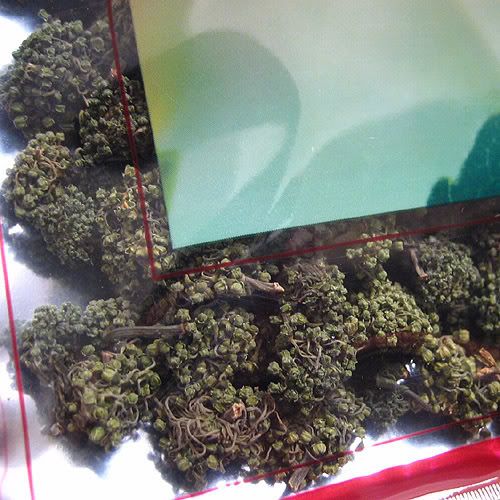
After dimsum, we stopped by Wing Hop Fung where I bought 2 teacups to replace the broken ones. I also got some dragon pearl jasmine tea for my mom-in-law. While browsing around, something caught my interest. Among the Soumei and Baimudan teas, there was this green herbs that is labelled as "Yunnan Thien Ji tea" (it's not tea tea, but rather a type of herb). They look like tiny brocolli florets and fresh green in color. Two customers were chit chatting with the saleslady about this very thien ji. They were speaking in a Chinese dialect that I couldn't understand (Teochew?) when I approaced the saleslady, who recognized me from my prior visits and invited me to try the "tea" out. It's bitter-sweet in an herbal kind of way...almost like ginseng. I can't really describe it. It's not bitter like kudingcha and it leaves a certain pleasant aftertaste. The saleslady and the 2 customers proceeded to tell me to only put about 7 "flowers" if I want to drink it straight. It can be mixed with other teas as well, they said ("Don't put too much, though," they added). So I grabbed 2 oz of this herb, which cost me about $3.50. I took the photo above at home...haven't opened the sealed bag yet. I will write about it when I try it again. Does anyone know what this is and how to treat it right?

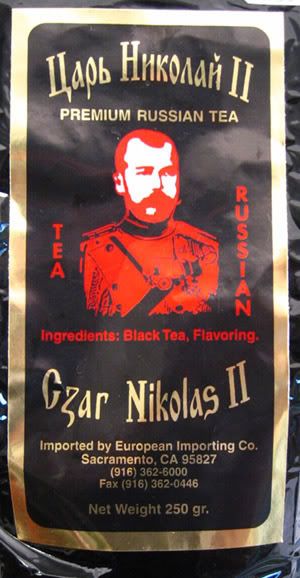
On the way back we stopped by a Russian grocery store for some everyday staples (sosisky, kevir, kalamata olives, etc.) when I found this (see pic, click to enlarge). My curiosity cost me $4.99 for the 250gr bag. When I opened it at home, the loose smallish, black leaves reeked of menthol / eucalyptus / mint. Very strong! I kid you not when I say it smells like a mosquito or insect repellant that is made from a certain tree oil that you can apply on your skin. How does it taste? I am still summoning the courage to brew it. Somehow, I think it’s beter suited as a bathroom deodorizer or a closet moth repellant. It smells toxic to me.

Hope you had a fun St. Pat's weekend!
Wednesday, March 14, 2007

More Darjeeling Oolong's

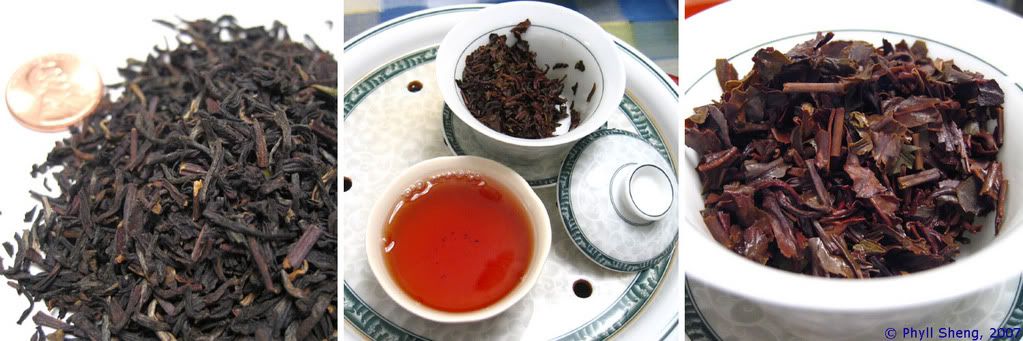
Prior to hosting the online Darjeeling oolong tasting at T Ching (see Feb. 28 post), I purchased 2 teas of the same origin and genre. Call it a prep or research, if you will. They are named the Okayti Ivory and the Hillton Ebony.

With these 2, I now have (only) tasted 5 different Darjeeling oolongs (3 with T Ching). Each one was quite different from another, which I found to be quite fascinating considering that they sprang from the same region. Still, there are common denominators among them. These are my impression and what I found to be the common characteristics among the 5 Darjeeling oolongs I tasted.


  • Incredibly lovely, complex nose. Of muscatel and various tropical fruits – the yellow types, such as mango, peach, and star fruits (I’m a big fan of riesling and gewürztraminer, by the way)
  • Brews an amber to brown / red-colored liquor
  • Impecabble crystal clear clarity
  • Soft(er) and smooth(er) than the 1st flush teas, yet less robust in taste than most 2nd flush teas
  • Short on the aftertaste

    The 2 oolongs below were purchased from Wild Orchid Teas. The vintage year is not mentioned by the vendor. My guess is they are 2006 teas, though I can’t be sure which season they were harvested in.

  • Okayti Ivory Oolong, Darjeeling, India

    Excellent looking dry leaves. Twisted lengthwise and mostly whole. Evenly and generously downed with white fur. Nose is complex but more subdued and subtler than the other 4 Darjeeling oolongs…of mango, muscatel, peach…a mix of tropical fruits (common Darjeeling nose). The tea also tastes subtle and quite fragrant. Light to medium body. Short aftertaste. Quite charming and especially nice when in the mood for a subtler tea. 3.5 stars (g - vg)


    Hillton Ebony Oolong, Darjeeling, India

    I have depleted my entire 100gr of this tea. I brewed it in many ways: in a small gaiwan (gongfu), in a large pot, straight in the cup, iced, not iced, etc. It is a good and pleasant tea for everyday, everyway. This is one tea that I consider having as a staple for fuss-free enjoyments.

    Closer to being a black tea (“red tea” in the Chinese tea category), it is highly oxidized. The nose resembles a fully oxidized 2nd flush tea, though slightly softer and fruitier. The liquor brews quite red when done in a gaiwan. (Otherwise, it is medium amber/brown in a 5-cups Bodum teapot with ~4 teaspoons of leaves). Tastes more robust than the other 4 teas. Quite smooth and not tannic. Refreshing and good tasting with ice! A very versatile tea that can withstand abusive brewing methods, yet delivers a pleasant enough taste. Does not break the bank ($12/100gr). 3 stars (g)

    Wednesday, February 28, 2007

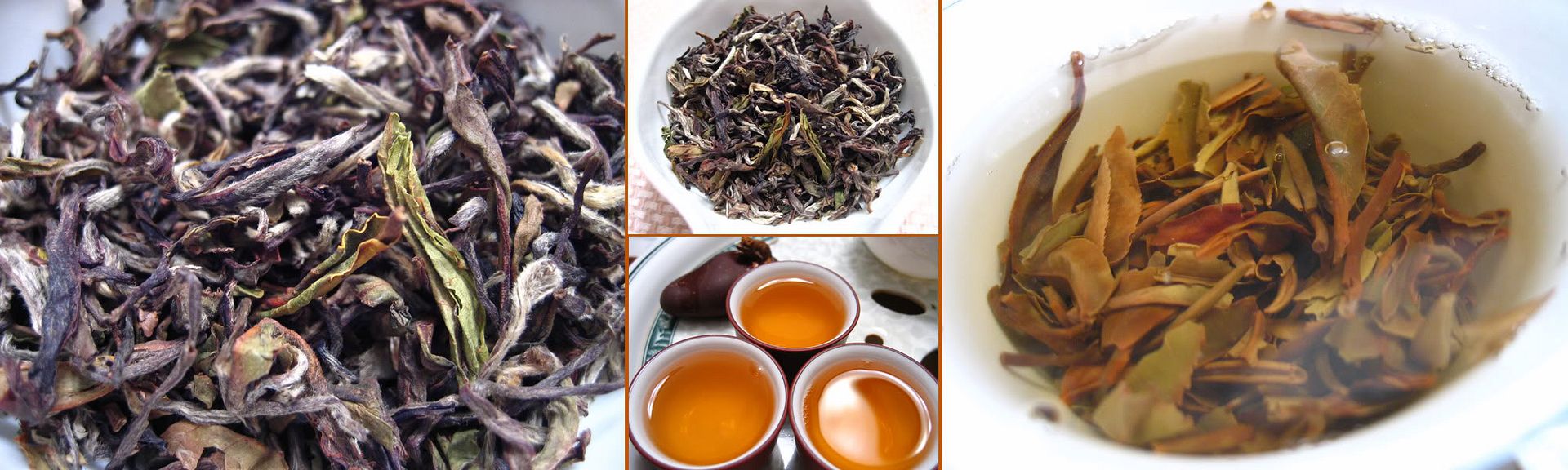
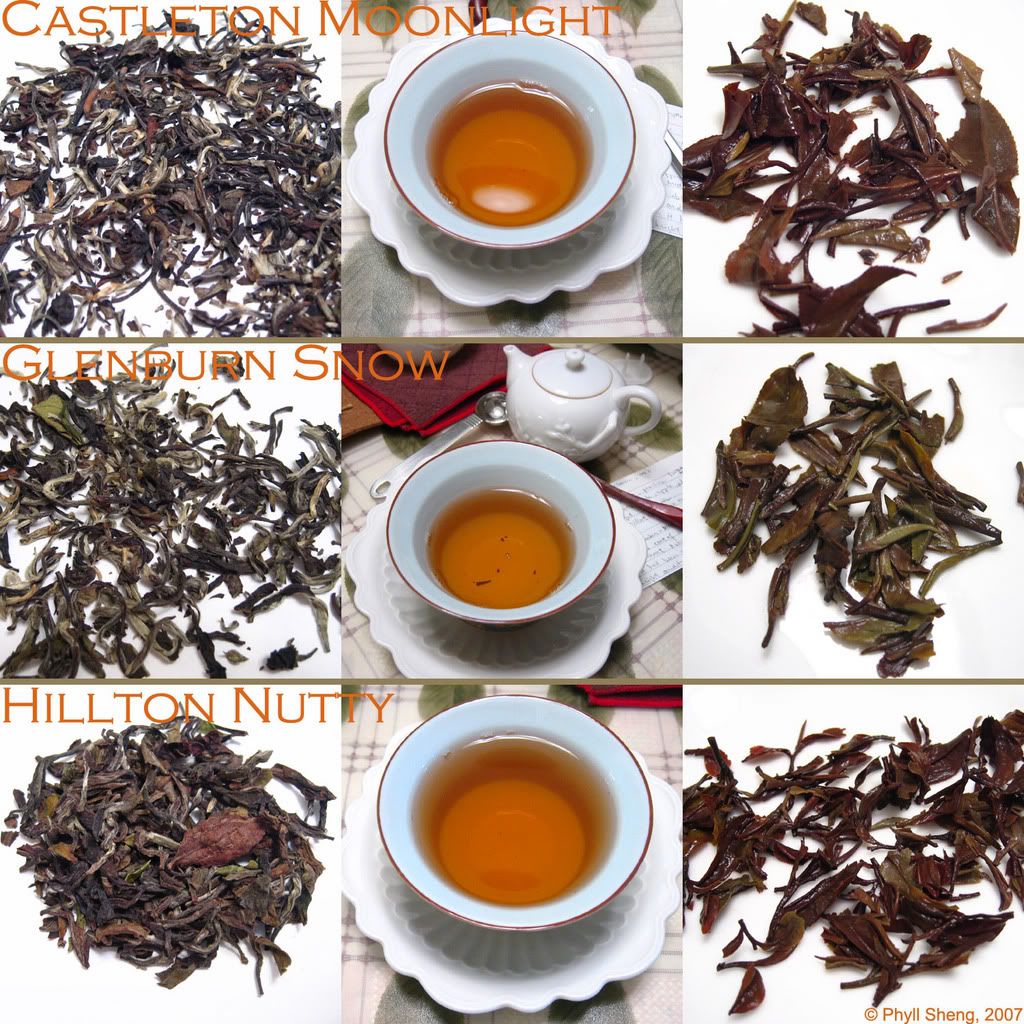
    T Ching's 1st Online Tasting: Darjeeling Oolongs

    CLICK ON THE IMAGE FOR TASTING NOTES

    Click here for the high resolution images.

    Thursday, February 15, 2007

    My First Darjeeling Oolongs

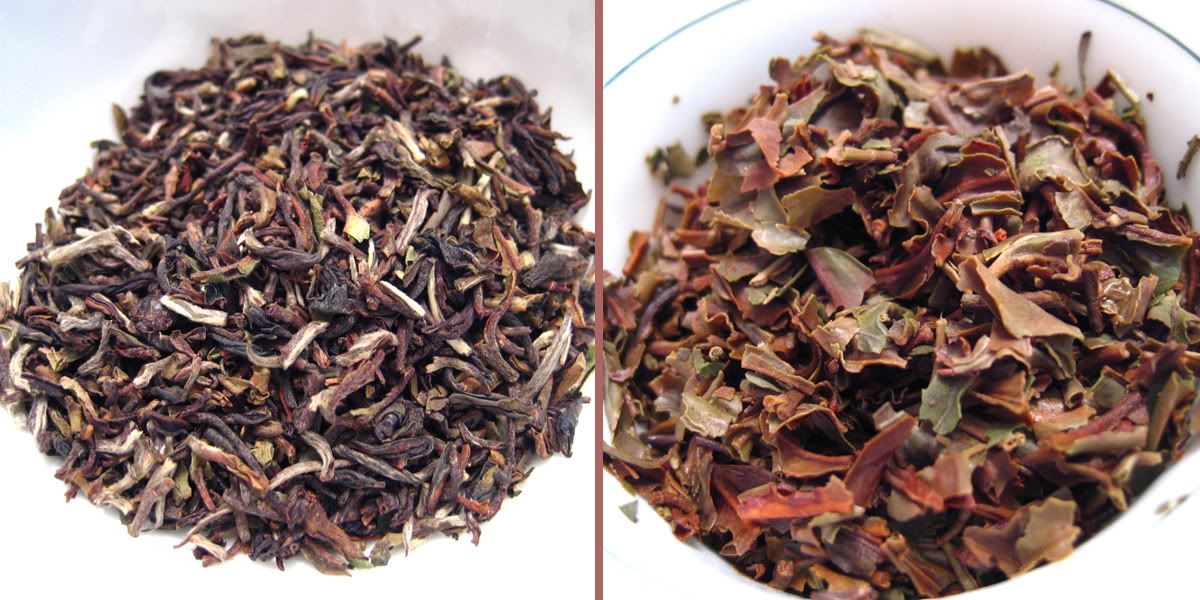
    In anticipation of the T Ching online tasting event, I purchased 100gr of Hillton Ebony and 50gr of Okayti Ivory -- both Darjeeling oolong teas -- to experiment with from Wild Orchid Teas in Sylvania, Ohio. Thanks to Mr. Ankit Lochan who recommended this excellent vendor.

    The Okayti is lightly oxidized, while the Hillton is highly oxidized. Both are only partially oxidized in order to achieve the "oolong" designation. Several sources recommend using 1-2 tsp of dry leaves with 6 - 8 oz of boiling water in a pot for 5 minutes. So I brewed the Okayti following the tea:water:time ratio recommendation in a small porcelain pot. Also, I used a small gaiwan filling it 1/2 full of dry leaves and brewed the tea in short (seconds), multiple infusions.

    How was the tea and which method yielded a better brew? I can't say for sure yet, though the Okayti Ivory is quite an aromatic and smooth tea by nature, whether brewed in seconds or in 5 minutes. More experimentation to be done with the Hillton Ebony as well.
    Saturday, July 8, 2006

    TN: 2006 Singbulli Estate 1st Flush, Darjeeling

    In other short tea news, along with the Gopaldhara noted below I also obtained a Singbulli Estate 2006 1st flush Darjeeling from Chado. This tea was more affordable at $1.75/oz than the Gopaldhara, which was $8/oz.

    The leaves are closer to being fannings, with reddish-green-brown broken bits and pieces. I had planned on using this tea for seasoning a whimsical flowery Yixing that I got recently, specifically for Darjeeling. I purchased the pot from Kam of Fun Alliance in Hong Kong.

    This morning I decided to brew a bit of it for breakfast to see how it compares to the more expensive Gopaldhara and others I've tried. Surprisingly, it has only a faint 1st flush characteristics and it's closer to tasting like a red tea. Qimen Hung (Red Keemun) comes to mind. The liquor itself is red-brown in color. Slightly smoky, medium bodied, with a touch of citrus. Like the Gopaldhara, it's not biting with tannin. Is this really 1st flush, I wonder? Overall, a simple yet decent everyday tea.

    2 stars (moderately good) an inexpensive good tea with breakfast.

    TN: 2006 Gopaldhara Estate Spring 1st Flush Darjeeling


    Inspired by Toki's tasting of the 2006 Gopaldhara Estate 1st flush Darjeeling, I went to Chado Tea Room yesterday afternoon to buy 2 ounces (@ $8/oz) of this tea to do a tasting comparison. I'm not sure if what I got was the same type and grade as the one Toki tasted. An estate usually produces more than one class of 1st flush Darjeeling hailing from different farms and altitudes.

    At the offline last weekend, the manager of Chado gave us a complimentary pot of this Darjeeling. I remember it to be charming, aromatic, tasty and smooth. While I thought the Makaibari 1st flush that I had a couple of months ago was more aromatic, this Gopaldhara was certainly much smoother and approachable.

    Brewing method: 120ml gaiwan, 1/2 full dry leaves, boiling water, flash rinse, and then 8s, 10s, 10s, 15s, and 2m.

    The dry leaves were considerably small, some with lots of white hair. Color ranges from green with red edges to brownish and black. It smelled of yellow fruits, sea breeze, dried flowers and a bit green. The heated (but dry) leaves in the gaiwan reminded me of Granny Smith apple (?), citrus, and apricot. The smell of the wet leaves was much mellower and fresh, however, than when it's dry: of muscat, honey, peach, plums, and a hint of straw green. Interesting!

    The liquor is of medium amber color. The immediate effect of drinking this was a refreshing and relaxing feeling. It was fruity, floral and pleasantly grassy. It had a smooth and an almost creamy texture to it, and it finishes quite dry. In the end, it left a sweet aftertaste.

    Brews well for only 3 rounds, after which the tea lacked the abovementioned aromas and taste.

    4 stars (vg) a complex, layered, and tasty black tea.