Showing posts with label Black Tea. Show all posts

Sunday, June 22, 2008

Weekend Dim Sum & 2 Indian Teas

Going to a dim sum usually means a time out with the family, lots of dumplings, chicken feet (love 'em!), and light conversation over many cups of tea. Whenever we do that, I prefer to bring my own tea leaves from home to be brewed in lieu of the restaurant's, which is more often than not lower in quality (passable, but...).

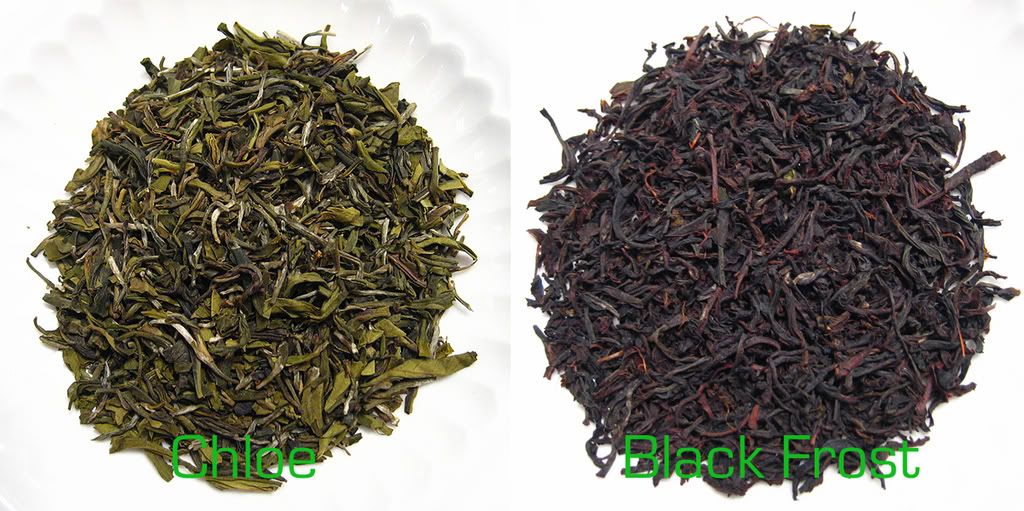
This morning, I brought along 2 tea samples that I received from The Simple Leaf (thanks Nikhil!). One is a single estate green tea from Darjeeling that is sold under the code name "Chloe". The other is called "Black Frost", a black tea from the Nilgiri Mountains in the Tamil Nadu state, South India.

I simply asked a waiter to bring two pots of hot water. Pre-rinsing the leaves, however, was a challenge without a lidded bowl, so I skipped that part and just tossed a handful of leaves straight into the pots. Now and then, I asked for more hot water to be added into the half-full teapots when I saw that the teas were getting too concentrated and starting to taste bitter.

Chloe, the green tea, is a rather different and interesting sort of Darjeeling for me. As far as I can remember, it's the first green tea I've had from Darjeeling. It’s subtle with spicy, minty qualities. An introverted sort, if you must, for one who has a sexy French name. The Black Frost, which I am partial of, is smooth and slightly malty with a bit of natural sweetness. In contrast, Black Frost is the extroverted masculine type. Of the two, I thought Black Frost was the more versatile one with the foods today.
(click to enlarge pictures)

In fairness, 1st and 2nd flushes Darjeeling teas do have pleasant acidity that makes them great companions of foods, especially spicy ones. Chloe, being a green Darjeeling, however, has completely different characteristics than its 1st and 2nd-flush relatives.

Reviewing the restaurant bill at home, I wonder why they still charged me $3.20 for my own teas!

Saturday, March 24, 2007

"Nyet!" to Czar Nikolas II Russian Tea

With all due respect to the dead Czar himself, I am afraid I don't have the stomach nor the will to ingest his tea. (to readers who want to know how I got this tea, please refer to my March 18 post, last paragraph).

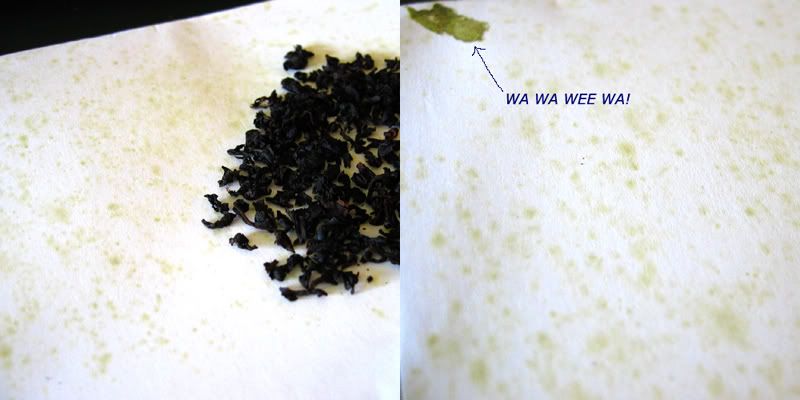
Last week, I placed half of the tea package content into a metal can with a sheet of white paper placed on the bottom. When I was about to discard the tea this morning, Wa-Wa-Wee-Wa! (I just finished watching Borat on DVD). The white paper is pockmarked with green, oily blots all around!

What did they do to the tea? Did they soak it in some kind of aromatheraphy oil? Is it even safe to drink the stuff? I dare not try...it looks and smells harmful to me. Off everything went into the trash.

Satisfying my curiosity -- $4.99
Throwing my curiosity away -- free of charge
Keeping my health intact -- priceless

Sunday, March 18, 2007

St. Pat's Weekend Notes

Ah, spring is in the air! I’m sure you’ve noticed that tea vendors are offering the spring harvest already. Long Jing, Taiwanese oolongs, Mengding, etc. While I’m not a Japanese tea drinker, word on the street is that Shincha has already come out or about to. So much good tea…very tempting!
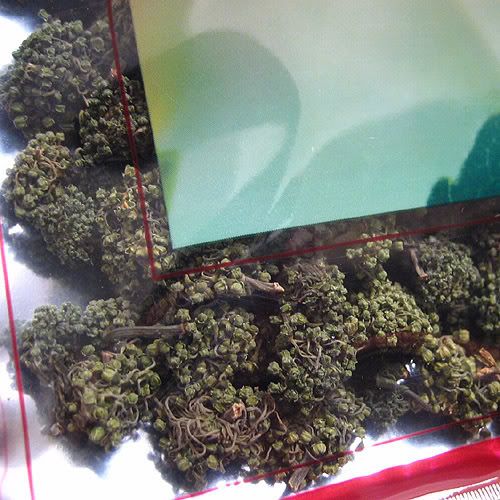
Unlike tea plantations, however, the grape vines are only budding right about now…there is still 5 to 6 months before harvest time. That doesn’t mean wineries aren’t buzzing. The good people of the grapey clan are busy re-racking or bottling the harvest of yesteryear(s), not to mention tending the vines.

I had a pretty nice weekend. Among other things, I dim-summed at the Empress Pavilion in Chinatown with the family (my younger sis joined). Loads of good dumplings! As usual, I brought my own tea…and this time instead of bringing some fisted oolong, I decided to take the Okayti Ivory Darjeeling oolong that I wrote about a few posts down. It was way much better than the restaurant’s tea to no one's surprise. I found out that this particular Darjeeling oolong is actually quite excellent when paired with dim sum dishes. Think of riesling or gewürztraminer with Chinese food, only this is tea. The fact that it is slightly more acidic (lively!), highly aromatic and it can take brewing abuse well, made the tea suitable in restaurants. When placed in a standard Chinese restaurant porcelain teapot and brewed over a long period of time, it didn’t get bitter and it remained pretty smooth.

After dimsum, we stopped by Wing Hop Fung where I bought 2 teacups to replace the broken ones. I also got some dragon pearl jasmine tea for my mom-in-law. While browsing around, something caught my interest. Among the Soumei and Baimudan teas, there was this green herbs that is labelled as "Yunnan Thien Ji tea" (it's not tea tea, but rather a type of herb). They look like tiny brocolli florets and fresh green in color. Two customers were chit chatting with the saleslady about this very thien ji. They were speaking in a Chinese dialect that I couldn't understand (Teochew?) when I approaced the saleslady, who recognized me from my prior visits and invited me to try the "tea" out. It's bitter-sweet in an herbal kind of way...almost like ginseng. I can't really describe it. It's not bitter like kudingcha and it leaves a certain pleasant aftertaste. The saleslady and the 2 customers proceeded to tell me to only put about 7 "flowers" if I want to drink it straight. It can be mixed with other teas as well, they said ("Don't put too much, though," they added). So I grabbed 2 oz of this herb, which cost me about $3.50. I took the photo above at home...haven't opened the sealed bag yet. I will write about it when I try it again. Does anyone know what this is and how to treat it right?

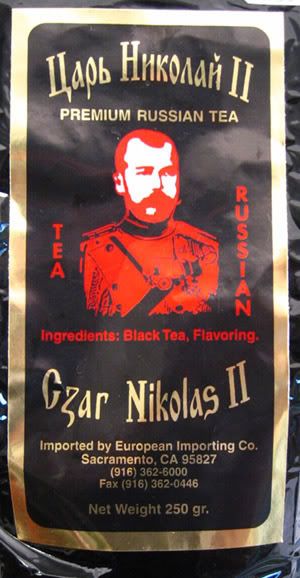
On the way back we stopped by a Russian grocery store for some everyday staples (sosisky, kevir, kalamata olives, etc.) when I found this (see pic, click to enlarge). My curiosity cost me $4.99 for the 250gr bag. When I opened it at home, the loose smallish, black leaves reeked of menthol / eucalyptus / mint. Very strong! I kid you not when I say it smells like a mosquito or insect repellant that is made from a certain tree oil that you can apply on your skin. How does it taste? I am still summoning the courage to brew it. Somehow, I think it’s beter suited as a bathroom deodorizer or a closet moth repellant. It smells toxic to me.

Hope you had a fun St. Pat's weekend!

Friday, February 23, 2007

Guangxi Liubao Teas, A Comparison

A number of posts ago, I mentioned briefly about the Three Cranes brand Guangxi Liubao tea ("3 Cranes") that I brewed with some fresh ginger to help alleviate my nasty cold symptoms. Since I recovered, I have had this tea a few more times. Last night, I brewed it alongside an older loose Liubao tea from the early 1990’s (“1990 Loose”) for a side-by-side comparison.

The differences in their overall quality are quite apparent. The 3 Cranes is consistently made up of small, diced leaves, compressed into the shape of a bird nest (tuocha). The 1990 Loose, which originally came loose in a large bamboo basket weighing 50 jins (25kg/55lb), is made up of larger cuttings, twigs and a small amount of almost-whole leaves.


Three Cranes 2000 Guangxi Liubao (tuocha)
Source:
Jing Tea Shop
$5 /100gr tuo

Parameter: in a 120ml gaiwan, filled half-full with dry leaves. Boiling water. 10 seconds rinse, and then infused for about 10s, 10s, 10s, 15s, 20s, 20s, 30s, 45s, stop.

Compressed into a bird’s nest form (tuocha), the leaves are small, broken, and dark brown in color. The liquor has high clarity. It appears rather viscous and easily opaque when infused with the stated parameter. The nose is woody and grassy/vegetal. Full bodied with a silky texture. Finishes short, clean and rather green. It’s a tea that comes across rather simple, yet there is absolutely nothing unpleasant about it.

2.5 stars (mg – g)

VL of the Tea Logic blog had posted a well-written tasting note on the 3 Cranes (
click here).


While the liquor of both teas are dark and deep-colored, I observed that the 3 Cranes is more opaque and more viscous than the 1990 Loose. Relative to each other, the 3 Cranes is fuller bodied than its older peer. Soy milk thickness comes to mind about 3 Cranes’ full bodiedness. They are both silky smooth.

Taste wise, both teas are easygoing (read: simple), pleasant and soothing. They are woody, earthy, clean-tasting and without any unsettling pond-y or moldy smell. The 3 Cranes has a green/grassy/vegetal edge on the nose. The 1990 Loose, on the other hand, gives a sweet, woody smell with a tinge of mocha.


Early 1990 Guangxi Liubao (loose leaves)
Source:
Houde Fine Tea
$9.50 / 2oz (57gr)

Parameter: about the same as applied to the 3 Cranes tea

Mostly larger cuttings, twigs and some whole dry leaves, the color is deep brown and it smells like fresh wood/bark with a tinge of chocolate. The liquor is almost opaque-brown and high in clarity. Medium to full body with silky smooth texture. A simple tasting tea, yet this woody-earthy tea has a charming sweet aftertaste with a hint of metallic note. The first sip of each subsequent infusion celebrates and amplifies the sweet lingering aftertaste from the previous cup. Enjoyed for 8 infusions, but the tea could go for a few more.

3.5 stars (g – vg)


The most obvious difference in their taste is, actually, in their aftertaste. The 3 Cranes finishes short, clean, green, but not much else. The 1990 Loose finishes a touch metallic yet sweetish throughout. I really like the sweet aftertaste of the 1990 Loose that lingers for a long time. The most delicious part of this tea comes at the first sip of the next cup after resting for a couple of minutes in between infusions. That first sip somehow amplifies the lingering sweetness from the cup prior. Very nice. For this, I think the 1990 Loose is hands down the more interesting tea of the two.

A Little About Guangxi Liubao
The name of the tea itself is actually the name of the place where the tea is produced. This tea hails from a town named Liubao in the Cangwu County of Guangxi province.

At its heart, it is a black tea that underwent a wet fermentation process to mellow out the tea’s taste. The wet fermentation technique (“wo dui” in Chinese) is the same process used to make Yunnanese cooked/ripe/shou pu’er. Basically, fully oxidized leaves are exposed to a high degree of humidity in order to accelerate the fermentation for a certain period of time until the desired level is achieved. Unfortunately, I am not privy to any information on which cultivar Liubao tea is made from.

Teamakers in Guangxi had employed the wet fermentation technique for at least a couple of decades (around 1950's or earlier) before their Yunnanese counterparts adopted a similar technique in the 1970's. Guang of Houde Fine Tea said:

“I was told when Kumming tea technicians learned the cooked skill of Liu Bao from Guangzhou, the cooked process still took ~ 8 months to complete. A slow "cooked" process, with less fermentation degree. So 70's and 80's cooked puerhs are mostly kind of like "semi-cooked" in our current standard.

Since early 90's, they kept "improving" the cooked process and now it only takes about 1 month to complete.

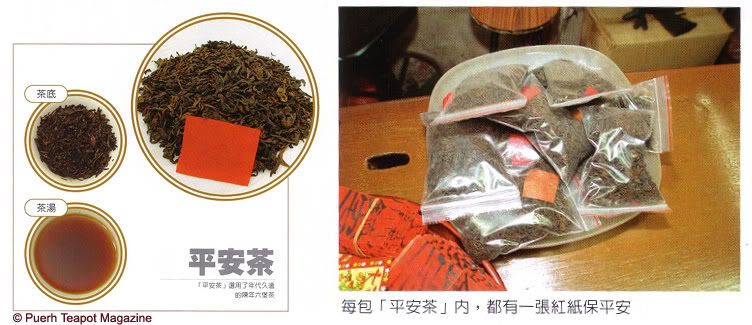
Liu Bao was not only used in restaurant in HK/Macao, it was also often used in Temples to pack as "Pin An Cha" (you know Pin An - meaning safe) in a little plastic bag with a square red tag in the bag. Especially during Chinese New Year, people like to go to the Temples and receive the "Pin An Cha" for the safety in the following year.”


Mr. Chan Kam Pong in his new book “First Step to Chinese Puerh Tea” wrote:

"Guangxi Liubao (广西六堡) is the special production of Cangwu (苍梧) County, Guangxi province. Liubao was mainly exported to Southeast Asia through Hong Kong. Overseas Chinese always brew this tea because the taste of Liubao is smooth and rich in addition to its aging capacity. It was said that overseas Chinese stored Liubao at home as simple medicine for treatment of dysentery in the old days and for relieving mild illness(es)."

(First Step to Chinese Puerh Tea, pp 52-53, by Chan Kam Pong, Wushing Books Publication Co. Ltd., 2006)

Short Conclusion
At this tasting, the 1990 Loose is certainly the better of the two. After tasting the 1990 Loose, I think a good quality aged Liubao tea can give a similarly aged cooked pu’er a run for the money.

Will the 3 Cranes' grassiness evolve into something else as it ages? I will report back in a few years. I'm keeping several tuos for long term storage, and one tuo has been broken up and kept inside a porcelain jar for frequent visitations.

Saturday, February 3, 2007

Winter Cold & 2000 Guangxi Liu Bao Tea

I am having a nasty cold. I thought all the tea and wine I've drunk is supposed to have given me an added immunity. Isn't that what they say? I never even added milk into my cuppa. By now, I should already be like Popeye after gulping a can of untainted spinach. What gives?

I feel miserable and I yearn for a tea that soothes. This usually calls for a good dose of decent cooked pu'er. However and fortunately, a package of 6 to 7-year old Liu Bao tea from Jing Tea Shop just arrived and I opted for this instead. The following is in no way a fair assessment of the tea, as I enjoyed it with a muted sense of smell and taste.

With my nose blocked and my throat itchy, I prepared the Liu Bao tea in a 120ml gaiwan, using about 10+ grams of dry leaves and just-boiled spring water. The small, dry leaves appeared reddish-black-brown and it smells like -- nope, my nose was too blocked to smell anything. The resulting liquor from the brew was dark brown and opaque. Pretty intimidating looking. It looked like a very bitter Chinese medicine that my parents told me to drink -- with dire consequences if I refused -- when I was a snotty kid.

I slurped the dark water carefully. Mmmm...smooth! It tasted like a clean-tasting cooked pu'er. It's got a thick milky texture, and it effortlessly slid down my throat. Curiously, the taste of this tea reminded me of milk! The aftertaste was clean but did not linger for long.

This tea was what I needed. It warmed and soothed my body. At a time like this, I rarely want any aromatic oolong or green tea. I'm going to brew this Liu Bao again later considerably more diluted and I'll add ginger to the brew.

*cough, sniffle, a-choo!*
agony of winter cold
this tea tastes like milk

~ Phyll in his pajama next to a big cuppa

Image: "Sick Puppy" from www.cartooncomedyclub.com