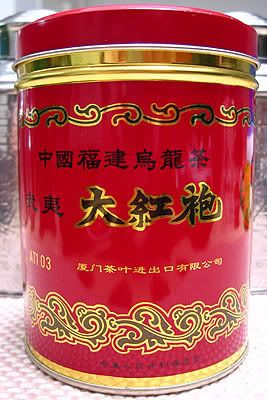
Sunday March 25th. I arrived late to be greeted by Danica, Jonathan, Louise and Will. They were already in mid-session of tasting a Wuyi rock oolong called the Thousand Sweet Miles. Feeling comfortable, I immediately slinked right in and joined the fun at the table. The tea was sweet smelling, floral and honey. It was also mellow and smooth with only a bit of roast. I liked it. This sample came from Best Tea House’s British Columbia (Canada) branch and costing C$112 per 100gr. Quite steep. We couldn’t figure out what this Thousand Sweet Miles is called in its original Chinese tea nomenclature (anyone?).
And then there is Stéphane Erler’s silver teapot -- Now Danica's.
 Danica unleashed the silver beauty from its original packaging only moments before I showed up. It was its own feature debut! One side of it is embossed in dragon. The other side’s embossing is of a phoenix. Rather surprisingly to me, it felt very solid, thick, substantial and balanced! From all the pictures that I’ve seen in Stephane’s blog, I (incorrectly) assumed that the teapot is thin and light. A lot of sterling silver (995) went into the making of this pot. When I brewed a tea with it, the pour was smooth and it did not drool or leak from its lid. It is an excellently made teapot overall. Well, for the precious material used and the high price one has to pay for it, it better be.
Tieguanyin Tea: Silver vs. Clay
Having never been used before, Danica rinsed its inside – which looked matted and resembled more of white oyster pearl than silver – with boiling water straight from her tetsubin. Then she asked Will to take over the helm. Will decided to brew a Tea Gallery’s qingxiang tieguanyin. Nosing the first brew (second after rinsing), Louise’s sensitive nose detected a certain metallic smell and taste. Others concurred. Jonathan said it could be psychosomatic. We asked each other whether the pot ought to be washed thoroughly first under the sink. We decided not to, unless somebody dropped on the floor writhing in pain. The second brew did not have as much of that metallic taste. Probably it’s the tea.
After 3 or 4 rounds, we decided to brew the same tea using a hongni clay Yixing pot. The result was noticeably different, although Louise again detected some metallic smell in the first brew. Must be the tea then. Coming out of the silver teapot, the tieguanyin had a hard and crisp edge to it. From the Yixing pot the tea felt more rounded and, well, not crisp. I remember Jonathan sharing this opinion and liking the tea from the Yixing better. So did I.
As an amateur photography hobbyist, an analogy that I can think of is that of a person being photographed with a direct, undiffused strobe light vs. with a bounced and diffused strobe light. The former is what the silver pot would produce in a manner of speaking. If this analogy is correct, then only model teas can withstand the unflattering effect of this silver being and come out beautifully. In my opinion, this tieguanyin test suggests strongly that a Yixing or a gaiwan is not replaceable by a silver unless one only brews exceptional tea every time. It is a teapot that you whip out to showcase your best teas and/or to impress and honor your guests with. It works well as a status symbol, too. You get instant credibility as a tea connoisseur brewing with it.
A Beautiful Oriental
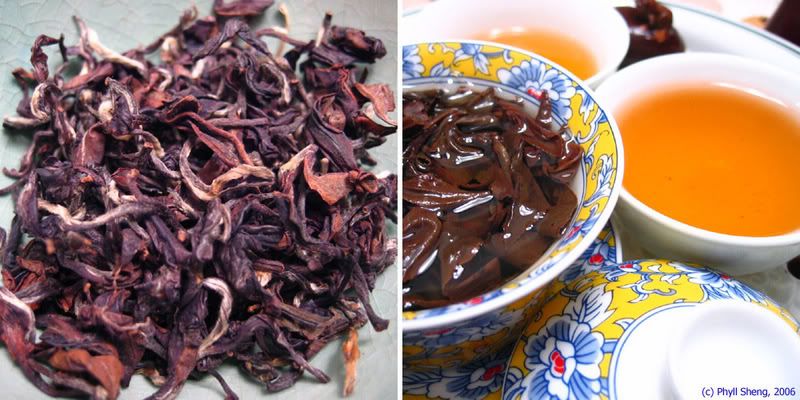
After Will, Danica gave me the high honor of sitting on the brewer’s chair to handle a very special tea. I politely declined but she insisted, so I relented. A gift from Stéphane to Danica was 4gr of a rare Oriental Beauty oolong, which he himself was only allocated a mere 25gr. Allow me to summarize by saying I would kill for his 21gr. I kid you not it’s that good. I would rate it 5 stars. It’s so exotically perfumed with an aftertaste to die for. An hour after my last cup I could still taste it in my mouth. Stéphane said in his email to me:
“It was made by a farmer in Nantou: only 1.2 kg, if I remember well. It is the most precious tea from that farmer (a tea he did to push the limits of quality, not a tea made for sale). Extremely high quality and very expensive to make. A rather low oxidation for OB. The tea vendor I got it from said it was a white tea, but several tea friends/experts had a look at it and we all agreed it was an Oriental Beauty with low oxidation.”
 I was actually surprised by how greenish-white the resulting liquor was. I never had an Oriental Beauty with such a color before. The tea has a vivid spicy floral perfume and a lasting aftertaste. Looking at the leaves inside the silver pot, they were entirely made of dark green-colored buds (one flag, one spear).
After only 3 cups of this memorable tea, I had to excuse myself and leave to pick my family up for a meeting at the Descanso Gardens with some relatives and friends. Any day I learn and experience something new is a good day. That Sunday was one of them. The only thing infinitely better than brewing with this exquisite shiny pot and tasting the special Oriental Beauty tea was the company I enjoyed them with.
My huge thanks go to Danica and Jonathan for hosting the meeting and for the special memory of that day. I feel very fortunate and privileged.
[Photo of wet leaves by Will]