Wednesday, March 14, 2007

Tea Vodka

Have you ever got drunk from tea? (Strong tea can make some people feel woozy, especially when taken on an empty stomach). If never, then this might. Today’s Los Angeles Times Food Section features an interesting article on gourmet “sipping” vodkas. One of the flavors is *drum roll* tea.

“The tea flavor, based on a mixture of black, green and oolong teas, is surprisingly rich, with a nose more like some sweet spice than like tea. This was Melkon's attempt to commemorate their honeymoon in France, where they'd made a memorable visit to an old tea house.”

Guess what I’ll be bringing to a regular gathering with my Russian buddies? I doubt they will sip the vodka, though…that’s just too new school.

(Photo: Francine Orr / LAT)

More Darjeeling Oolong's

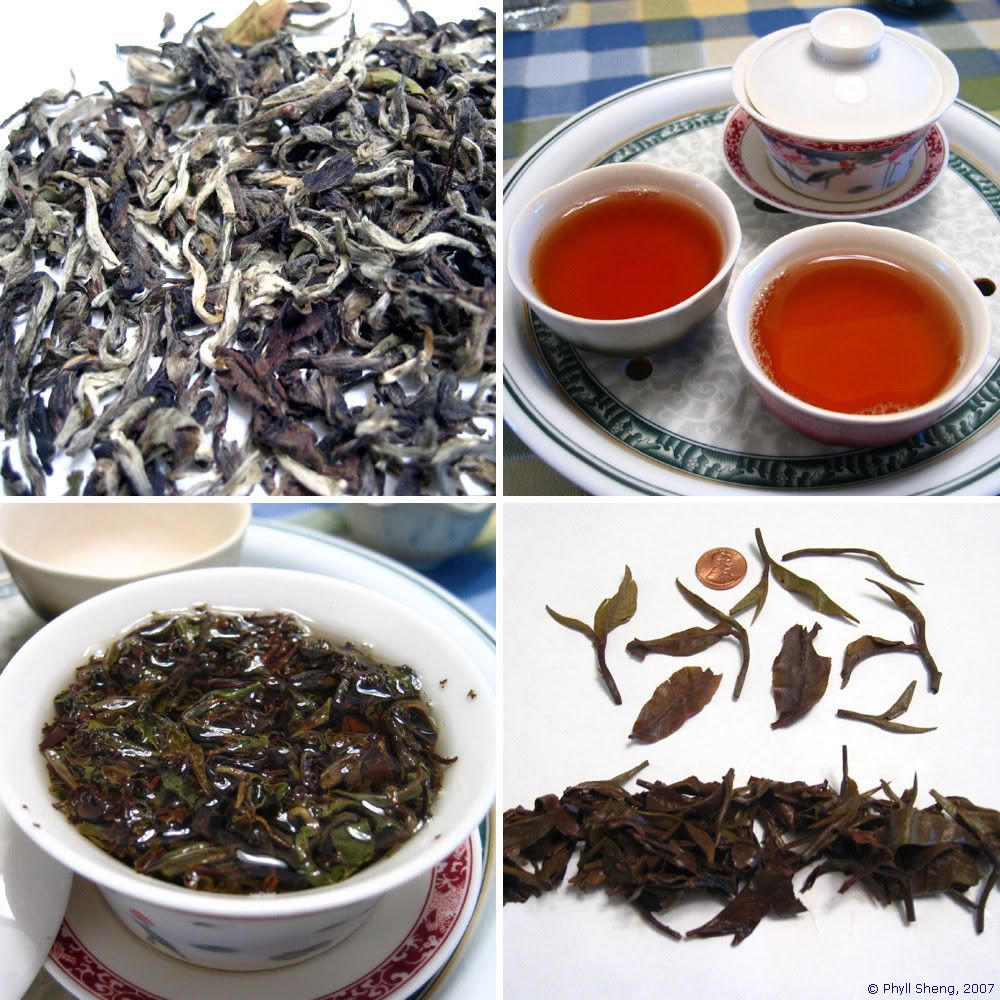
Prior to hosting the online Darjeeling oolong tasting at T Ching (see Feb. 28 post), I purchased 2 teas of the same origin and genre. Call it a prep or research, if you will. They are named the Okayti Ivory and the Hillton Ebony.

With these 2, I now have (only) tasted 5 different Darjeeling oolongs (3 with T Ching). Each one was quite different from another, which I found to be quite fascinating considering that they sprang from the same region. Still, there are common denominators among them. These are my impression and what I found to be the common characteristics among the 5 Darjeeling oolongs I tasted.


  • Incredibly lovely, complex nose. Of muscatel and various tropical fruits – the yellow types, such as mango, peach, and star fruits (I’m a big fan of riesling and gewürztraminer, by the way)
  • Brews an amber to brown / red-colored liquor
  • Impecabble crystal clear clarity
  • Soft(er) and smooth(er) than the 1st flush teas, yet less robust in taste than most 2nd flush teas
  • Short on the aftertaste

    The 2 oolongs below were purchased from Wild Orchid Teas. The vintage year is not mentioned by the vendor. My guess is they are 2006 teas, though I can’t be sure which season they were harvested in.

  • Okayti Ivory Oolong, Darjeeling, India

    Excellent looking dry leaves. Twisted lengthwise and mostly whole. Evenly and generously downed with white fur. Nose is complex but more subdued and subtler than the other 4 Darjeeling oolongs…of mango, muscatel, peach…a mix of tropical fruits (common Darjeeling nose). The tea also tastes subtle and quite fragrant. Light to medium body. Short aftertaste. Quite charming and especially nice when in the mood for a subtler tea. 3.5 stars (g - vg)


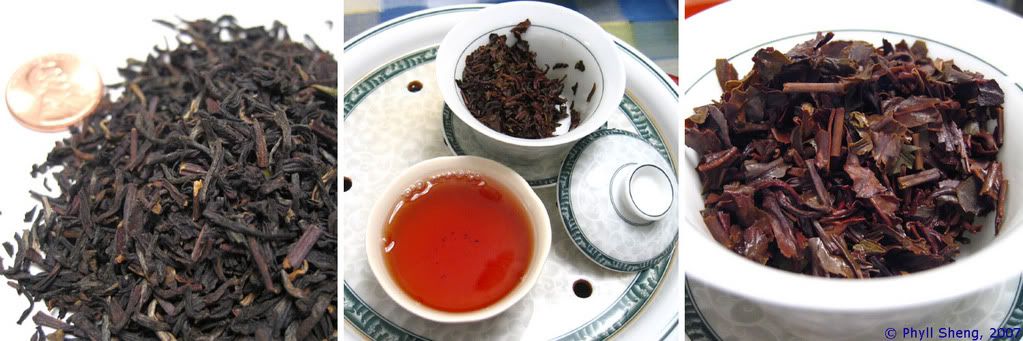
    Hillton Ebony Oolong, Darjeeling, India

    I have depleted my entire 100gr of this tea. I brewed it in many ways: in a small gaiwan (gongfu), in a large pot, straight in the cup, iced, not iced, etc. It is a good and pleasant tea for everyday, everyway. This is one tea that I consider having as a staple for fuss-free enjoyments.

    Closer to being a black tea (“red tea” in the Chinese tea category), it is highly oxidized. The nose resembles a fully oxidized 2nd flush tea, though slightly softer and fruitier. The liquor brews quite red when done in a gaiwan. (Otherwise, it is medium amber/brown in a 5-cups Bodum teapot with ~4 teaspoons of leaves). Tastes more robust than the other 4 teas. Quite smooth and not tannic. Refreshing and good tasting with ice! A very versatile tea that can withstand abusive brewing methods, yet delivers a pleasant enough taste. Does not break the bank ($12/100gr). 3 stars (g)

    Tuesday, March 13, 2007

    Thank You V.L.!

    A BIG thank you to V.L., the eloquent author of the highly inspired Tea Logic blog, for providing me with the code fix. Now my blog is viewable normally with Firefox as well as MS Internet Explorer (hopefully also with Linux, Safari and Opera). V.L. emailed me the codes when I literally was giving up on fiddling around with a different template.

    Saturday, March 10, 2007

    Best Viewed With Internet Explorer

    Just a quick note to say that my blog, as it unintentionally turned out, is best viewed with MS Internet Explorer. Apparently, if viewed with Firefox, the background does not load properly and it remains gray. Not that anything is wrong if you prefer the bland gray background. Some images were designed to blend with the white background in mind, however. Thanks for reading my blog.


    Thursday, March 8, 2007

    Monthly Wine Tasting @ Winexiles

    Did you know that members of Winexiles hold monthly online wine tasting? The next one up is scheduled for March 22, 2007. Libbyg will be hosting the event and, as host, he has chosen the 2003 and/or 2004 E. Guigal Crozes-Hermitage for this cyber tasting (around $15 - 22 per bottle, depending where you are).

    Click on the wine label for more information and discussion.

    Winexiles online tasting is a great way to learn about wines from different regions of the world. The forum also allows you to compare notes and glimpse insight from those who are in-the-know about the particular wine being tasted.

    What you need to do is simply get the wine, drink it with your family/friends (or by yourself, if you prefer), and log on to Winexiles to share opinion with others.

    Members of Winexiles also occasionally meet to dine & wine together at various locations in the United States. In New York City, ŌTTŌ is one of many favorite meeting places. Bodega Tejas, a Texan grape grower who sells his crop to wineries in Texas, regularly invites fellow members to his ranch for some great wine experience and, of course, fabulous home-made foods!

    Hope you can join us on March 22nd.
    Edit 3/13/07: The tasting date has been moved from March 21st to 22nd.

    Wednesday, March 7, 2007

    Lu Yu & Mary Ewing-Mulligan, M.W. Advised...

    ...you to trust your own mouth.

    “The really superior taster will judge tea in all its characteristics and comment upon both the good and the bad. For every individual criticism there is a reason. It’s goodness is a decision for the mouth to make.”

    ~ Lu Yu, Tea Sage (733 - 804 AD); As translated by Francis Ross Carpenter

    "It is your mouth after all. No one can tell you what you like. No critics, no wine experts. Drinking wine is a very personal experience."


    ~ Mary Ewing-Mulligan, M.W. (Master of Wine);
    Read article

    Tuesday, March 6, 2007

    In Memoriam: Ernest Gallo (1909 - 2007)

    Raise our glasses to a visionary, a pioneer, and an entrepreneur! A very big guy in the American and global wine industry. Alla Salute!

    Photo and article: www.gallo.com/ErnestGallo

    Monday, March 5, 2007

    A Relaxing, Spendthrift Weekend

    My weekend, as usual, revolved around my kid's activities. We were invited by our close family friends to their son's 2nd birthday party out in the park. The weather was glorious! It was a joy to see my little girl playing with other kids her age and enjoying the day to its fullest.

    On the way home from the party, I stopped by a big box wine store in West L.A. (
    Winehouse) to pick up the 2 cases of 2003 Bordeaux clarets that I purchased as futures about 2-3 years ago. They have been laying in Winehouse's cellar under my name all these while since they were released.

    Inside the store, seeing all those bottles of wine lined up like rows of vine was extremely tempting to me. But first, the liquor aisle. I have run out of a good sipper at home.

    Ever since I read a recent article – I forgot in which publication – about the growing trend of maturing Scotch whisky in barrels that were previously used to age different types of wine in (e.g. Sauternes, Sherry, Port, Madeira, Rum, Burgundy, etc.), I have wanted to try a good one that was aged in a sherry barrel. If I am not mistaken, Scotch whisky is traditionally matured in ex-barrels of Bourbon whiskey to give a certain oomph and finish. I love a good Scotch, but my knowledge of it is rather rusty.

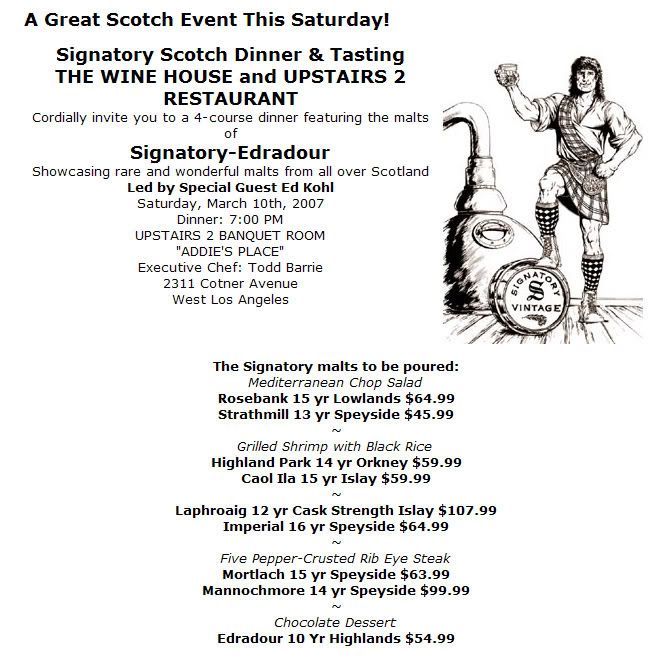
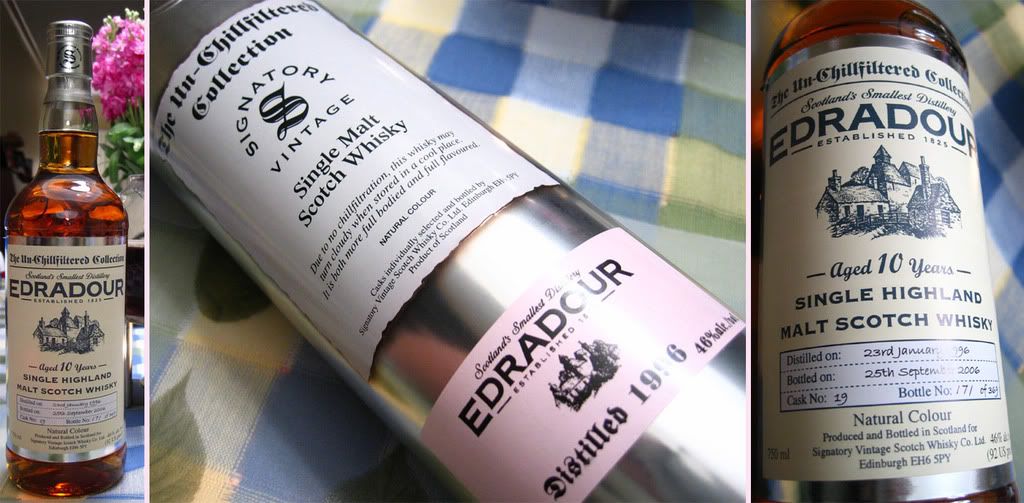
    While browsing around in the whisky aisle, a guy named Tim, a Market Manager of a liquor distribution company called Total Beverage Solution, chatted me up. He was visiting the store that day to push his company's product line and promote an upcoming tasting event at the Winehouse (click inset on the right). Upon his inquiry, I said that I was interested in trying a sherry barrel-matured Scotch. He was more than happy to point to a bottle that his company represents: 1996 Signatory Edradour Unchillfiltered Highland 10 years Scotch. He also said that ex-sherry casks cost extensively more at $3,000 per barrel as compared with an ex-bourbon barrel, which costs only $150 per. Is that true? I’m not sure.

    From Tim’s description of the producer, Edradour is the smallest distillery in Scotland. Just by the salesman’s words alone, this bottling sounds more artisan to me than the widely available Glenmorangie and Macallan. I decided to give it a try. It set me back $66.

    TN: 1996 Signatory Edradour Unchillfiltered, 10 years (46%)
    Medium amber color. The nose is deeply sweet, like overripe yellow fruits, with some iodine and nuttiness. Spicy and woody. It's very silky...goes down smoothly like oil. Medium bodied. Finishes a touch acidic, fruity and caramel. This is an aperitif/digestif style. Enjoyed in a Riedel Vinum Cognac Hennessy tulip crystal with a spritz of mineral water added to 2oz of liquor.

    On my way to the cashier, I tried to close my eyes as best I could to control the potential damage to my bank account. It didn’t work. At the check out I ended up with the following:

  • 2x 2005 Columbia Crest Merlot, Washington (a good, cheap merlot...goes well with burgers, pizza, marinara sauces)
  • 1x 2003 Swanson Merlot, Oakville, Napa (my go-to CA merlot producer)
  • 1x 2005 Dr. Loosen "L", Mosel-Saar-Ruwer, Riesling, Qba
  • 1x 2005 Muller-Catoir Haardter Burgergarten, Pfalz, Riesling, Kabinett (from a respected estate)
  • 1x 2004 Kurt Darting Durkheimer Nonnengarten, Pflaz, Riesling, Kabinett (need to try it out)
  • 1x 2005 Joh Jos Christoffel Urziger Wurzgarten, Mosel-Saar-Ruwer, Riesling, Kabinett (one of my favorite Mosel estates)
  • 1x 2005 Gunderloch Jean Baptiste, Rheinhessen, Riesling, Kabinett (an excellent everyday white)
  • 1x Wild Turkey 101 Kentucky Bourbon (I love it…raises the hair on your chest, if you have any)
  • 1x 1996 Signatory Edradour Highland 10 years Scotch (matured in Sherry casks…see TN above)

    And the Bordeaux futures I picked up:
  • 12x 2003 Ch. Gruaud Larose, Saint Julien (2nd Growth)
  • 12x 2003 Ch. Pontet-Canet, Pauillac (5th Growth)
  • 3x 2003 Ch. Lafaurie-Peyraguey Sauternes 375ml

    There goes my tea and wine allowance for many months…

  • What have you been buying to satiate your tea and/or wine obsession?

    Friday, March 2, 2007

    A Meeting of Tea Minds

    [A rather long post]

    As I turned left onto Beachwood Drive, I glared at the H-O-L-L-Y-W-O-O-D sign boldly emblazoned up on Mt. Lee dead ahead of me. A local landmark that I usually take for granted, that day it was being shoved in my face and it was quite a sight! It reminded that no matter where I came from, I am now a subject of this little kingdom…this Tinseltown. And our king-elect is Arnold Schwarzenegger.

    But I am not about to bore you with such stories…I’d rather talk about our tea gathering.

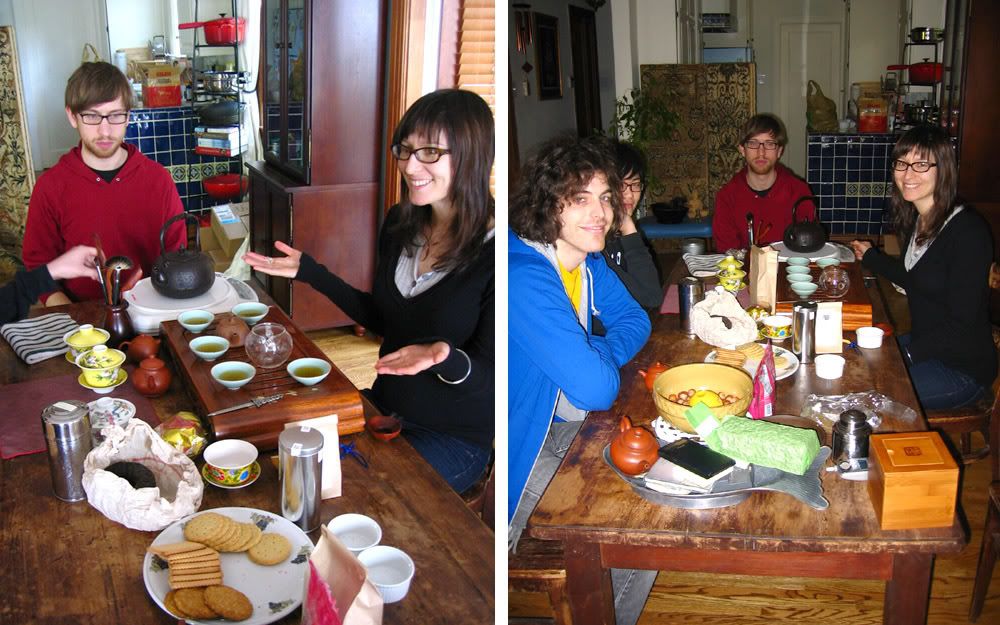
    Sunday last, I was invited by Danica (Dah-nee-tsa), a film producer and a serious teahead, to her charming home for some tea. Also joining us were Jonathan, Will, Louise, and Danica’s black pug. The dog, judging by its color, is probably more of a coffee drinker. Did I just color-profiled Danica’s puppy? Somebody sue me!

    The camaraderie developed almost instantly. It’s amazing to think how ol’ Ms. Camellia sinensis can bring different people together. I always say that friendship is the healthiest thing that comes out of tea – good friends are probably going to make you live longer than that EGCG-XYZ anyway.

    Right Photo (clockwise from left): Jonathan, Louise, Will, and Danica in charge of tea.

    5 people, 1 dog, 4 solid hours, 6 teas, ~42 infusions, ~210 cups, no sweat!

    1980’s Zhong-Cha (Menghai) #7532 Xiao Huang Yin Sheng Pu’er
    Source: Houde Fine Tea

    Danica: Very strong tea, with great cha qi lasting many steeps. Forceful woody quality that is balanced by earth and forest, with some astringency. Surprisingly young feeling, although the leaves look aged and the liquor shows signs of age. Becomes floral at the 9th steep; would have continued but I ran out of desire.

    Will: I liked it - maybe a little on the young / bitter side for my taste still. I'm a little hesitant to talk about teas having strong qi, but this one did seem to have a kick beyond just caffeine.

    Phyll: I remember this tea as tasting quite young and green still for an 80’s sheng. A lot of cha-qi and caffeine. The leaves are still quite young looking too, for a 20+ years old tea. I could feel myself feeling wired and tingly on my back after 4 cups or so. A lot of activity and taste there. This tea tastes like it’s been stored dry and clean. 4 stars (vg).

    1985 Chan’s Tea House Sheng Pu’er Loose Leaves (stored for 20 years in Hongkong)
    Source: Guangzhou

    Phyll: Much older looking and tasting than the Xiao Huang Yin. Then again, I can say that this tea went through some mild wet storage period. The tea itself is earthy, woody, mellow and smooth. Not overly complex, yet there is something to be said about its subtleties. Calming and cooling, my body felt much better after this tea – it was like the XHY mentioned above created a fire and this loose sheng doused the fire. It is such a contrast to the 1980’s XHY. I rated it 3 stars
    before, and I still think it’s a 3 star.

    Danica: Smooth liquor, comforting, with an earthy, mushroom note; possible wet storage or cooked (we didn't check the leaves!). Simple tea, easy to drink. Great for every day.

    Will: This one was nice and mellow, in contrast to the other aged pu-erh. I liked it a lot. There was a weird flavor I couldn't quite put my finger on and certainly can't describe.

    Highly Roasted “Monkey Picked” Tieguanyin
    Source: Jing Tea of U.K.

    Phyll: This tea has a wonderful aroma of nuts, caramel, honey, and various fruits. A complex tea overall, but the roast is (still) much too strong. Perhaps this was roasted fairly recently and it needs some resting time (months) to calm the fire. The charcoal aroma is too apparent. Otherwise, it is a wonderful tea. I loved it, despite. 3.5 stars (g – vg) due to too much charcoal. Otherwise it's 4 stars.

    Danica: Very dark roasted appearance. The tea is strong and complex, dominated for the first 4 steeps by the roast. Leaves a wonderful caramel/ vanilla/ orchid/ complex scent in the cup that is quite revelatory. The caramel flavor begins to open up in later brews (I think it was #4); this could be in concert with the leaves opening in a very full teapot. Perhaps a longer brew time would also have given more flavor up front. Personally I found there to be a metallic note to the roast that reminded me of fuel, which may be a result of the charcoal. It made it less smooth and palatable for me. This note makes an otherwise 8.5 tea a 7.5 for me. Drinkable, interesting, but not perfect.

    Will: This reminded me a lot of Stéphane's roasted high grade TGY (to be fair, that's the only other high-fire TGY I've tried). Slight differences, but the basic flavor is the same. I'm not sure which one I like better yet - maybe we should try a side-by-side. They both have a pretty strong taste of... I guess I'd call it caramel. The smell was very nice; Louise thought it had a bit of a sandalwood aroma. It looked a lot darker than the one in the picture I see on their site


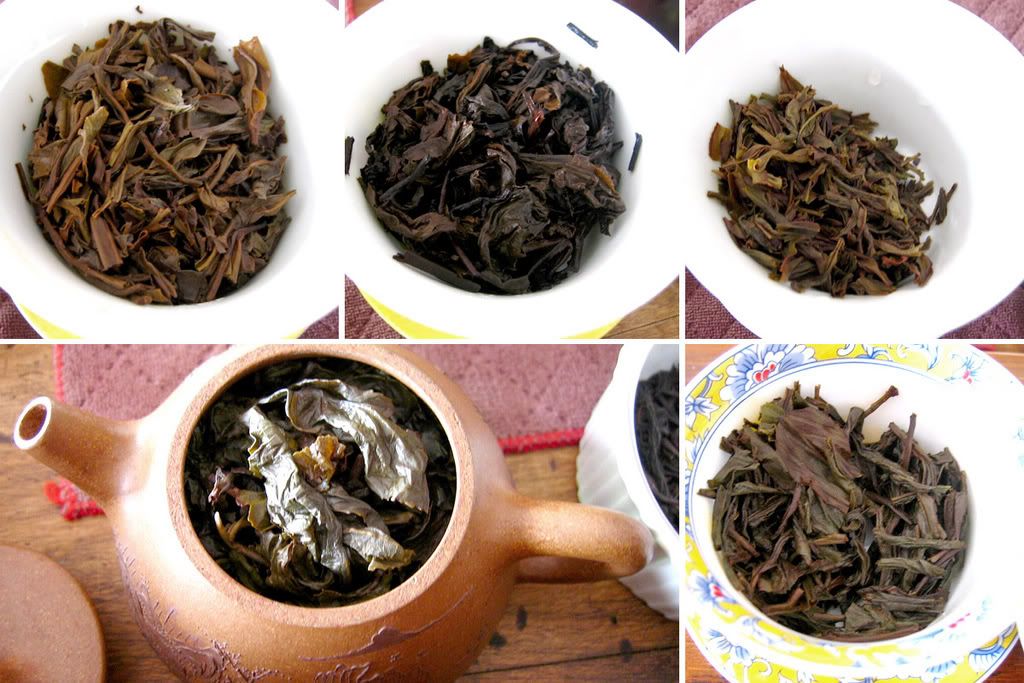
    Clockwise from top left: 1980's Zhong Cha Xiao Huang Yin Pu'er, 1985 Sheng Pu'er, 2006 Milan Dancong, Song Zhong Dancong, Long-an Taiwanese oolong (pot). Not pictured: Monkey Picked TGY.

    2005 Long-an Wood Roasted (Heavy Fire) Formosa Oolong
    Source: Houde Fine Tea

    Danica: Round and fruity scent of dry leaves, more roasted smell from dry leaf. This one brews up strong; it has a consistent, fruity flavor with a nice hint of roast. The roast is different from the monkey pick, it is less prominent and less complex, but the tea is clean and pleasant-tasting. Good durability--I got at least 7. After brewing the leaves showed some oxidization but were primarily a shiny dark green color, with some stems. I had it again and brewed it a little lighter; I think Will would have enjoyed it more.

    Will: It's described on Houde's site as "heavy fire" (maybe for Taiwan), but I'd describe it more as a medium or low-medium roast based on the appearance of the wet leaf and the taste of the tea. As brewed, it was a little on the bitter side for my taste (though everyone else seemed to like it -- I'm just weak sauce). Memory is failing me in terms of other specifics right now.

    Phyll: This tea is rather simple tasting with a pleasant woody – fruity aroma. Though regarded as “heavy fire” by the vendor, it is much less roasted tasting than the abovementioned Monkey Picked TGY. A nice change of pace after the TGY…the difference between a dark roasted oolong (with charcoal?) and a traditional Taiwanese wood-fired oolong is very clear when tasted one after another. 3 stars (g)

    Spring 2006 Milan Xiang Dancong Oolong
    Source: Jing Tea Shop of Guangzhou

    Will: I like this tea... I feel like it's almost *too* accessible (like maybe I'd get sick of it if I drank it all the time) - the lychee taste is right there to the point where it's very fruity. I like to brew it withnot too much leaf so the bitter notes don't take over. It's very lightly oxidized, and the taste is very light. The wet leaves also have a strong lychee smell.

    Danica: Really lovely fruity dancong tea, Will described it as a lychee or maybe passion fruit flavor. Brewed well with fewer leaves, there was hardly a hint of bitterness.

    Phyll: This is simply lovely! It is highly perfumed with all sorts of yellow fruits and flowers, noticeably peach, apricot, and floral (orchids, as the name implies). The aromas are very upfront and expressive from the very first brew. If it were an opera singer, I would say it’s a mezzo-soprano. Simply charming. Will used less leaves than I usually would brew my Dancong, and it came out very nice. 4 stars (vg).

    Song Zhong Dancong (Highly Roasted)
    Source: Best Tea House of Hong Kong

    Phyll: The 2 previous times when I brewed this tea at home, I ended up with too strong a tea. So after witnessing that Will successfully brewed the Milan Dancong with less leaves, I decided to follow suit (about 1/4 full in a 100ml gaiwan). I think for this tea, it needed a little more leaves than the Milan Dancong, but less than what I used at home (1/2 of a gaiwan). It’s a learning curve. Dancong is rather hard to get right.

    A late bloomer. The first 3 or 4 cups were light and rather sleepy. Then it gradually opened up on the 5th brew, giving nice complexities. The perfume that comes off of the tea gave a warmer feeling than the Milan Dancong. Peachy, honey, and floral. Very good aftertaste. 4 stars (vg)

    Danica: This was an interesting tea with a wonderful and special aftertaste. It was complex and floral with a fruity main note. I can imagine if it was brewed stronger it would be extraordinary.

    Will: This was very nice. Would have been nice to try it without knowing exactly what it was, since this tea's reputation precedes it. That said, I thought it was very nice. Similar notes to the Milan Dancong from Jing (lychee, peach), but a little less up front (I think Phyll made that point), more complex, and with a great lasting finish. You hear people talk about teas with a good finish / aftertaste, but this one really had a lot going on there. I'm glad we didn't skip this one, especially to taste right after the Jing one. Despite being fairly high-fired, the tea didn't have a strong oasted taste.

    We are planning to meet again in a few weeks time, and hopefully Imen and Nick can join us.

    Wednesday, February 28, 2007

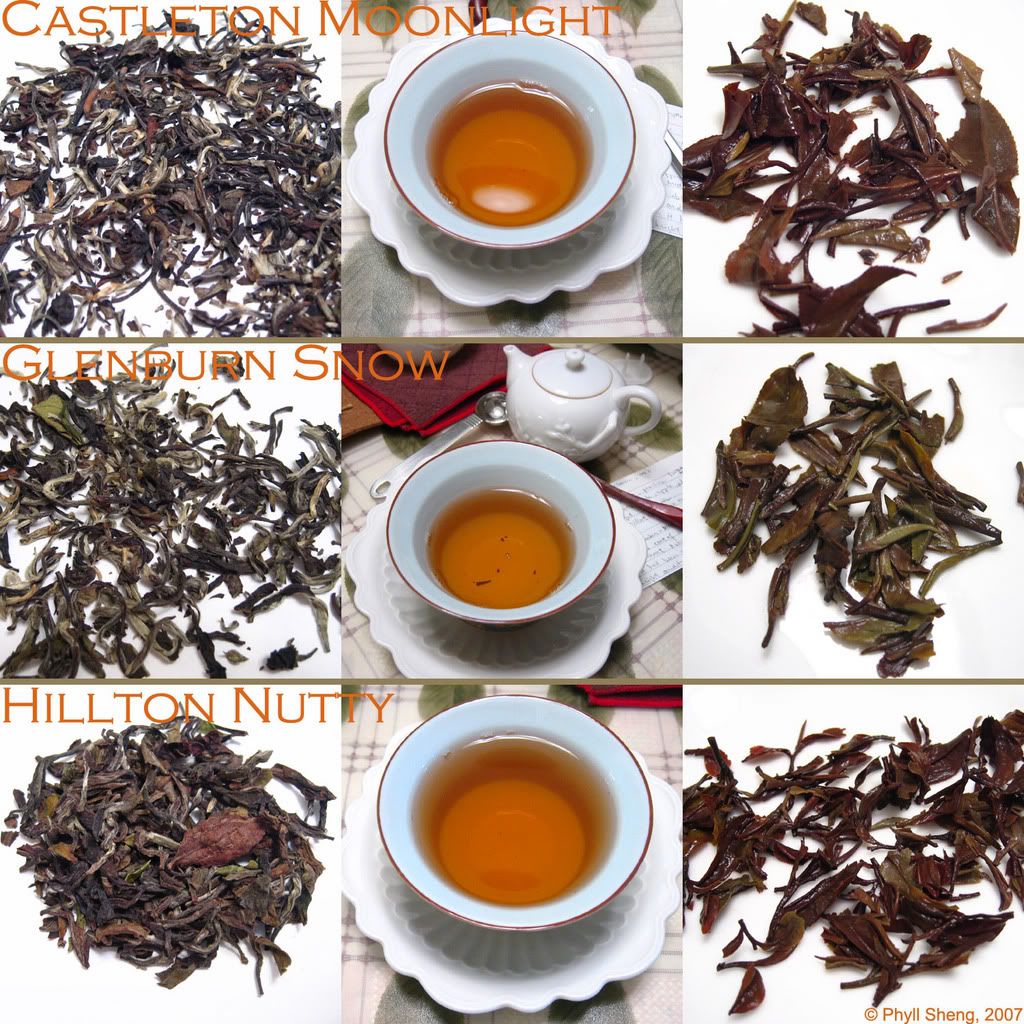
    T Ching's 1st Online Tasting: Darjeeling Oolongs

    CLICK ON THE IMAGE FOR TASTING NOTES

    Click here for the high resolution images.

    Friday, February 23, 2007

    Guangxi Liubao Teas, A Comparison

    A number of posts ago, I mentioned briefly about the Three Cranes brand Guangxi Liubao tea ("3 Cranes") that I brewed with some fresh ginger to help alleviate my nasty cold symptoms. Since I recovered, I have had this tea a few more times. Last night, I brewed it alongside an older loose Liubao tea from the early 1990’s (“1990 Loose”) for a side-by-side comparison.

    The differences in their overall quality are quite apparent. The 3 Cranes is consistently made up of small, diced leaves, compressed into the shape of a bird nest (tuocha). The 1990 Loose, which originally came loose in a large bamboo basket weighing 50 jins (25kg/55lb), is made up of larger cuttings, twigs and a small amount of almost-whole leaves.


    Three Cranes 2000 Guangxi Liubao (tuocha)
    Source:
    Jing Tea Shop
    $5 /100gr tuo

    Parameter: in a 120ml gaiwan, filled half-full with dry leaves. Boiling water. 10 seconds rinse, and then infused for about 10s, 10s, 10s, 15s, 20s, 20s, 30s, 45s, stop.

    Compressed into a bird’s nest form (tuocha), the leaves are small, broken, and dark brown in color. The liquor has high clarity. It appears rather viscous and easily opaque when infused with the stated parameter. The nose is woody and grassy/vegetal. Full bodied with a silky texture. Finishes short, clean and rather green. It’s a tea that comes across rather simple, yet there is absolutely nothing unpleasant about it.

    2.5 stars (mg – g)

    VL of the Tea Logic blog had posted a well-written tasting note on the 3 Cranes (
    click here).


    While the liquor of both teas are dark and deep-colored, I observed that the 3 Cranes is more opaque and more viscous than the 1990 Loose. Relative to each other, the 3 Cranes is fuller bodied than its older peer. Soy milk thickness comes to mind about 3 Cranes’ full bodiedness. They are both silky smooth.

    Taste wise, both teas are easygoing (read: simple), pleasant and soothing. They are woody, earthy, clean-tasting and without any unsettling pond-y or moldy smell. The 3 Cranes has a green/grassy/vegetal edge on the nose. The 1990 Loose, on the other hand, gives a sweet, woody smell with a tinge of mocha.


    Early 1990 Guangxi Liubao (loose leaves)
    Source:
    Houde Fine Tea
    $9.50 / 2oz (57gr)

    Parameter: about the same as applied to the 3 Cranes tea

    Mostly larger cuttings, twigs and some whole dry leaves, the color is deep brown and it smells like fresh wood/bark with a tinge of chocolate. The liquor is almost opaque-brown and high in clarity. Medium to full body with silky smooth texture. A simple tasting tea, yet this woody-earthy tea has a charming sweet aftertaste with a hint of metallic note. The first sip of each subsequent infusion celebrates and amplifies the sweet lingering aftertaste from the previous cup. Enjoyed for 8 infusions, but the tea could go for a few more.

    3.5 stars (g – vg)


    The most obvious difference in their taste is, actually, in their aftertaste. The 3 Cranes finishes short, clean, green, but not much else. The 1990 Loose finishes a touch metallic yet sweetish throughout. I really like the sweet aftertaste of the 1990 Loose that lingers for a long time. The most delicious part of this tea comes at the first sip of the next cup after resting for a couple of minutes in between infusions. That first sip somehow amplifies the lingering sweetness from the cup prior. Very nice. For this, I think the 1990 Loose is hands down the more interesting tea of the two.

    A Little About Guangxi Liubao
    The name of the tea itself is actually the name of the place where the tea is produced. This tea hails from a town named Liubao in the Cangwu County of Guangxi province.

    At its heart, it is a black tea that underwent a wet fermentation process to mellow out the tea’s taste. The wet fermentation technique (“wo dui” in Chinese) is the same process used to make Yunnanese cooked/ripe/shou pu’er. Basically, fully oxidized leaves are exposed to a high degree of humidity in order to accelerate the fermentation for a certain period of time until the desired level is achieved. Unfortunately, I am not privy to any information on which cultivar Liubao tea is made from.

    Teamakers in Guangxi had employed the wet fermentation technique for at least a couple of decades (around 1950's or earlier) before their Yunnanese counterparts adopted a similar technique in the 1970's. Guang of Houde Fine Tea said:

    “I was told when Kumming tea technicians learned the cooked skill of Liu Bao from Guangzhou, the cooked process still took ~ 8 months to complete. A slow "cooked" process, with less fermentation degree. So 70's and 80's cooked puerhs are mostly kind of like "semi-cooked" in our current standard.

    Since early 90's, they kept "improving" the cooked process and now it only takes about 1 month to complete.

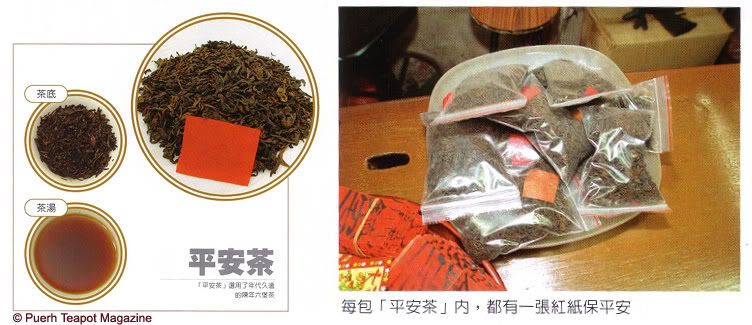
    Liu Bao was not only used in restaurant in HK/Macao, it was also often used in Temples to pack as "Pin An Cha" (you know Pin An - meaning safe) in a little plastic bag with a square red tag in the bag. Especially during Chinese New Year, people like to go to the Temples and receive the "Pin An Cha" for the safety in the following year.”


    Mr. Chan Kam Pong in his new book “First Step to Chinese Puerh Tea” wrote:

    "Guangxi Liubao (广西六堡) is the special production of Cangwu (苍梧) County, Guangxi province. Liubao was mainly exported to Southeast Asia through Hong Kong. Overseas Chinese always brew this tea because the taste of Liubao is smooth and rich in addition to its aging capacity. It was said that overseas Chinese stored Liubao at home as simple medicine for treatment of dysentery in the old days and for relieving mild illness(es)."

    (First Step to Chinese Puerh Tea, pp 52-53, by Chan Kam Pong, Wushing Books Publication Co. Ltd., 2006)

    Short Conclusion
    At this tasting, the 1990 Loose is certainly the better of the two. After tasting the 1990 Loose, I think a good quality aged Liubao tea can give a similarly aged cooked pu’er a run for the money.

    Will the 3 Cranes' grassiness evolve into something else as it ages? I will report back in a few years. I'm keeping several tuos for long term storage, and one tuo has been broken up and kept inside a porcelain jar for frequent visitations.

    Monday, February 19, 2007

    Red-Wine Spaghetti With Broccoli Rabe

    My wine friend, Gumby (not his real name), got this recipe from Easy Entertaining with Michael Chiarello and posted it on Winexiles. I decided to try it out in lieu of the traditional Chinese noodle dish that is served during the Lunar New Year celebration. My wife and I loved it, though she thinks it’s a bit too spicy.

    Red-Wine Spaghetti with Broccoli Rabe
    (6 generous servings)

    1 3/4 pounds broccoli rabe, thick stems discarded
    1 pound spaghetti
    1 bottle red wine (750 ml - preferably zinfandel)
    1 teaspoon sugar
    1/3 cup extra-virgin olive oil
    4 garlic cloves, finely chopped (2 tablespoons)
    1 teaspoon dried red hot pepper flakes
    3/4 teaspoon salt
    1/2 teaspoon black pepper
    1/2 cup grated Parmigiano-Reggiano

    Cut broccoli rabe into 1-inch wide florets. Blanch in a 6 to 8 quart pot of boiling salted water, uncovered, 2 minutes. Transfer with slotted spoon to a large colander to drain, reserving broccoli-cooking liquid in pot, then transfer broccoli to a bowl.

    Return cooking liquid to a boil and cook spaghetti, stirring occasionally, 5 minutes (pasta will not be fully cooked). Reserve 1 cup of pasta water and drain pasta in colander and return empty pot to stovetop.

    Add wine and sugar to pot and boil vigorously 2 minutes until liquid is reduced a bit. Add spaghetti and shake pot to prevent pasta from sticking. Gently stir with tongs until coated and boil over high heat, stirring occasionally, until most of the liquid is absorbed, about 6 minutes (pasta will be al dente).

    Immediately after adding spaghetti to wine mixture, cook garlic and red pepper flakes in the olive oil in a large, deep skillet over moderately low heat, shaking skillet occasionally, until garlic is pale golden, about 5 minutes. Add broccoli, salt, and pepper and cook, stirring, 1 minute. Add 1/2 cup of reserved pasta water. Pour broccoli into skillet with the spaghetti mixture and carefully toss with tongs to combine (skillet will be very full). Cook while stirring, about 2 minutes. Remove from heat, season with freshly ground black pepper and drizzle with a bit of olive oil.

    Stir in the grated cheese. Serve immediately.


    Phyll's Note:

    - Broccoli rabe can be substituted with spinach
    - I used a round, supple and fruit forward H.R.M. Rex Goliath zinfandel ($7.99)
    -
    The dish came out a little too spicy. I recommend using a bit less red hot pepper flakes
    - I added 1/4 lb of ground chicken and 1 cup of diced orange bell peppers for added color and acidity


    Wine pairing suggestion: this dish is bold tasting. The combination of red hot pepper flakes, black pepper, fruity zinfandel, and the slightly bitter broccoli rabe makes this dish tastes gutsy! So we paired it with a bottle of 2002 Domaine Baumard Savennieres ($18) from the Loire Valley. It excellently balanced the dish out. The wine was lithe and lively with fuji apple, orange rind, lime and pear. We think this dish would also go well with a kabinett level German Riesling or an Alsatian Pinot Gris.

    Saturday, February 17, 2007

    Happy Lunar New Year!


    A Prosperous New Year
    May It Be So Year After Year
    (Now, Give Me The Red Packet :)

    The incoming lunar year is 4705 of the boar zodiac.

    Ah, another Chinese / Lunar New Year. Time does fly, doesn't it? This time of the year always brings me down the memory lane to the years when I was just a snotty little boy in my hometown Jakarta. Since my dear paternal grandmother (rest her soul) lived with us -- coupled with the fact that my father is the eldest among his siblings -- we played host to all the uncles, aunts, cousins, and their friends. The custom is to pay our respects to our elders. Therefore, on the first and second days of the Chinese New Year, my house was always rowdy with me running around playing with my sisters, cousins and friends. One of the best part as a kid, of course, was receiving the red packets (hong pao) full of cash from the grown ups.

    The next few days were usually filled with trips to the homes of other relatives and friends to whom we owed customary visits to. The trip usually started early in the day, and the first destination was always my maternal great-grandmother (both of my grandfathers and my maternal grandmother had passed away before I was born). After staying for a couple of hours at her house, without forgetting to receive the red bounties, we moved to visit other relatives and friends of the family. Each visit we made usually involved some sweet treats or another! The good ol' days.

    Now as a parent, I need to make sure that my daughter gets to experience that growing up. My wife will make sure that she gets to experience the customs of Russian and Jewish holidays. And the both of us will also need to expose her to wonderful American traditions. What is life if not for these customs that let us share such moments together and feel belonged?

    Happy New Year to all whether or not you celebrate the Lunar New Year! May you and your loved ones be blessed with health and well being.

    Friday, February 16, 2007

    How To Host an Afternoon Tea Party

    It is always fascinating to reflect on the different ways people around the world enjoy their tea. Whether it is sipped from a fragile porcelain cup, a large earthen bowl or a thimble-sized clay cup, and whether it is taken ceremoniously or not, tea plays an important role of being a social lubricant in every society.

    Mr. David Clifton of Oxford University was kind to share his intimate knowledge on how to host a gracious afternoon tea party and the intricacies of its preparation. Without further ado, here are his elegant words:

    The actual tea as such is a minor part, and doesn't require as much attention as if you're serving someone familiar with Chinese tea. While the event of afternoon tea is something of an institution with which most people will have some familiarity, the actual leaf you use is a secondary concern. Remember that you're trying to appeal to a
    broad range of tastes, so don't pick something too far from the mainstream (such as lapsang souchong, Earl Grey, etc.). Darjeeling is a classic for afternoon tea; or pick a robust, unchallenging blend.

    Far more important is the attention that you pay to where you serve tea, how you serve tea, and in what you serve tea. If you're billing it as "afternoon tea", use your best china: a delicate, appealing pot, pleasant cups, matching saucers, and matching plates if you can. At the very least, don't use mugs / saucerless cups, or anything stained or chipped, if you can avoid it. It's time to break out your "Sunday best". There's no right answer, but the more effort you put in, the more honour you're paying your guests, and the more touched they'll be.

    Standard issue afternoon tea usually comes with some home-made (by you!) scones, halved, and placed on a central plate. A small selection of jams (not marmalade) in small pots (with small serving spoons). A few curls of butter (not margarine or sunflower spread) placed in another dish. Most people would rather have a crumbling, poorly-constructed scone made by you than something androgynous bought from a shop. It doesn't matter if you got it wrong, but at least you tried. Never, ever serve "store food" (i.e., bought pre-made from a store) at afternoon tea - it's a great way to get people to question your taste. Officially, store food is for convenient only, and something one eats when one must. Definitely not at afternoon tea. I have known people to never return to a hotel based solely on the fact that the cakes were obviously store-bought.

    Crustless small sandwiches (quarter-slice triangles) and small cream cakes are always good. We don't usually take muffins and those sorts of small baked goods for afternoon tea, but a Victoria Sponge or similar can be a classic. Delicate biscuits *perhaps*, but they're getting close to being categorised as "store food" unless they're particularly fine. Of course, home-made biscuits are great (but never cookies, which are anathema to afternoon tea).

    Offer a single jug of good milk (of any variety as long as it's not 100% skimmed - semi-skimmed is least controversial these days), and have a bowl of brown and white rugged-cut sugar lumps (ideally with serving tongs). One little plate per place, butter knife, teaspoon, cup-and-saucer, napkin.

    Pick a pleasant place for tea, with some pleasant unintrusive music (fresh and gentle). Clear and clean the table, pick a decent tablecloth. Unless you're going for a rustic farmhouse-style event, don't pick the kitchen table (and only go for a rustic farmhouse-style event if you have access to something approximating a rustic farmhouse). Fresh flowers in a small, understated arrangement are just fine.

    Accommodate, don't capitulate. You're the host, and what you pick is, by default, what they will have. They have no choice, you're the boss, and you shouldn't pander to their every anticipated whim. Believe in yourself and have the confidence to understand that they are obliged to enjoy what you serve, as long as it's carefully done with no obvious tat (shop cakes, rough mugs, unpleasant teapot, poor setting).

    Like Basho said, "learn the rules, then forget them". Afternoon tea is all about bringing a little gentility back to the busy world, so take it slowly. Prove to your guests that the art of conversation isn't dead, yet. :)

    Everyone loves afternoon tea. Whether for gossip or for that particularly type of profundity that usually only arises from the nether regions of a pub, the fact that it is still with us is one of the more encouraging aspects of modern life.


    The article above was first posted on Rec.Food.Drink.Tea discussion board, and it is posted here with Mr. Clifton’s express consent. Contact David Clifton.

    Photo (c)
    Silks restaurant at Stonehedge Inn, Tyngsboro, MA.

    Thursday, February 15, 2007

    My First Darjeeling Oolongs

    In anticipation of the T Ching online tasting event, I purchased 100gr of Hillton Ebony and 50gr of Okayti Ivory -- both Darjeeling oolong teas -- to experiment with from Wild Orchid Teas in Sylvania, Ohio. Thanks to Mr. Ankit Lochan who recommended this excellent vendor.

    The Okayti is lightly oxidized, while the Hillton is highly oxidized. Both are only partially oxidized in order to achieve the "oolong" designation. Several sources recommend using 1-2 tsp of dry leaves with 6 - 8 oz of boiling water in a pot for 5 minutes. So I brewed the Okayti following the tea:water:time ratio recommendation in a small porcelain pot. Also, I used a small gaiwan filling it 1/2 full of dry leaves and brewed the tea in short (seconds), multiple infusions.

    How was the tea and which method yielded a better brew? I can't say for sure yet, though the Okayti Ivory is quite an aromatic and smooth tea by nature, whether brewed in seconds or in 5 minutes. More experimentation to be done with the Hillton Ebony as well.