Tuesday, October 31, 2006

Happy Halloween! Would You Like Some Wine With Those Candies, Dear?

Excuse me, are you going to eat that candy? With wine?! With a 20-year-old tawny port wine?!?!?!

Sure, why not!

DCist.com has created a candy-wine pairing suggestions, inspired by 2 New York City's full-service dessert restaurants (they don't serve anything but yummy desserts),
ChikaLicious and Room 4 Dessert.

Here are what DCist.com suggests:

Candy Corn +
Elio Perrone Moscato d’Asti ($15)
The sheer, slightly effervescent Moscato is the perfect foil for creamy and addictive candy corn. The wine, which is chock full of peach and apricot notes, is a great match for candy corn’s orange dreamsicle flavors.

Hershey's Miniatures +
La Sera Red Malvasia ($14)
The old standby of Halloween candy, the bag of Hershey’s miniatures, receives a fun new lease on life when it’s paired with this fuschia-colored fizz that tastes like fresh raspberries. Because this wine is red, and thus has a slightly fuller body, it’s not overwhelmed by the chocolate, which can be difficult to pair because of its thick, mouth-coating texture. Best of all, it handles Special Dark and Krackel with equal aplomb.

Snickers +
Taylor Fladgate 20-Year-Old Tawny Port ($50)
A 20-year tawny, which oddly is more an indication of style than of age, is going to set you back a few bucks, but we’ll bet you’ve never had a better high-brow/low-brow pairing. Tawnies have a silky, rich texture that stands up to the thick caramel/nougat/chocolate combo of Snickers. Plus, tawny ports -- especially those with age indicated on the label -- are known for their heady, nutty aromas.

Butterfinger +
Chambers Rutherglen Muscat ($17/375 ml)
From Australia comes this liqueur wine that is one of the sweetest in the world. Due to its high sugar content and extremely viscous texture, it is commonly referred to as a "sticky" (spill a drop on the table and you’ll agree). It also smells and tastes just like toffee in alcoholic, liquid form. No better match here than a Butterfinger.

Read the
full article here at DCist.com.

My personal favorite dessert-wine pairings are:

  • Vanilla ice cream topped with thick and sweet late harvest zinfandel

  • Crème Brulle with Hungarian Tokaji (4 or 5 Puttonyos)

  • Strawberry shortcake with a glass of Sauternes (Sauternes also goes well with raw oysters. Love the salty-sweet contrast!)

  • Godiva Chocoloate Cheesecake (from the Cheesecake Factory) with a glass of tawny port

  • Mosel-Saar-Ruwer Eiswein, just by itself
  • Monday, October 30, 2006

    New Cha He and Oriental Beauty

    It feels like it's been forever since I last posted. Work, home projects and chores had taken over my life in the past 2+ weeks, and not to mention the ongoing quarrel on Winexiles. It's always exciting when there is a quarrel of some sort...it makes everything more alive, but not when I'm being pulled left and right (literally, by the Republican conservative members vs. the liberal members) to resolve matter even handedly. Sigh.


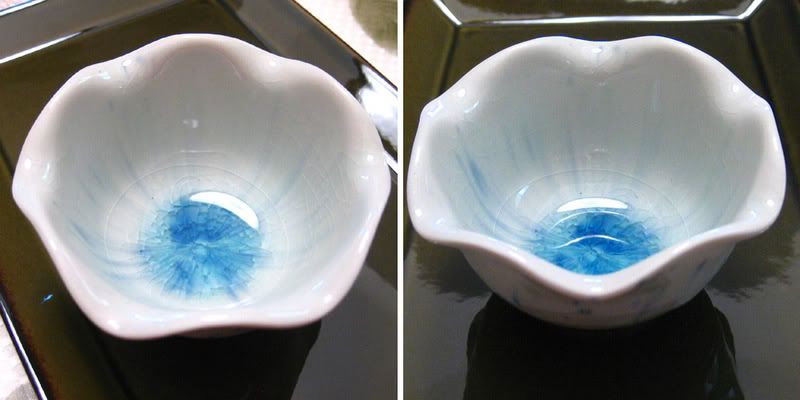
    Anyways, I met a worthy replacement of my cha he (tea leaves holder) that committed suicide on me a few weeks ago. While visiting the Bamboo Tea House near my office a few days ago, I found this Japanese-made bowl that is perfectly shaped as a tea holder. Its sexy lips guide the tea leaves into any vessel with minimum spill. For just USD $8, it's a beautifully made ceramic cha he.

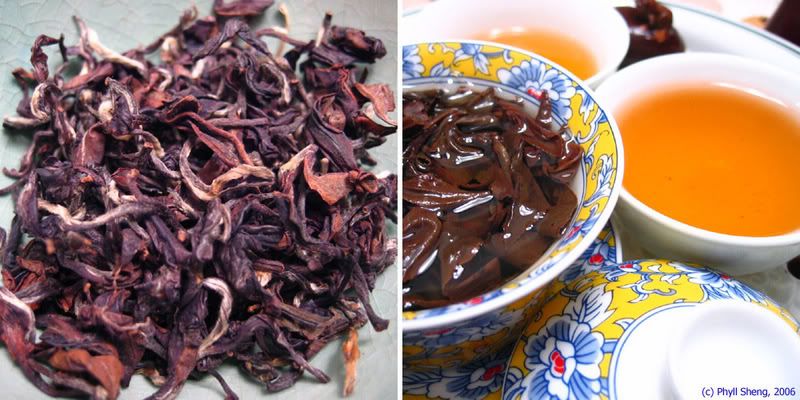
    2005 Summer Oriental Beauty Oolong
    Source: Teamasters

    Stéphane Erler was very kind to send me a sample of this Oriental Beauty oolong tea (aka: bai hao oolong, dong fang mei ren). Thank you.

    This Oriental Beauty was quite refined. It reminded me a lot of some of the best 1st flush Darjeelings I've had, but without the usual astringency and bite. It's well rounded, soft and smooth in the mouth with a complex taste of various tropical fruits and of something subtly sweet.

    This tea does not brew bitter, which is a good thing. When I was brewing it for the 2nd infusion, I suddenly had to help with my daughter (diaper change, yeah). As a result, the tea was brewed for a good 5 to 7 minutes before I decanted it (the previous 1st infusion was only for a few seconds). I expected a very bitter and astringent tea. But, no! Its taste held up well under such a long brew, and yet it gave almost no bitterness or astringency. Yes there were a little bit of bitterness and astringency, though the tea was still pleasant to drink. Thereafter, I was able to brew this tea for 7 or more times, which means it has good brewing durability.

    4 stars (vg)

    Wednesday, October 11, 2006

    Doodle

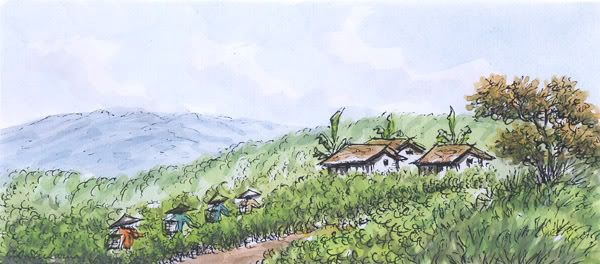
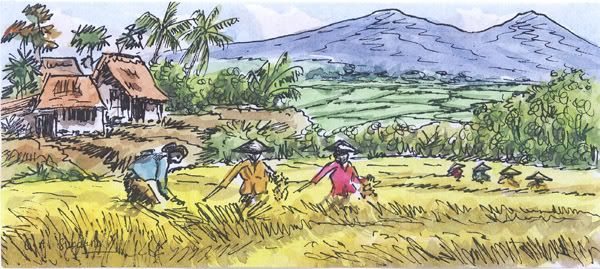
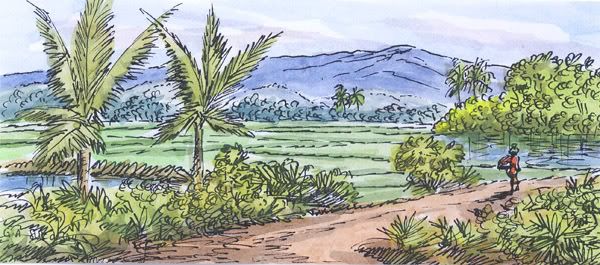
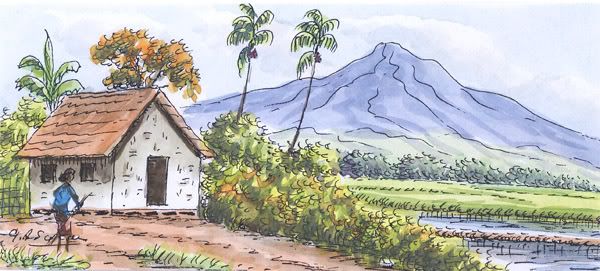
    Water color paintings of rural farmlands and tea fields in Western Java. I obtained these paintings while vacationing with my family there. The first two depict tea harvesting.


    2002 Coutet St. EmillionSo with your overflowing passion you would like to grow grapes and make wines. Where do you start? You need a nice piece of terroir that will give birth to the wines of your dream.

    Say you love Cabernet Sauvignon, how about this Napa Valley parcel for $3,900,000:

    "Estate site with Silverado Trail address near Dariush and Reynold Family Winery. 10 plus plantable acres, already staked 8x5. Park like setting to the Napa River 1400sf cottage, natural stone exterior fully landscaped, trellis cover patio, great vineyard hills and river views."

    Perhaps your passion lies with Malbec, instead. Then this winery in Argentina might do for a mere $489,000:

    "Amazing winery that shows very well with 1,113,000 liter capacity located on the main highway (188) between Buenos Aires and Chile and only 2km from the center of the city, General Alvear. . The winery has a 3 bedroom/1bath apartment attached to the property."

    The above properties and others are
    listed here.


    2002 Coutet St. EmillionHave you tried L'Occitane Green Tea Shower Gel before? It's quite nice and uplifting in the morning. It reminds me of Tai Ping Hou Kui (monkey king) green tea, but sweeter.

    Photo: L'Occitane

    Sunday, October 8, 2006

    Weekend Notes

    In Memory of Jeffrey Kneebone

    J. Kneebone
    1959 - 2006

    I uncorked a rare gem from Rasteau in remembrance and in honor of Mr. Jeffrey Kneebone (aka: Verdiball), a Baritone extraordinaire and a friend. Jeff was very passionate in what he did in life. His intense love for the opera can only be matched by his love for the nectar that is wine. Though I have never met him in meatspace, I’m glad to have been acquainted with him through the cyberspace for the past 2+ years. We have formed a friendship, as all other Winexilers had with him. I have only fond memories of him, his wisdom and intelligence in our exchanges. I really miss his presence on Winexiles. Jeffrey passed away [pdf] on August 1, 2006 from melanoma.

    A bunch of Winexilers gathered together on Saturday 10/7/06 at NYC’s Café Loup to celebrate and remember Jeffrey by fondly. I almost went to NYC, but a family circumstance prevented me from going. In his memory, I decided to open this special gem. As one winexiler said: “Verdi, I hope wine is legal in heaven.”

    2003 Sassira2003 Domaine des Escaravailles “Sassira”, Rasteau, Rhone
    (~300 cases produced, $27, if you can find one)

    Inky purple. Subtle and shy on the nose (going through dumb period?). But once it’s inside the mouth, it knocked my socks off! A powerful wine. It is concentrated, intense, full body of soy milk texture, and simply exhilarating. Boysenberries and blackberries of the highest intensity and concentration on the palate. A leathery aroma is also present. A coffee, dark chocolate and spicy rosemary finish that is long and persistent. This is a big-big wine with dusty tannin. At 15% alcohol level, it is balanced by lively acidity and fruit. I simply couldn’t put my glass down! A very balanced wine and impeccably detailed. An Hermitage in a Rasteau bottling! This wine should evolve finely and easily over 5+ years, probably even 10+ years.

    4.5 stars (vg - ex, due to a rather shy nose. Otherwise, it's a 5-star wine)

    Background information on the wine: Sassira is the flagship bottling and most limited item from Domaine Escaravailles. Only 300+ cases of this wine were made. From 30-60 year old vines, the Sassira is 90% Syrah with the remainder Grenache. This wine was not fined or filtered. This wine is extremely difficult to procure – it is one of the hardest Rhone wines to acquire outside of the Rhone Valley.
    The Sound of Music That is Zhuni

    What is the sound of Zhuni? Guang of Houde on his blog demonstrated some of his priced possessions to the world. It is simply a beautiful music to the ears of those who value the beauty of premium Yixing teapots. As a side note, the last pot in this video clip is none other than the late 18th century (mid-Qing Dynasty) "Fu Yuan Ting" Long Dan Zhuni that I mentioned about in my previous post. It is up for grab for just US $3,250 (also notice the pot's shine!). Now that I can listen to it online, I don't need to spend money for it. I can brew my tea in my humble $4 gaiwan and drink it while listening to the *pinging* of his zhuni collection. :o)


    2002 Coutet St. Emillion
    2002 Chateau Coutet, St. Emillion
    $20


    Plump, juicy, watery (light bodied), with reserved oaky-ness. Blueberry predominant. This is an easy going quaff. It went well with the Domino’s Pizza I ordered. Although 2002 was just an RP 89pts vintage year in St. Emillion, I’ve had a $7 Washington state merlot of similar, if not better, quality year in and year out.

    2+ stars (mg-g)

    Thursday, October 5, 2006

    TN: 2006 Meghma Garden Oolong, Kalikhop Valley, Nepal

    2006 Meghma Esate Nepalese OolongSource: The Simple Leaf
    $15 / 4oz

    Here is a pleasant tasting and highly aromatic oolong from Nepal. It’s certainly a new kind of animal for me! From observing the dry leaves, this oolong looks and smells like a good second flush Darjeeling tea of BOP (Broken Orange Pekoe) grade mixed with some OP (Orange Pekoe) grade. It smells like a mix of tropical fruits (mango, peach, citrus, orange peel), muscatel and floral honeysuckle.


    I brewed this tea in several different ways to see how it reacts to different brewing methods: “gongfu” method with a gaiwan (lots of leaves, short infusions), “English” method in a porcelain teapot (little leaves, long infusion time of >3 minutes), as well as “office” method (vacuum thermos, little leaves, daylong brewing). I found the “middle path” method to be my personal choice for this tea. Middle path in this case is a method between the gongfu and the English styles where I use my larger (~400ml) Yixing pot, ~2 tablespoons of leaves, and medium infusion time of about 45 secs to 1 minute for each brew. Let me explain why.

    I felt that the gongfu method yields an intense brew but not quite an aromatic liquor, as if the tea’s perfume did not have enough time to infuse itself out. The English method yielded a tea that I thought was a bit too acidic for my taste, and so does the office style especially after several hours in the thermos (although the nose is very vivid and appealing). As such, the “middle path” brews a tea that is not too acidic, yet smooth, perfumy with a hint of honey aftertaste.

    The Simple Leaf provided this
    background information about the producer and the tea's characteristics.

    “It exudes the aroma of the native Daphne bholua and Rhododendron plants. With a light and smooth liquor and a trace of honeysuckle flavor …. Founded in 1999, Meghma Garden is in the Kalikhop valley in the Ilam District in the far northeastern corner of Nepal. Nestled in the lap of the mighty Himalayas, Meghma Tea Estate is situated at an altitude of 7,000 feet, far away from the modern world. This makes it one of the highest tea growing areas in the world. This small estate produces hand-rolled all-natural teas."

    What I still don’t understand about this tea is the description of “hand rolled” in the product information. Is this definition identical to when one refers to pellet-shaped (fisted) Chinese oolong leaves? The leaves of this Nepalese oolong certainly are not fisted. Or perhaps “hand-rolled” means differently when we are discussing Indian and Nepalese tea processing techniques? Does it perhaps mean the leaves were “bruised” by hand and not by a machine?

    Another observation is that the picture of the tea on The Simple Leaf’s website looks much greener and more colorful than what I received. Has it been further oxidized during storage and so it lost its color vibrancy? The Simple Leaf claims that the tea was harvested in early August of 2006, which is only 2 months since this tasting note was written.


    Overall, a pleasant tasting and aromatic everyday kind of tea. Due to its shape and size, this tea is quite sensitive to infusion time. I agree with whoever said it would make a very refreshing iced tea, though I think serving it warm brings out its charms better.

    Tuesday, October 3, 2006

    R.I.P. My Tea Holder

    Rest In Peace
    March - October 2006

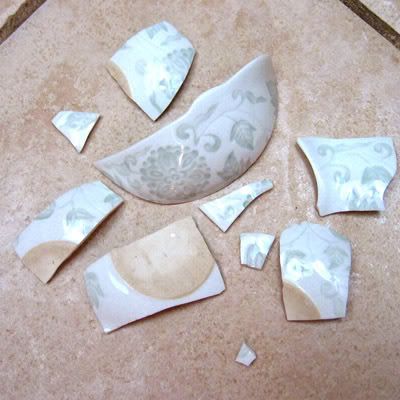
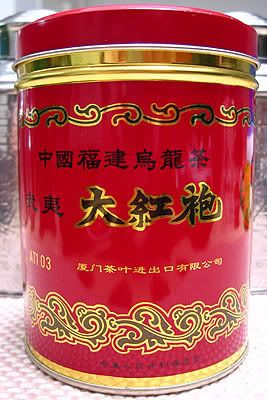
    It's a sad day. My porcelain tea holder has commited suicide. It leaped out of my hand while I was drying it gently after washing and crashed on the floor. No suicide note, though I suspect the severe trauma from having held some repulsive Da Hong Pao leaves just minutes before was what caused it to end it all.

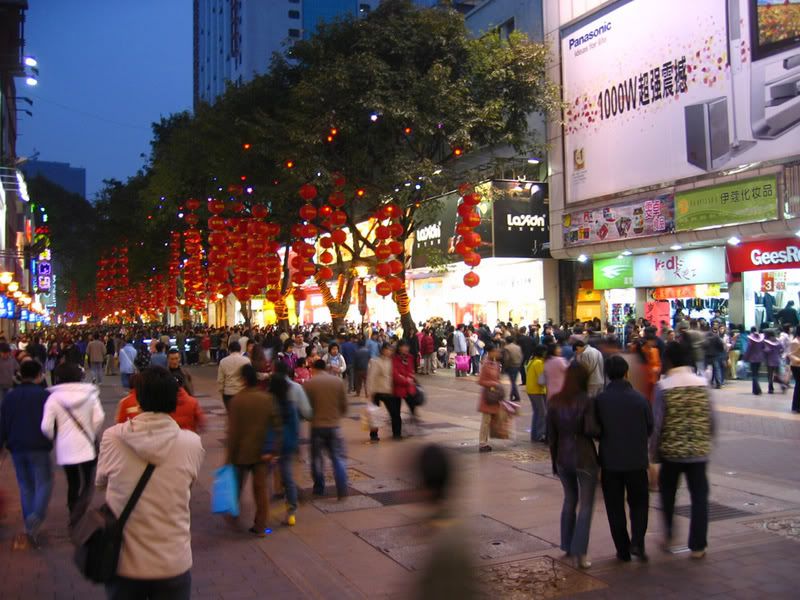
    I met it in Guangzhou in March of 2006 at a tea store on the popular Bei Jing Road. It's been a loyal tea companion during its short time with me. It will be missed.

    Monday, October 2, 2006

    Weekend Notes

    Az Agr 2001 Uccelliera Rapace IGT, Toscana

    2001 Uccelliera RapaceI won this 2001 Uccelliera Rapace from Winebid.com, an internet auction site. The Rapace is a modern style Super Tuscan made of primarily native Sangiovese varietal blended with “foreign” Cabernet Sauvignon and Merlot, and it is aged in small French barriques. Traditional Tuscan wines, on the other hand, never use Cabernet Sauvignon or Merlot, and they are aged in large old barrels (mostly made from Slovenian oak wood).

    Uccelliera also makes excellent traditional Tuscan Brunello and Rosso di Montalcino. The winery is located just outside of a village named Castelnuevo del'Abate in the southeastern corner of the Montalcino D.O.C. (Denominazione di Origine Controllata). Its vineyards face the southwestern exposure. The 2001 vintage was considered an excellent year in Tuscany.

    Tasting Note:
    2001 Uccelliera Rapace, Toscana
    ($30 retail, won on winebid.com at $15/bottle)

    Intense, deep garnet color with a slight brick-ish red hue on the rim. The brick-ish hue had me worried at first that this wine had gone over the hill, but I was proven wrong. Focused nose of black berries, plums and a certain earthy notes. Fresh from opening, the wine was still very tight and tannic, so I decided to decant it. While decanting, I noticed that this wine had thrown some sediment.

    An hour later, the wine had somewhat softened, giving a complex nose of casis, along with those mentioned above. The texture turned slightly softer and creamier. A certain improvement already.

    About 24 hours later in the decanter, all the good aspects of the wine seemed to have melded together, giving it a certain complexity with an added touch of coffee and sweet eucalyptus aromas. Long finish.

    I would give another year until I open the second of the 3 bottles I won.

    4 stars (vg)

    Torrontes Wine

    2005 Finca de DomingoAs part of Winexiles twice-monthly online tasting, I tasted something that I’ve never tried before: a wine made from the Torrontes varietal. If not for my fellow wino Bodegatejas, who is a professional grape grower, a winemaker, and a Spanish grapes maestro - from whom various wineries buy wine grapes - I would never have thought of trying this varietal, let alone knowing it exists.

    What is Torrontes? Bodegatejas explained on Winexiles:

    “Torrontes......which produces a wine whose aroma is a tumultuous outpouring of tropical fruit, candied peaches, lychee nut, rose petals and other floral hints. Its flavors rush into the mouth, with bright ripe fruits similar to the ones found in the aroma, with an extra zing of spice and acidity for good measure. Needless to say, this is not a wine for the faint of heart.

    Torrontes is a grape emanating from the Galician region of northwest Spain. There it is commonly used in wines from the sub-region of Ribeiro (not to be confused with the more popular wines of Ribera del Duero). Though you won't hear much about Spanish Torrontes, the same-named grape flourishes in the dry climate and mountains of Argentina. It is not clear whether the grape is identical in both countries, but who really cares? The main thing to remember is to look for Argentinean Torrontes, which has a strongly perfumed, distinctive character.”

    The wine which I was able to find locally was the Argentinean example. I couldn’t find any Spanish Torrontes. An interesting note: the fruit that goes into this wine is grown 1 mile above sea level.

    Tasting Note:
    2005 Finca de Domingo, Torrontes, Cafayate (5600 meters above sea level), Salta, Argentina
    $10

    Muy bien! Color was clear, yellow-white. Immediately a nose of lychee and white flowers that reminded me of Alsatian pinot gris. There was this saltiness in the nose, as if I was smelling fino sherry. In the mouth, it striked me that this wine reminded me very much of the classic Tio Pepe Fino Sherry in its briny, ocean breeze character (no nuttiness as in Tio Pepe). The body was quite full, yet at the same time light feeling, as if it's foamy. Intriguing taste, but the finish was rather short.

    A simple dinner of grilled king salmon seasoned with dried dill and drizzled in olive oil complimented this white wine very well.

    3 stars (g)

    2000 Muga Reserva Rioja

    2000 Muga ReservaAs I’m writing this post, I am also sipping my Spanish favorite: 2000 Bodega Muga Reserva, Rioja. The strange thing about it is that the wine is in its 26th hour of decanting and it has evolved beautifully! Why strange? A year or so ago when I opened a bottle of the 2000, it tasted quite beautifully right from the start (though far from reaching its maturity or peak). It was immediately elegant and approachable, showing balanced dark fruits, gentle oakiness with a hint of violet floral-ness.

    I decided to open my last bottle of the 2000 last night and I was sorely disappointed, at first. The wine tasted extremely tart and tight. I was certain that the wine was still in a good shape and not yet over the hill. Color was fresh purple, with no hint of brick-ish red. Nose was of sour cherry and dark plums. Taste, however, was like esophagus-corroding acid...though not quite vinegary. I had about 5 sips and each one made my face cringe. I almost threw it all out down the sink, but I decided to decant it instead.

    12 hours later, the wine softened a bit and was less tart, but it still was too tart.

    26 hours later, this wine is now showing its elegant self…the way I remembered it last year. Nice!

    0 star, right after uncorking (poor)
    3+ stars (g -vg) after 26 hours in a decanter

    Thursday, September 28, 2006

    TN: 2006 Traditional Dong-Ding "Hong Shui" Oolong

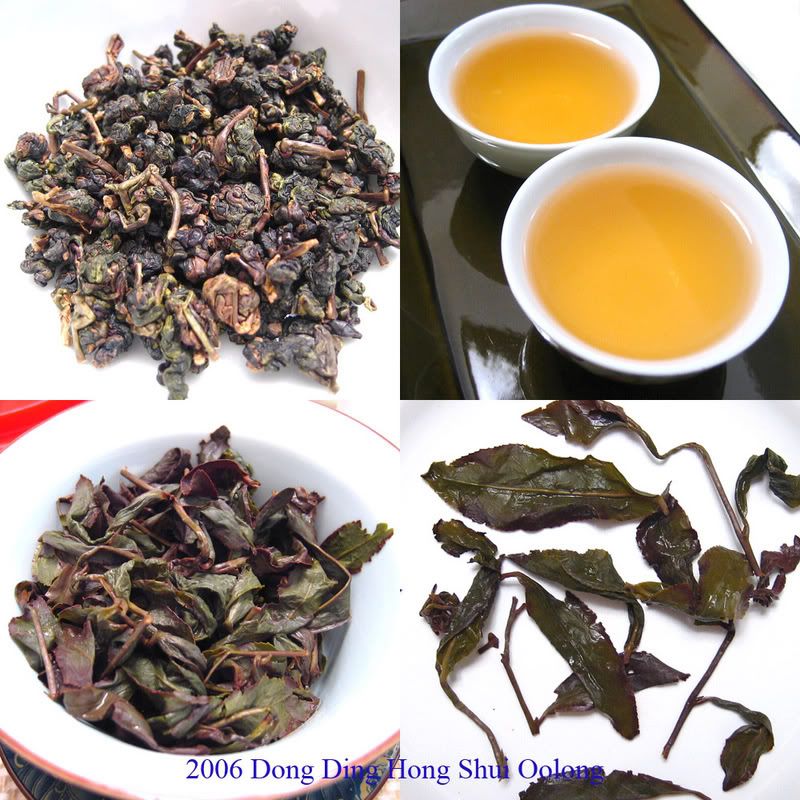
    2006 Dong Ding Hong ShuiOver the past few days, I tasted on several occasions a traditional type of Taiwanese Dong Ding oolong called 红水 (Hong Shui or Red Water). This style of oolong is more oxidized (~60%) and less roasted than most Dong Ding oolongs commonly found in the marketplace today, or at least where I live in. Apparently, according to the product description [pdf], this is the way Dong Ding oolongs used to be crafted before it later evolved to the less oxidized (~30%) and heavier roasted style that is now widely available.

    In response to my inquiry, Guang, the proprietor of
    Hou De, said “There is a ‘retro’ trend among Taiwan's tea drinkers recently. And the Hong-Shui oolong is getting more demand than before." His blog also explains the close ties that this Hong Shui style shares with Anxi Tie Guan Yin and Wuyi Yan Cha oolongs: the appellation of Lu Gu in Nantou County, Central Taiwan, inherited Anxi’s processing heritage and Wuyi’s oolong cultivar, and later also employed Wuyi’s processing philosophies, which resulted in the birth of the Hong Shui style.

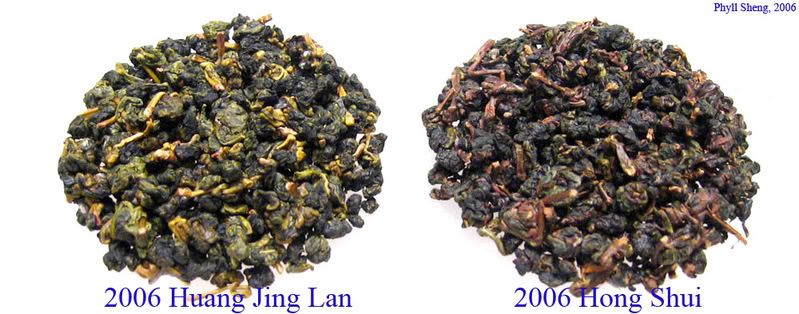
    Compare the dry Hong Shui to the Huang Jin Lan (Golden Orchid) oolong, which is ~25% oxidized and lightly roasted (also in Hou De’s inventory).

    2006 Huang Jin Lan & Hong Shui

    Tasting Note:

    2006 Traditional Dong Ding "Hong Shui" oolong
    From Hou De Fine Asian Arts
    $12.50 / 2 oz

    Green-red, tightly fisted leaves (dry). Leaf pellets open up to wholesome and stalky dark green leaves with heavy streaks of redness due to the oxidation. Brown-red liquor. This is an interesting oolong altogether. It is quite different from the other Dong Ding oolongs I've tried. The highly oxidized and light roasting technique gives it the aroma of yellow fruits (dried mango, apricot and peach come to mind) and a whiff of lightly roasted grains. There is also caramel, which is especially found "on the bottom of the empty cup" and from the hot damp leaves. The liquor itself gives a tint of sweetness in the mouth, which persists in the back of my throat for quite long after swallowing the smooth liquid. Medium, rounded body, which in my opinion is good when compared to some Dong Ding oolongs that have good “nose” but hollow mouthfeel. I agree with Guang's observation on the Wuyi oolong taste resemblance in this tea, to some extent. In my view, this is a complex and very enjoyable oolong.

    4 stars (vg)

    Tuesday, September 26, 2006

    "Tea is like eating silver."

    The Good EarthThe Good Earth Poster

    The old man continued to cough perseveringly and would not cease until the water boiled. Wang Lung dipped some into a bowl, and then, after a moment, he opened a glazed jar that stood upon a ledge of the stove and took from it a dozen or so of the curled dried leaves and sprinkled them upon the surface of the water. The old man's eyes opened greedily and immediately he began to complain.

    "Why are you wasteful? Tea is like eating silver."

    "It is the day," replied Wang Lung with a short laugh. "Eat and be comforted."

    The old man grasped the bowl in his shriveled, knotty fingers, muttering, uttering little grunts. He watched the leaves uncurl and spread upon the surface of the water, unable to bear drinking the precious stuff.

    "It will be cold," said Wang Lung.

    "True -- true -- " said the old man in alarm, and he began to take great gulps of the hot tea. He passed into an animal satisfaction, like a child fixed upon its feeding. But he was not too forgetful to see Wang Lung dipping the water recklessly from the cauldron into a deep wooden tub. He lifted his head and stared at his son.

    Buck, Pearl S., The Good Earth, Chapter 1, Washington Square Press, 1931

    Sunday, September 24, 2006

    TN: 2004 Marquis de Goulaine, Rosé d’Anjou “La Roseraie”

    04 Rose d'AnjouA good rosé is a high quality wine of terroir. Too bad that in the US most people regard a wine that is neither red nor white as unsophisticated. For good reasons too. Most "pink wines" from California, which produces the majority of US pink wine output, are made with 2 things in mind: quantity and revenue maximization. These are usually made from the zinfandel variety, though lately other grape varieties such as merlot, syrah, and grenache have seen their share of pinkness.

    The wineries in Provence, Loire and other regions in France, on the other hand, are very passionate about their rosés, which have been perfected for centuries. These areas produce some of the most interesting rosés that I think are worlds apart in quality compared to the ocean of pink plonks produced in California.

    I looked into my wine fridge and found that I still have 4 bottles of rosés (a Côtes du Rhône, a Tavel, a Côtes de Provence, and this Anjou) that I had planned to open during the summer. Gotta drink them up soon lest they get stale by next summer!

    TN: 2004 Marquis de Goulaine, Rosé d’Anjou “La Roseraie”
    ($11 regular, purchased for $7 at Chronicle Wine in Pasadena).

    Lively pink-red color. Plenty of tropical fruits soaked in subtle rose water. This wine is bright and refreshing. Its high notes and acidity livened up the palate and made the wine seem sweet, though there is barely any residual sugar. At 11%, it is quite a nimble wine. Dry finish. This is a pleasant wine that is far from being a cliché, yet perfect for easygoing enjoyment. A good bargain!

    3 stars (g)

    Thursday, September 21, 2006

    Super-Hyped Vintage 2005 Bordeaux

    The October 2006 issue of the Food & Wine Magazine features Robert Parker’s take on the ultra-hyped vintage 2005 Bordeaux wines long after the first futures was offered. It is akin to an updated review on the vintage. Commentaries like Parker's are relevant to wine collectors in order to get a sense of perspective; have we been sucked in by the senseless frenzy of the market? It serves to calm down buyers’ anxieties.

    Here is the article in Food & Wine Magazine, issue October 2006.
    (If the link is broken, the PDF version is available here)

    3 years ago in 2003, still reeling from the disappointment of missing the 2000 en primeur boat, I decided to get into the excellent 2003 Bordeaux en primeur market. I only purchased 3 cases, one of which is a Sauternes sweet wine. By that time, the recently released vintage 2000 Bordeaux had reached stratospheric prices in the stores.

    We are seeing this 2000 mania again with the “BEST EVER!” 2005 vintage Bordeaux. The market for 2005 wines is super-hyped left and right, up and down by everyone from the producers to the retailers, as well as by wine writers. All these have helped drive futures' prices for the 2005 vintage to become the highest ever in the history of Bordeaux.

    I’ve decided to forego the 2005’s overpriced futures for something that I love as much: 2005 pu’er teas and 2005 German Rieslings. They are both as ageworthy as fine Bordeaux, and maybe more so.

    What is en primeur / futures?
    It is basically buying your wine in advance, before it’s even bottled. The grape juice is practically still inside the oak barrels at the Chateaux when you buy it. Major critics and buyers travel to Bordeaux to get a first-hand taste on the juice and evaluate their potential. Then the wines are offered to the consumers by the importers/wholesalers/retailers. This is why consumers rely heavily on their favorite [supposedly] independent wine critics/writers/publications, such as Michael Broadbent, Steven Tanzer, Robert Parker, Decanter Magazine, Wine Spectator Magazine, etc. as guides.

    It is also, basically, an educated gamble. Depending on subsequent news and critics’ reviews, a wine produced by a particular Chateau may appreciate or depreciate in value before it even hits the retail floor. Therefore, it can be said that if you buy a futures for $30/bottle and this particular wine hits retail at $40/bottle, your investment has appreciated by 33.33% or you have saved 25% off retail price (not taking into account future value of present dollar, etc). However, the opposite may also happen. Some win, some lose.

    Read The Wine Doctor’s excellent article about en primeur to learn more.

    Monday, September 18, 2006

    Weekend Notes

    Package From Tea Masters
    a
    Package from Tea Masters
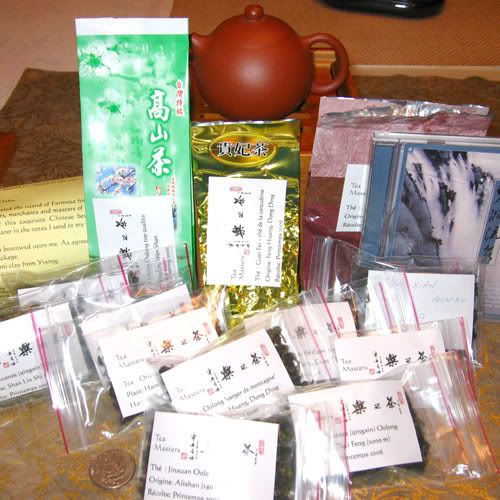
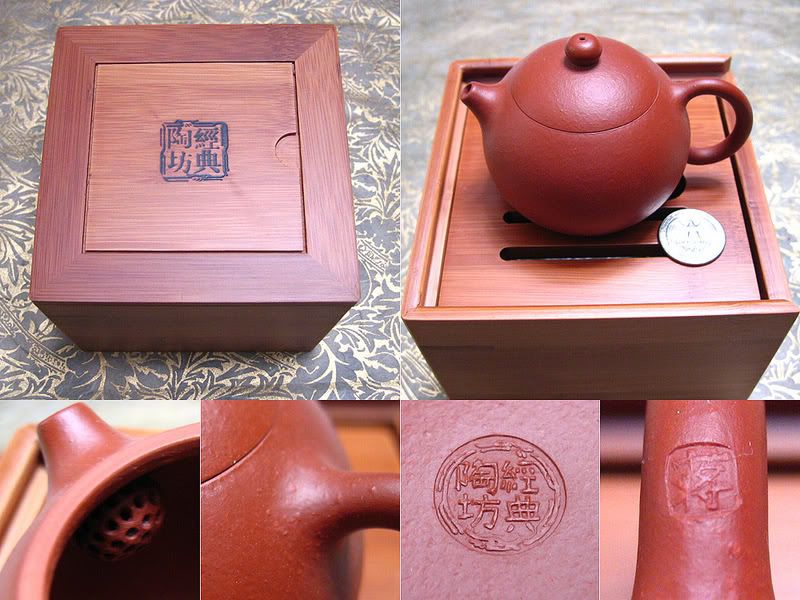
    A highly anticipated package finally arrived this weekend from Monsieur Erler in Taipei. I purchased from Stéphane (of Tea Masters) a small zhuni Xishi Yixing pot and a variety of oolong samples from his product selections. Stéphane really paid a lot of attention to the details, down to the littlest of things on the labels, packaging and the well-written cover letter (with deliberately-burned sides for visual effect!). I felt like receiving a package from a very dedicated and boutique-y teashop. Having tried a few of his selections, including his 2003 Yiwu pu’er and 2006 Dong Ding "classic" oolong, I can confidently say that he had carefully chosen his products to include only the very high quality. Moreover, his approach to customer service is simply responsible in all manners, which is more than one can ask for. To wit, Tea Masters is among one of the best and most reliable vendors out there, and it has set the standard bar very high for other vendors to match. Praise where praise is due.


    Zhuni "Xishi" Yixing Pot From Tea Masters (100 ml)

    Xishi Yixing Pot
    If Marie Antoinette’s bosoms were dedicated to Champagne saucers, then the realm of Chinese teas has Lady Xishi to thank for. At least that’s how I view a Xishi teapot should look like. I decided to purchase it from Stéphane because, first and foremost, of its very sensual shape. Most Xishi teapots out there do not have the shape that is as “appealing” as this one, in my humble opinion. Ok, so I maybe have a fixation on breasts…I mean, who doesn’t? It’s the perfect symbol of mother nature.

    So how is the teapot? Outstanding! Good clay, great proportions, excellent workmanship, swift pour, and perfect lid fit that is airtight and not drippy. It is the epitome of satisfaction a Yixing can give. I think it’s an excellent buy for the quality. It’s too soon to say what it’s for, but I am thinking of dedicating Da Hong Pao with it.


    04 le Clos du Caillou CdR

    2004 Domaine le Clos du Caillou, Côtes du Rhône, Vieilles Vignes (Old Vines)
    $22

    "We assembled a blend of 75% Grenache, 15% Syrah, 5% Mourvèdre and 5% Carignane for our Cuvée Unique. Think blackberries dusted with baking spices, juicy cherries dipped in dark chocolate—simply a blockbuster Côtes du Rhône! Our selection of the finest lots of the vintage includes wine from some 37 older barrels, blended with wine from two different tanks and a few larger foudre. Hard work—but it definitely paid off. This is unmistakably the best of Châteauneuf-du-Pape, in a bottle of Côtes du Rhône."

    TN: Beautiful, lively young, deep ruby red color. Refreshing nose of blue and black berries, red cherry, pencil shavings, and soft oak. Some minerality came through. Soft and silky mouthfeel with fine tannin. Medium finish (20 secs) with a light coffee and chocolatey aftertaste. Good acidity level complements the overall taste to make the wine feel vibrant. On the second day (stored with inert gas to preserve freshness), some stewed strawberry taste emerged.

    I think this is good wine to accompany lamb chops, osso buco or that $15 hamburger at a fancy restaurant.

    3+ stars (g - vg)


    04 Drouhin Chablis

    2004 Domaine Joseph Drouhin Chablis
    $20

    Vivid nose of gooseberries, citrus, pear and sweet ripe apple…and the absence of oak, of course, which is Chablis. I prefer my white wines non-oaked nowadays because oak masks the true characters of such a delicate type of wine. In the mouth it is quite lean, bordering on being watery. Dry and crisp, with bearable amount of acidity. I was expecting daggers from the acidity, which is common in young Chablis. Better nose than mouth, I say.

    This wine makes for a good aperitif to accompany light salad with vinaigrette dressings or fresh raw oysters! It should also go well with light seafood dishes.

    3 stars (g)

    a

    a

    a

    a

    a


    Wuyi Weekend

    06 DHP

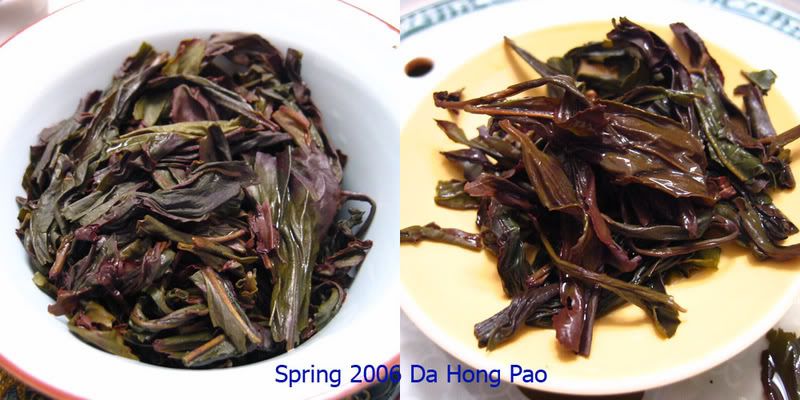
    Spring 2006 Da Hong Pao from Teaspring.com. A lighter fired version of Da Hong Pao that I found to be very good. Complex tastes and aromas of flowers, fruits, caramel and some greenness, all this with an undertone of soft roasted taste. I enjoyed it very much. According to Daniel Ong (the proprietor), the lighter-fired oolong such as this should be at its apex in about 3 years time.

    a

    06 BJG

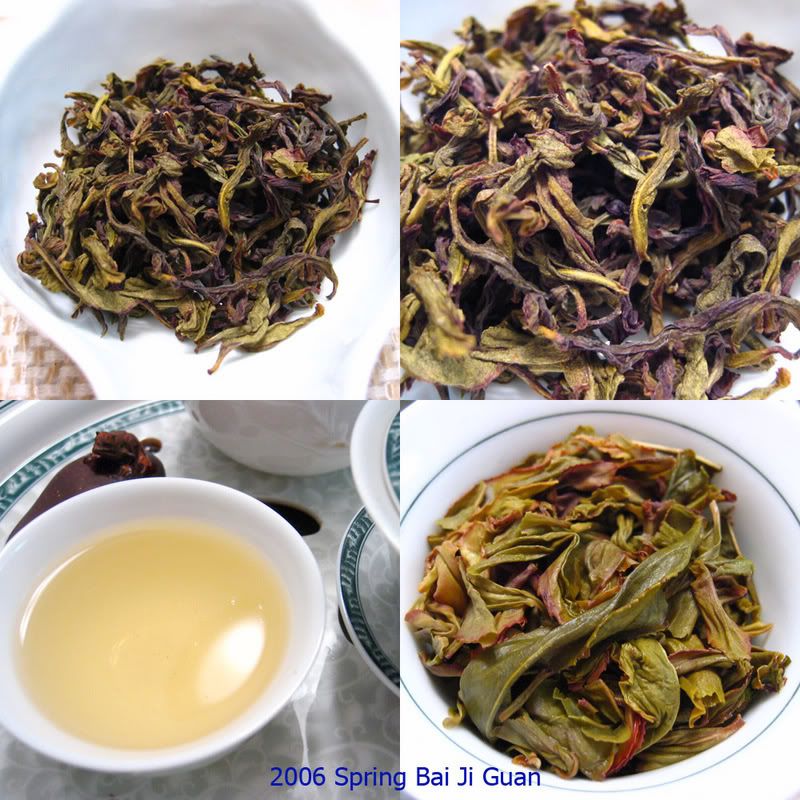
    Spring 2006 Bai Ji Guan from Teaspring.com. This Bai Ji Guan is quite green! It’s quite hard to describe the aroma profile of this tea…I don’t think I have the vocabularies for them yet. Can anyone please tell me to what usually the aromas of Bai Ji Guan is attributed to? It’s light bodied and mild.

    a

    a


    06 SJG

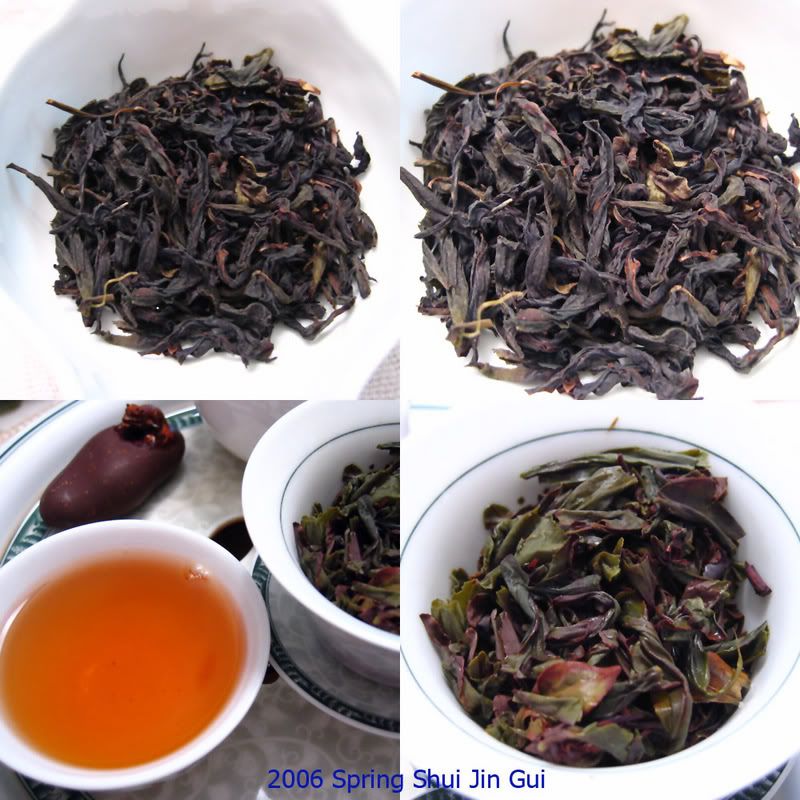
    Spring 2006 Shui Jin Gui from Teaspring.com. The Shui Jin Gui is a bit more roasted than the Da Hong Pao, and it exhibits herbal characteristics reminiscent of Chinese medicine…the tolerable one. It’s kind of soupy in a way that it reminds me of the herbal chicken soup with a potpourri of Chinese herbs in the mix. Interesting, but an acquired taste for me.

    a

    a

    06 SJG
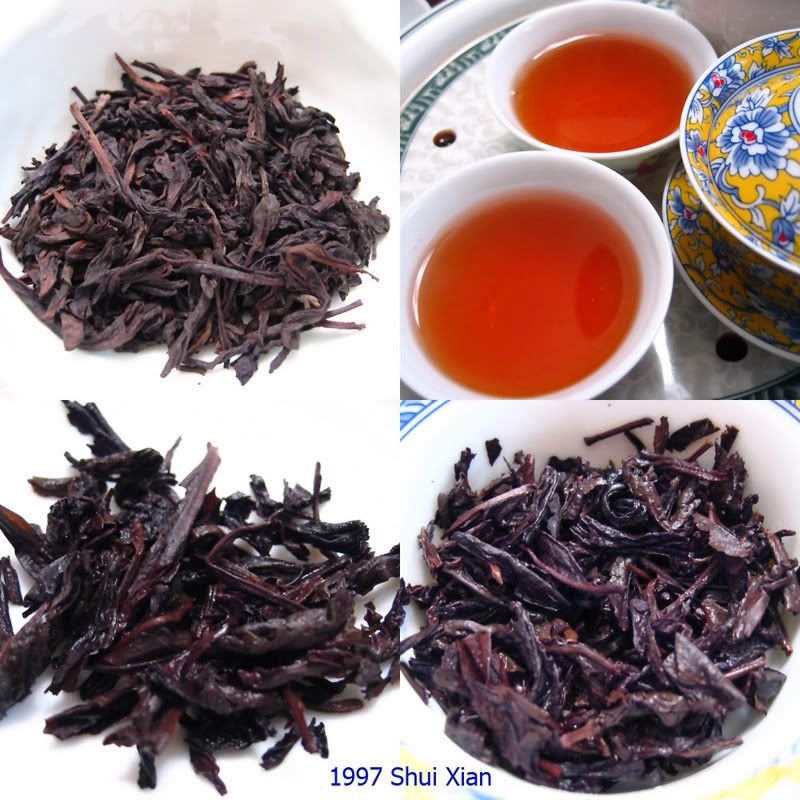
    I also tasted a 1997 Shui Xian sample from Stéphane (Tea Masters). This tea exhibits a chocolatey nose and something that reminds me of toffee. On the palate, the first thing I noticed was its obvious astringency, as if there is a drop or two of lemon juice in my cup. The mouthfeel is pretty good…medium bodied and smooth. There is no smokiness or any heavy roast taste, perhaps due to the aging effect?

    Friday, September 15, 2006

    In Another Very Important News...

    "If you have to drink something that comes in a can, Snapple is probably as good as you can get.”
    ~ Michael Bloomberg, NYC Mayor

    Now, that's funny!


    Thursday, September 14, 2006

    Marketplace Today: Rare Classics For Sale

    Some very rare items that may make the most jaded tea and wine enthusiasts giddy have just become available on the market today.

    Garagiste Wine in Seattle sent out an e-mail offer to their registered mailing list customers for two rare Burgundy wines:

    1971 Domaine de la Romanee Conti “Romanee Conti”, 750ml, $5,986.63

    1966 Domaine de la Romanee Conti “Grand Echezeaux”, 750ml, $2,867.80

    Garagiste is a specialty wine shop located in Seattle. They offer limited production wines as well as very-hard-to-find wines via daily e-mails. Past offerings have included rare vintages of top estate wines from all over the world that most enthusiastic wine collectors would aspire to have in their cellars. At the moment, however, I can only continue to dream owning some of their offerings.


    Hou De Fine Asian Art has just made a late 18th century Yixing pot available on the market for a handsome price of $3,250. I highly commend the transparency of information provided by Guang (the proprietor) about this rare antique. In the description, he noted that through his observation of the clay, the craftsmanship, and the seal, this piece is an authentic mid-Qing dynasty pot made from the precious zhu ni clay. To be safe, he also noted that when the clay, the craftsmanship and the seal are observed independently, “Nothing alone leads me to have a 100% confidence,” though as a whole he is confident of its authenticity.

    Per Guang’s observation, factor-by-factor:
    Clay: 75% sure [that it is a mid-Qing dynasty antique]
    Craftsmanship: 80% sure [that it is a mid-Qing dynasty antique]
    Seal / Sign: 60% [sure that it is a mid-Qing dynasty antique]

    Bravo! Although I can not afford it, I appreciate this kind of open and personal opinion from a reliable vendor. I have been – and I suspect I will continue to be – a satisfied customer of Hou De for their more affordable teas and teawares.

    Wednesday, September 13, 2006

    New York Times & Washington Post on Chinese Teas

    Here is an article published today in the New York Times on the Chinese gong fu tea preparation and ceremony. It does a nice job of connecting fine teas with fine wines for readers who are more familiar with the latter. Click here for the article.

    Another article in the Washington Post reports that vintage Chinese teas dating as far back as 1949 is available at the Park Hyatt Hotel in Washington, DC. I guess folks there can now shun away that $300 Krug Champagne and instead spend the money on a potful of 1985 vintage tea. Here is the article.

    The above articles are as a breath of fresh air after reading the other article -- about a clueless tea businessman in Lake Tahoe -- which I mentioned in my previous post.