Wednesday, January 17, 2007

2003 Silver Dayi (Menghai) Pu'er

Thanks to Mr. Chan Kam Pong (Managing Editor of The Art of Tea magazine) for sending a 10gr sample of this tea to many people worldwide, including me. The organized online tasting was, I think, a success.


Parameter: Boiling filtered water, 5-10s rinse, 10s rest, then 10s, 10s, 10s, 10s, 15s, 15s, 20s, 45s, 1m…

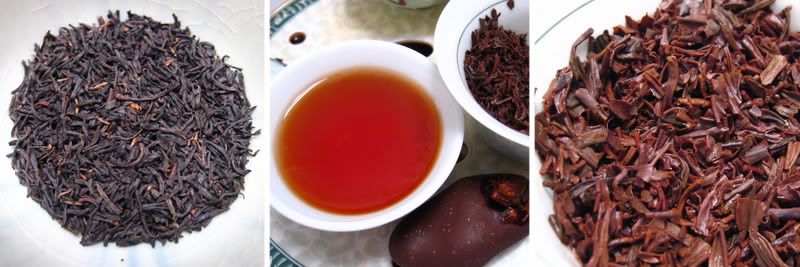
Dry leaves: Dark brown-green with downy silver buds strewed sparsely. The sample that I received was quite broken up. In a warmed gaiwan, the dry leaves gave off a pleasant floral whiff and sweet-sour plum note. A bit of smoke came through, though it was not unpleasant. Excellent nose overall.

Wet leaves: Smokey, plummy, woody, and floral. Bright and uplifting. Smoke was quite dominant.

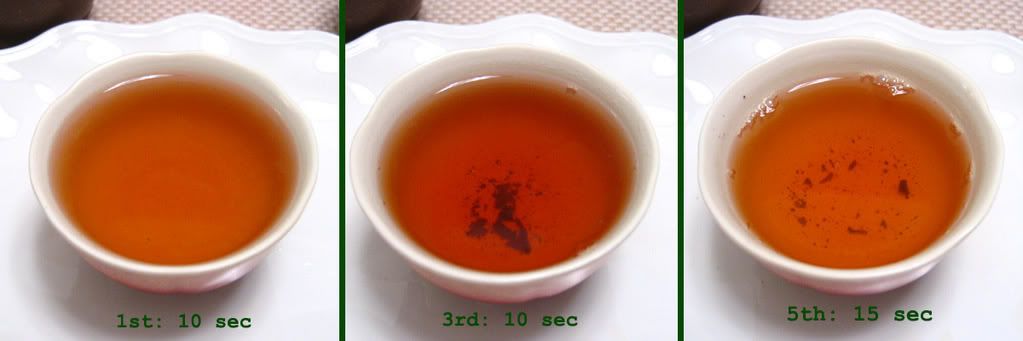
Liquor: Amber-brown color with varying intensity, depending on the steeping time given. Clarity was decent, though not crystal clear throughout all infusions. The first brew came off fruity – it mostly reminded me of yellow plums and ripe, sweet apricots – and also a bit of smoke. The brews thereafter were assertive and intense, with bitter gourd-like taste. The caffeine buzz hit me pretty hard at around the 4th infusion. On the 6th brew, the camphor/woody aroma showed up, as if it had been hiding behind the intensity and bitterness all along. Brewed nicely for 9 infusions before going downhill.

Medium bodied. Good, wholesome mouthfeel. Went down quite smoothly, leaving a mouth-coating dusty tannin and a cooling effect, which was then followed with a bitter-sweet aftertaste that turned sweet on the back of the tongue and far down the throat for a long time. Pretty impressive.

An excellent tea all around, though it is still too primary and brutish for immediate enjoyment. I can imagine it being a good candidate for long term aging.

More about this tea (warning: a long post with many pictures...slow download)

Monday, January 15, 2007

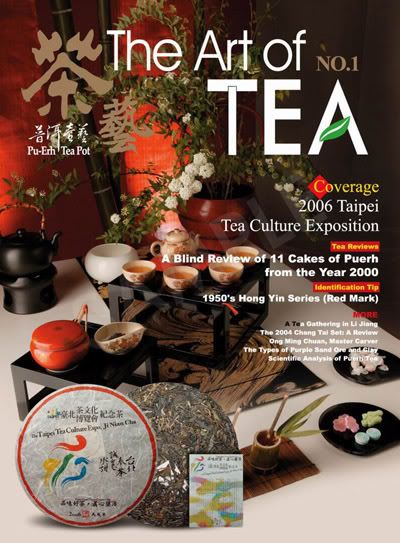
The Art of Tea Magazine

The Art of Tea 1The Art of Tea magazine debuted last month. For English speakers who are interested in Chinese teas and its culture but have found a general lack of in-depth printed information, The Art of Tea fills this near-void. It is being published by the publisher of Pu-Erh Tea Pot, a popular Chinese language periodical that is mainly sold in Asia.

Being an English-written descendant of a pu-erh-centric publication, the first issue has its fair share of articles on pu-erh. However, it also strives to be a Jack of all trades with comprehensive pieces on oolongs, Yixing pots, history, farming, arts, travel, philosophy, cooking (with tea), as well as the Japanese art of flower arrangement (Ikebana). The first issue is 192-pages thick and printed on high quality paper.

Contributors are mainly tea industry insiders, published authors, as well as passionate enthusiasts. As such, the magazine offers insight beyond the generic information commonly available online or within the blogosphere. Most of the articles are translated directly from the Chinese language, and it shows. Typos and awkward translation appear frequently, though in my humble opinion they do not alter substance.

I personally think that – despite the available room for improvements – The Art of Tea is a boon for Chinese tea enthusiasts who have found language to be a barrier to industry news, trend and general understanding.

The publication is seasonal. Subscription and individual magazine are available from
Houde Fine Asian Art and Yunnan Sourcing LLC . My understanding is that the publisher is currently working with a US-based publication house to make The Art of Tea available at newsstands nationwide.

Thursday, January 4, 2007

Happy New Year 2007!

Happy New Year everyone!

Since I last updated this blog, I enjoyed some excellent as well as not so satisfying teas and wines.

1997 Beringer Cabernet Sauvignon Private Reserve, Napa Valley ($100)
It seemed like this wine had gone over the hill -- though still palatable -- like the previous 2 bottles I opened in 2005. It was oaky and only a shadow of the fruits remained. I was quite dissapointed, again. Either this wine was improperly stored by the supplier, by Costco -- where I got 3 bottles from in 2004 -- or that this particular vintage and bottling was short-lived by nature or by craft, despite coming from a very good year. 1-2 stars.

2004 Seghesio Old Vines Zinfandel, Sonoma County ($26)
Nice. Lively acidity with good flavor intensity of red/black fruits and that classic zinfandel's peppery finish. It's still a bit too primary (young) and the tannins was tight. In 2 years or so this wine should sing better. I think its 2001 and 2003 siblings were slightly better, but the 2004 was delicious, too. 3.5 stars.

N/V Billecart-Salmon Rosé Champagne ($55)
As always, a delicious and classy rosé Champagne. When in the mood for a good and [relatively] affordable rosé bubbly, you can't go wrong with this baby. Yum! 4 stars.

Magnum of N/V Dampierre Cuvee de Ambassadeur, Champagne ($75/magnum)
Also a good bubbly that had a talcum-like taste and texture. Fine mousse and bubbles. 3 stars.

I had these excellent teas:

Anji Baicha
Despite the word “Bai” (白: white) in its name, I've been told that it is technically a roasted green tea. Anji Bai Cha hails from the Anji county in Zhejiang province.

I love this tea! The thin grass-like leaves are full of life and health. Its bright green color is almost luminous and lend it a delicious appearance. Surprisingly, it manages to not smell grassy. This tea is vibrant with aromas of white flowers, sweet almonds and a hint of basil undertones. The aroma of the brewed liquor reflects fairly the aroma of the dry leaves. Its excellent mouthfeel is subtle, yet round, supple and mouth watering. Finishes with an impressive sweet aftertaste that lingers on. 4 stars (vg)

Parameter: 165 – 175 F spring water. About ¼ full of dry leaves in a gaiwan. Start with 30 seconds then adjust to taste.

Anji Baicha (a slightly higher grade than the one above)

Dry leaves are of medium to dark green with some yellow tint. When steeped, each shoot opens to reveal a one-bud-one-leaf or one-bud-two-leaves system. The liquor gives a sweet taste and a pleasant floral, peanut, honey, and fresh cut grass aromas. This tea somehow reminds me of a fragrant rice / mealy concoction. It finishes sweet in the back of the throat with a long lasting hui gan. The rice-y character becomes more pronounced with each subsequent brew up until the 4th or 5th, when the leaves are spent. Medium bodied with a smooth and sweet finish. 3.5 stars (g – vg).

Parameter: 165 – 175 F spring water. About ¼ full of dry leaves in a gaiwan. Start with 30 seconds then adjust to taste.

Zhenpin Lu Xue Ya

The dry leaves look very appealing and are similarly shaped to the bamboo tea leaves of Mount Emei (aka: Emei-shan Zhuyeqing), except that the leaves of this Lu Xue Ya are slightly larger, darker and meatier. Some are coated neatly with white down. This tea’s mealy characteristic along with bamboo, oatmeal, honey, hay, and sweet floral aromas is wonderful! The soymilk-like texture of the liquor and its wholesomeness add to the complex beauty of this tea. A pleasure to drink! 5 stars (outstanding).

Parameter: 165 – 175 F spring water. About ¼ full of dry leaves in a gaiwan. Start with 30 seconds then adjust to taste.

And a tea that I wished I could enjoy:

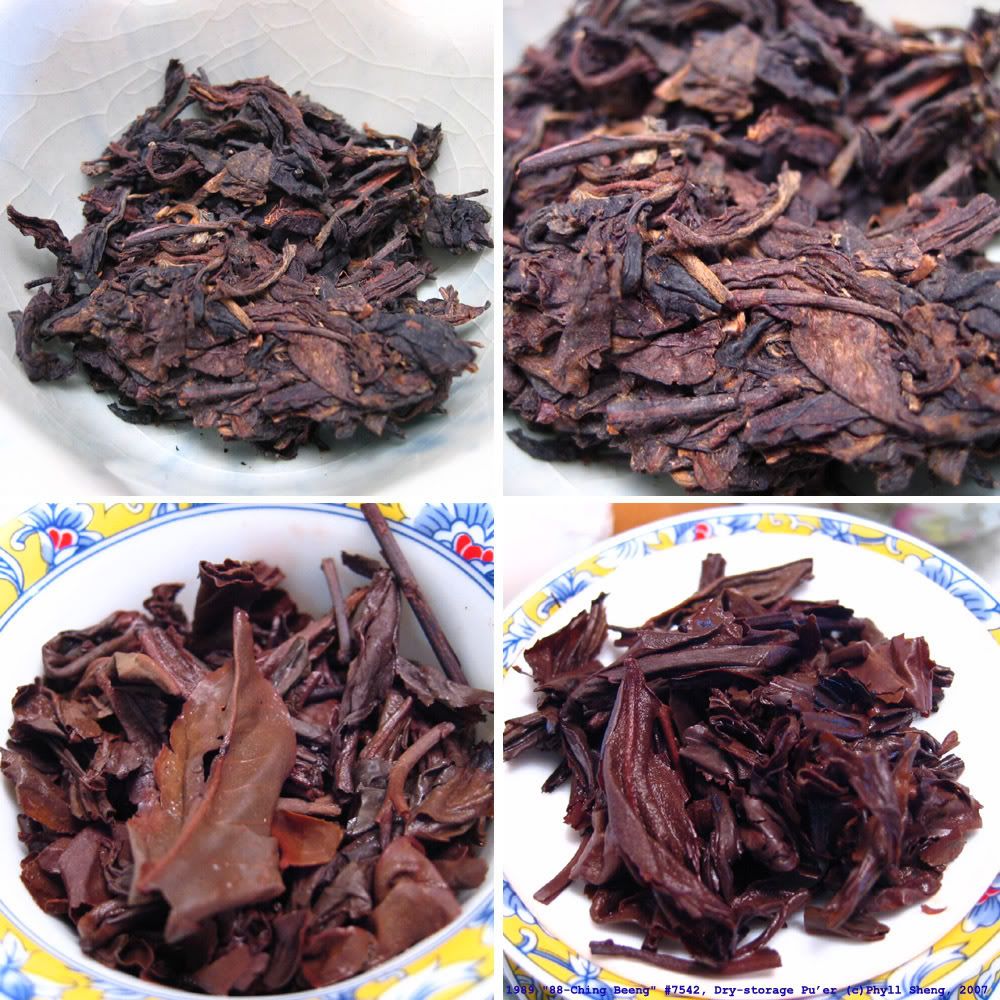
1989 Menghai #7542
aka: "88-Ching Beeng" #7542
10gr sample from Houde Asian Art


The 1989 "88-Ching Beeng" pu'er is regarded as a benchmark of excellence among quality "older" pu'er that have been stored under the so called "dry storage" environment. The story goes that Mr. Chan of Best Tea House in Hong Kong was offered a boatload of this tea at an affordable price, he took them and store them in a dry-condition warehouse (read more). At US$450 per 357gr, I expected it to live up to its reputed good taste. Unfortunately, however, I didn't find it enjoyable. Whether it was due to my personal taste or other reasons, my 2 attempts to brew this tea -- each time with a different parameter and water -- did not produce something that I could regard as enjoyable.

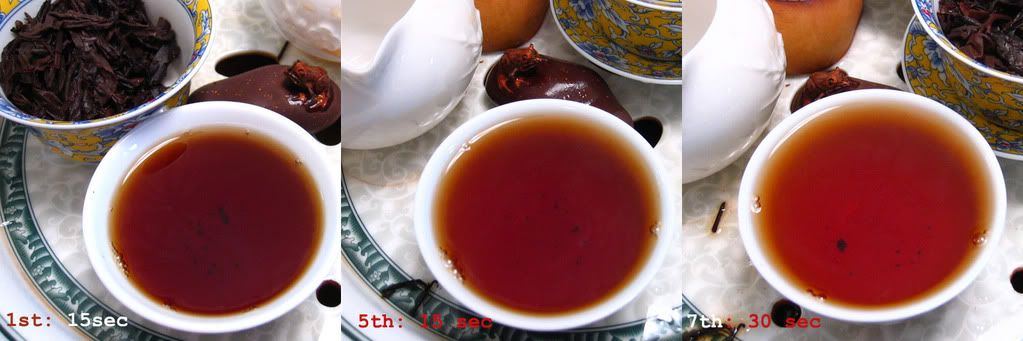
For my first attempt, I used Glacier filtered water and the following parameter: boiling water, approx. 5 grams of dry leaves in a 100ml gaiwan, 10 sec rinse, 30 sec rest, then 15s, 10s, 15s, 15s, 30s, 1m, 2m.

The wet leaves were pleasantly and vividly woody with some white pepper aroma. Exceptional liquid clarity. Taste wise, there was some of mustiness that dissipated by the 3rd brew. The aroma of tobacco / cigarette smoke and a slight metallic taste was quite offputting. They were mostly gone by the 6th brew. By that time, however, it was already rather difficult to enjoy or think positively of the tea. The overall body was between thin to medium. The aftertaste was generally that of cigarette smoke / tobacco. Tannins, though present considerably, was more sateeny than dusty.

For my second attempt, I used Volvic spring water and approx. 5gr of dry leaves in a 100ml gaiwan. 10s sec rinse, 30 sec rest, then 5s, 8s, 8s, 15s, 30s, 30s, 1m, 2m.


As in my first attempt, the smell of the wet leaves was appealingly woody and peppery. My tasting note from this session was mostly consistent with the note from the first session, except that (1) Volvic water provided a slightly better mouthfeel and body and (2) by the 6th brew, when the aromas that I didn't enjoy had mostly dissipated, the tea gave a hint of sweet aftertaste.

Overall, however, I felt uneasy and unsatisfied throughout the 2 sessions with this tea.


PS: I have shortened the title of this blog. Though the intended meaning might have changed somewhat, I thought the shortened title sounds more concise and it still retains the gist and focus of this blog.

Sunday, December 17, 2006

Happy Hanukkah!

Happy Hanukkah to all dear readers who celebrate the Festival of Lights!

We went over to my wife's parents' home to open the first day of Hanukkah with a traditional meal of latkes (potato pancakes fried in vegetable oil) and other sumptuous delicacies. It is said that every Jewish household has its own recipe for making latkes, but I didn't ask my mom-in-law how she made hers. I've always found them to be quite delicious, especially when eaten with a very thick Russian sour cream. For this occasion, I brought over 2 Israeli kosher red wines that I thought might be right for the celebration.

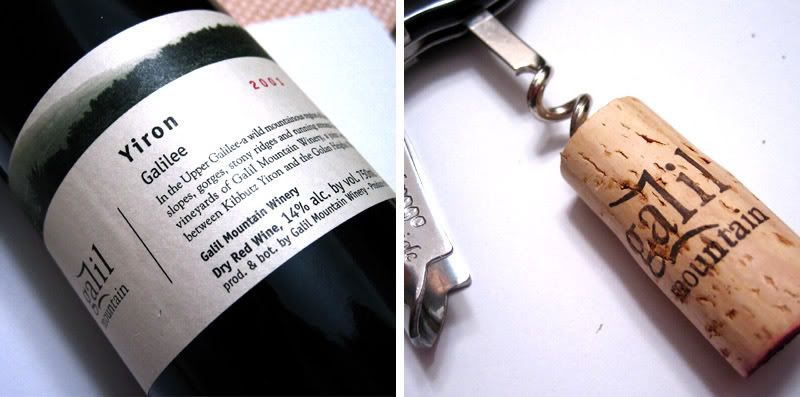
2001 Galil Mountain Winery, Yiron, Galilee, Israel ($20)
78% Cabernet Sauvignon, 22% Merlot
A very dry Bordeaux blend. Quite fruit forward with a spicy hit in the finish. Dark plums and oaky vanilla are the prominent tastes. Soft, ripe tannin. Quite delicious.

And...

2002 Yarden Cabernet Sauvignon, Galilee, Israel ($22)
Old-world style cabernet. Very Bordeaux-like in taste (St. Julien?). Oak and cedar hit the nose first, followed by tart blackcurrant. Quite tannic and tight (I'm enjoying this wine as I am writing this post. It's on its second day in the bottle and the tannins has not relented). A balanced wine with ample acidity and ripeness level. The label on the back of the bottle says that this wine "should age gracefully over the next decade." I am leaning towards believing this statement. But what do I know about Israeli wines at this point?

Of the two wines, I think I prefer the Yiron for now...in the long term however, the Yarden may well outlive the Yiron. It's my speculation.

Also tasted during the weekend:

2004 Marquis-Philips Shiraz, South Australia ($12, 15.5%)

This brand was a popular project by Dan Philips, the American wine importer, with Sarah and Sparky Marquis, the Australian wife-and-husband winemaking team. The partnership has since been disbanded in 2006.

The 2004 of their generic bottling is a HUGE, multilayered wine. I could sense its viscosity from the moment it poured out of the bottle. Very focused and concentrated nose of casis, currant and sweet chocolate. You can taste the sweetness of the glycerin. Full bodied with tastes that explodes like a grenade in your mouth. Finishes long and spicy with dark chocolate. Very good balance considering the 15.5% alcohol (though it showed a bit hot in its finish). Elegant? Maybe not. Fun and delicious? Hell, yeah!

Tuesday, December 12, 2006

Spring 2006 Qimen Hong, Top Grade

The sample being tasted here is a "top grade" Qimen Hong (Red Keemun) from Anhui Province (available from Jing Tea Shop). It has all the classic red tea characteristics. Dry leaves appear small, rolled, and in broken pieces, a common appearance of Qimen Hong. I placed 1/5 full of dry leaves into my gaiwan, which when brewed the steeped leaves filled 1/2 of the gaiwan.

Off-boiling spring water was used; flash rinse once, followed by 10s, 5s, 5s, 5s, 5s, 10s...

The liquor has an earthy-red color with an orange "bao guang" (halo). I botched the 1st brew by steeping the tea for too long (10 secs). Although the nose was inviting, the tea was bitter. For the 2nd brew, I reduced the time by ~5 secs, and the tea came out much better with distinct aromas of flowers, sweet fruits and salty plums. The smell and color of the wet leaves reminded me somewhat of Oriental Beauty oolong. Subsequent few infusions saw the tea improved in taste and aroma, but the mouthfeel became more tannic. Fine dusty tannin coated the entire mouth. I can see how a touch of milk would tame the tannins.

The finish was quite deceptive, which is a classic red tea behaviour. Though it seemed as if the finish was short, it actually lingered for a while after I drank the last cup. The one thing that bothered me about this tea was the harsh after effect on my throat...I felt as if I had a mild sore throat.

A good quality Qimen Hong, though not to my personal taste.

Monday, December 11, 2006

1970's Guangyun Gong Sheng Pu'er

A Brief Background
Guangyun Gong, or Guangdong – Yunnan Tribute tea, is the name given to this production to commemorate the trade relationship between the two provinces. Produced by the China Tea Co.’s Guangdong branch (中茶), the first batch of Guangyun Gong was released in 1958. Up until the end of the 1960’s, only raw Yunnan arbor leaves made up the series. Starting in the 1970’s, however, tea leaves from other provinces such as Sichuan, Guizhou and Guangdong, among others, were used in the production of Guangyun Gong. This was due to changes in the inter-province tea distribution structure in the 1970's when the Yunnan tea industry was given the rights to distribute their own teas and, as such, they were no longer required to send raw materials to the central distribution hub in Guangdong. Consequently, Yunnan arbor tea leaves became harder to obtain in Guangdong, so China Tea Co. began mixing raw materials from other abovementioned provinces.

Per
Mr. Chan Kam Pong, Executive Editor of the Art of Tea publication, the 1970’s version is referred to as “Guangyun Tea Cake” and it is regarded as inferior to the highly sought after 1960’s “Guangyun Royal Tea Cake”.

(Photo: Houde Asian Fine Art)

(Source of background: Houde Asian Fine Art, Mr. Chan Kam Pong, and various tea fora, especially the LJ Puerh Tea Community)

I do not know how the 1960’s Guangyun Gong tastes like compared with the 1970’s version, which I thought was an interesting education piece. I wonder whether Yunnan arbor leaves really are/were superior to leaves from other provinces (I mean the leaves used in Guangyun Gong), or if it is merely a puristic perception.

Tasting Note
Dry leaves: dark red-black. A patch of white mold and many tiny white dots are visible (
click here for a higher resolution picture).

Brewing parameter: 3 sec rinse, repeat rinse, 10s, 10s, 10s, 15s, 15s, 20s, 20s, 20s, 25s, 25s, 40s, 45s, 1m, 2m (total 14 drunk infusions)

Color: medium brown at 1st and 2nd infusions, then becomes darker brown until the 8th infusions, when its color descends to become lighter. “Bao guang” (yellow halo surrounding the red-brown liquor) is present throughout.

Exceptional clarity from the first to the last infusion. This, I believe, is one of the characteristics that sets an aged sheng pu’er apart from a shu pu’er. As dark as the liquor becomes, it retains its crystal clear clarity, whereas a shu pu’er tends to get opaque and/or cloudy.

A whiff of Chinese herbs…ginseng being the most recognizable. This is accompanied with an earthy, mushroom-y, and toffee-like nose. A subtle sweet sensation is well integrated and felt on the side and back of the tongue. This is not the same kind of sweetness that a decent shu pu’er gives, which tends to be more obvious. Nor this is the sweetness that one gets from a black tea, which tends to be bitter at first then turning to a sweet finish. A hint of metallic taste (iron?) is present. This tea doesn't turn bitter even with prolonged brewing. Medium body at first, and later infusions are fuller (as the color of the liquor became darker). This tea is very smooth with tannins that is almost non-existent.

There is an obvious cooling sensation in the mouth and throat. A soothing feeling also goes down to the stomach and lasts for a few hours.

I felt a blanket of warmth by the 4th infusion, and the sensation grew warmer especially on my back, shoulders and neck. By the 8th infusion, my body felt sufficiently hot. It’s a very relaxing and calming experience. I’d attribute this sensation to good cha qi.

This tea may be a turn off to those who dislike the smell and taste of Chinese herbs/medicine, but I mean it in a pleasant way. I generally dislike the taste of Chinese medicine, too. However, the herbal / medicinal quality of this tea is inviting and soothing. An excellent tea all around.


The 1970's Guangyun Gong is available at Houde Fine Asian Art.

Thank you, BBB, for the sample!

Tuesday, December 5, 2006

T Ching

T Ching
There is a new community dedicated to the discussion of tea. T Ching is supported by various professionals within the tea, health, arts, and media industries, as well as by individuals who partake the noble beverage in their everyday lifestyle. The wide ranging backgrounds of the contributors make T Ching a unique and dynamic community.

Published by two veteran psychologists, Michelle Rabin and Sandy M. Bushberg, T Ching’s primary mission is to “improve the state of declining health in this country” through the sharing of knowledge on the wonderful health benefits of tea. Having been in the health care field for 25 plus years, they recognize the growing epidemic of obesity and type II diabetes – in youths and in adults – and they have taken tea as the central ingredient in this fight.

In addition to the health aspects, the various contributors also discuss history, art, design, preparation techniques, poems, and other engaging topics related to tea. Currently, on every Tuesday James Norwood Pratt, a widely published author, shares his insightful writings on the history of Japanese tea practices.

I am honored and humbled to have been asked by Michelle to contribute to her excellent site and cause…a cause that I have a personal connection with. My mother and grandmother succumbed to complications due to long term effects of diabetes. I sincerely hope that my ongoing pursuit of tea (and wine) knowledge and my passion for enjoying them is going to make a positive contribution.

I encourage you to visit T Ching and to participate in the discussions.

www.tching.com

Monday, December 4, 2006

Thanksgiving & Picnic

The day after we returned from San Diego, my mom-in-law cooked a sumptuous [belated] Thanksgiving dinner. She is an excellent cook! (No, I don't think she reads my blog, so it's an honest opinion). We gathered at my wife's parents' home, joined by my bro-in-law, his wife and my 5-month old nephew, Anton. It was fun. So much so I forgot to take any picture of the foods she made until after we were finished. I brought two wines for the occasion, and the in-laws chipped in a bottle of an Australian Merlot by Jacob's Creek, which I didn’t enjoy, actually.

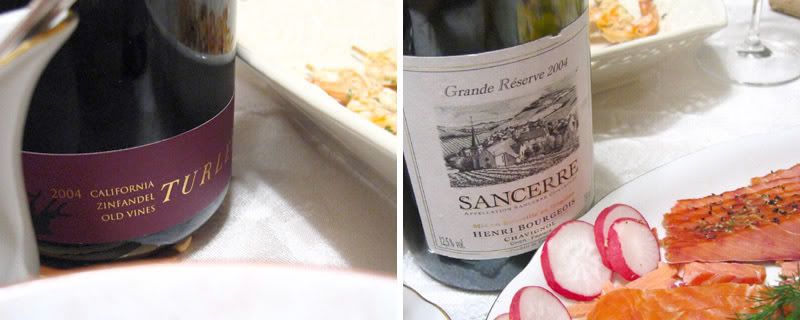
2004 Domaine Henri Bourgeois, Grande Reserve, Sancerre ($20)
Light yellow and straw green. Crisp and lithe with ample acidity and citrus taste. A nice and light aperitif to warm up the appetite.

2004 Turley Old Vines Zinfandel, California ($30)
Deep, dark ruby. The nose is very shy and subdued, which is unexpected for the usually upfront style that is Turley. In the mouth, however, it exploded with raspberry, cherry, coffee, and chocolate. A very ripe and high-octane wine (15.5% alcohol), which shows its hotness in the back of the throat. Any wine that is hot in the back is out of balance. Not the best showing of Turley Old Vines compared with the last 4 vintages (including the '04), though it still managed to be an intriguing wine at the table.

2005 Jacob's Creek Merlot, Australia
Tart and jammy. That's all I could remember. Had a few sips and gave up.


The next day, Sunday, we had a BBQ picnic with 10 of our best friends and their kids at the Will Rogers Park on Sunset Boulevard (nearby UCLA). The weather fortunately cooperated and gave us the whole afternoon of sunshine and low wind. It was a good day, overall. As usual, we hid the beer bottles from the authorities (not that they were around, but just in case) in our ice box and we drank from plastic cups.

Towards late afternoon, when the temperature began to drop, I took out 6 gaiwans, my Bodum glass teapot, and the jasmine tea balls that my cousin sent me from Shanghai. Everyone loved the tea, especially the ladies! There is something good to be said about enjoying tea in the great outdoors with friends and loved ones.

[Front: 2 jasmine tea balls in full bloom, Underberg: a spicy tasting German herbal liquor that my friend brought back from Germany. Back: My bro-in-law with my nephew, Anton, and behind him are our friend and her baby girl. Merely 2 years ago, our crowd clubbed and bar hopped until the wee hours...but not anymore]

Note to guys: impress your lady friends and girlfriends with jasmine tea balls in a large transparent pot. A vessel that fully shows the leaves and the flowers bloom is best.

Friday, December 1, 2006

Trip to San Diego

Sorry for the recent lack of update. The blogger beta just went nuts on me for the past few days and it still is. The formatting feature is gone, somehow, so I'm posting this using html, which requires a bit of a learning curve on my part.

The family (me, my wife, baby girl, and wife's parents) spent the Thanksgiving week in San Diego, which was nice. The weather is slightly cooler this time of the year in SD, but it could still pass as beach weather all the same. It was a casual trip with no preconceived mission for wine / tea drinking or any serious tasting notes.

On the way to our hotel in Pacific beach (next to the famous La Jolla beach), we stopped by Carlsbad to lunch at the Bellefleur Winery and Brasserie. The restaurant is also a bonded winery that makes wines under their own label. Since I was driving, I didn't order or bothered to buy any of their wine to go. The restaurant/winery was serving their Sunday Champagne brunch buffet, so they poured for us refill after refill of semi sweet (oxymoron alert!) Californian Champagne. Technically, it was a Sunday Californian sparkling wine brunch, but that doesn't sound as catchy, does it? At first I didn't get why the waiter poured the "Champagne" only halfway the flute, until the unannounced orange juice came. Aha...Mimosa! Go on ladies and gentlemen, load up on sugar and alcohol before you head to the buffet tables! The buffet selections were wide and varied. At $20/head I thought it was quite a good deal...a buffet like this in Las Vegas would probably have cost more.

We rented 2 cottages at the historic Crystal Pier Hotel where we literally slept above the lapping waves. The view from our private patio was just amazing, especially at sunrise and at sunset! The cottages are nice, too. Everything is clean and feel newly renovated with a comfortable large bed. The feature we liked best as young parents traveling with a kid is the full size kitchen. We could make food for our daughter in the comforts of our cottage before heading out to tour the city. And did I mention the view was great?

(Click to enlarge picture of the view from our patio. My baby and dad-in-law.)

I decided not to pack my tea set with me but just bring along 3 types of tea in stainless steel canisters: the Hong Shui oolong from Houde, the Spring 2006 Da Hong Pao from Teaspring, and the jasmine dragon pearls that my wife so loves. Since I brought with us a few bottles of wine in an ice box, and that we are not light travellers, the tea set had to give way, unfortunately. I should probably buy a small travelling set. It wasn't ideal, but I was able to improvise and managed to get decent cuppa every time.

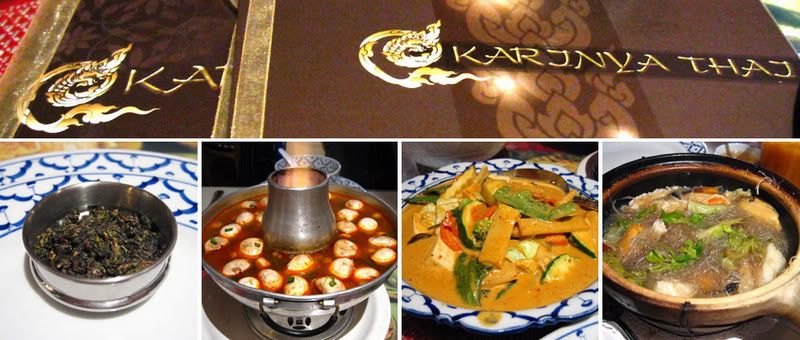
On one cool, foggy night we dined at a Thai restaurant called Karinya nearby our hotel. The food was good and the spices was just what we needed to warm up our bodies. Every dish had a touch of homemade feel to it, which I appreciated. The price is a tad high since they are located in a high rent district (on Garnett Street, which is the main retail and commercial vein leading to the Crystal Pier). I forgo ordering from the wine list, though the Ch. Ste. Michelle Gewurztraminer would be a good match for the dishes we had. Instead I just asked for a large pot of hot water for brewing the Hong Shui oolong that I brought along in my backpack.

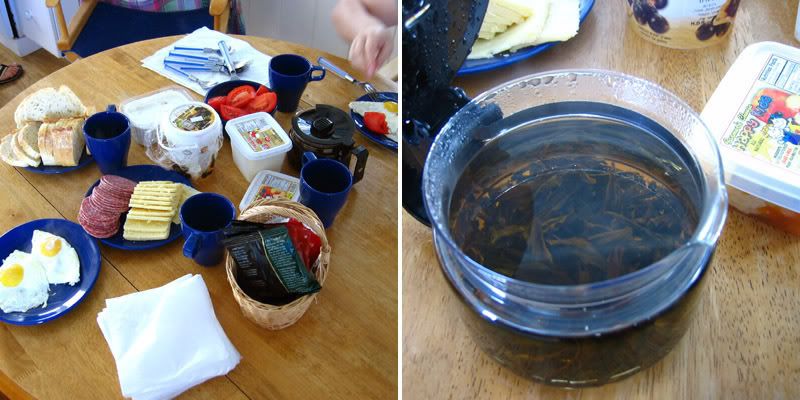
For breakfasts in our cottage, I brewed mostly the Da Hong Pao in the hotel's coffee pot. As long as I was careful not to overbrew it, the tea was quite good. Everybody liked it and I thought the tea went quite well with the eggs, cheese, sausage, bread, jam and tvorak (a sort of Russian cottage cheese). Fellow tea purists, please don't crucify me for brewing DHP in such a way and for drinking it with food. :)

After coming back from the zoo, the Sea World, and what not (yes, this trip was about entertaining and showing our baby "the world"...not really for the adults) we usually spent the rest of the day at the beach below our hotel or just hang out in our private patio with a glass of wine (or two or three). I'm glad to have brought the wines myself because we do spend a fair amount of our time in our cottage, with the little one's nap and meal schedule. I just didn't have time to look for a proper wine store in the area. Some of the wines I brought and opened:

N/V Billecart-Salmon Brut Champagne
($40) Fine mousse and bubbles. The nose is of sharp citrus and grapefruit. A little tight and needed decanting to soften it a bit, but I didn't have any workable decanter with me. The taste reflects the nose plus a hint of green apple. It's a mezzo-soprano of a Champagne. The finish is rather swift.


2004 Bodega Norton Reserva Malbec, Mendoza, Argentina
($15) We opened this one night while watching The Da Vinci Code on DVD in our cottage. Both the movie and the wine came up short. This Malbec bottling was mellow and rounded but lacked acidity, so it tasted flabby. An overall earthy wine with a somber note of blackberry. Rather depressing, actually, despite that it came highly recommended by some Winexilers.


2003 Joh Jos Christoffel Riesling Spatlese, Urziger Wurzgarten, Mosel-Saar-Ruwer, Germany
($25) Simply lovely! All the characters of a balanced Mosel Riesling in play: yellow fruits, rocky slate minerality, acidity and sweetness. A polished, detailed, juicy and delicious wine. The sweetness is a bit high for a Spatlese, which is a typical character of the hot weather in 2003.


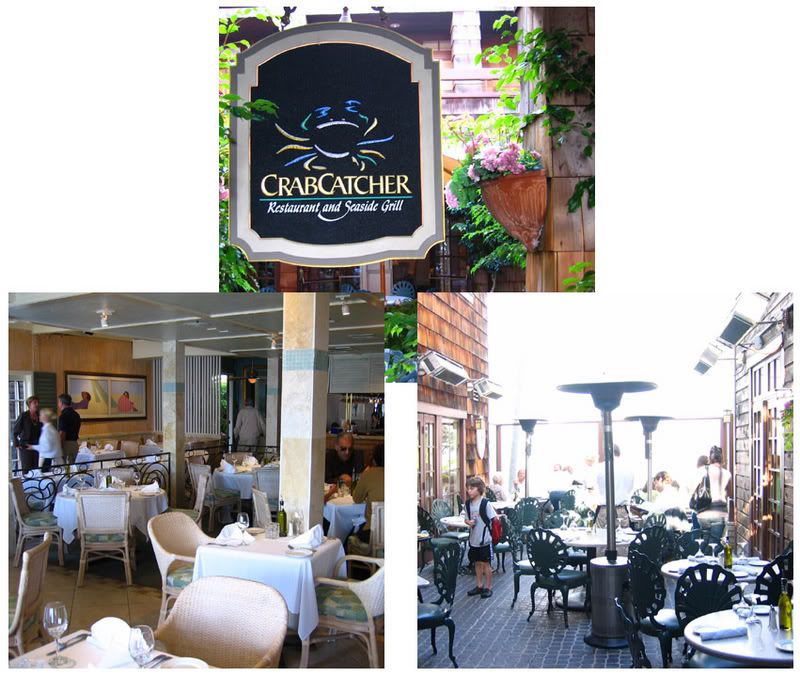
On the way home to LA, we lunched at an upscale looking white-linen restaurant called The CrabCatcher. The restaurant looked very nice and expensive, and it came complete with a snobbish lady maitre'd (perhaps because I had a little baby with me...a sign of potential mess and noise, which exactly what happened). Anyways, we were sorely disappointed with the quality of the food given the price, location and the manicured look of the restaurant. We ordered the crispy calamari as an appetizer, and for the entree we had the shrimp scampi, a $10 burger, the fish of the day (sea bass) cooked with a spicy salsa-like sauce ($24) and the Cioppino. The premium pricing was expected given the ambience and location of the venue...too bad the food didn't live up to the expectation that they themselves created, however. The service was gracious, I should note, so I still at least left them a generous tip at the end of our meal.

Their wine list was OK...they seem to have chosen their CA Pinot Noir and CA Cabernet Sauvignon selections with the recent trend in mind (Williams Selyem, Sea Smoke were 2 PNs I remember seeing on their list). The Champagne choices were good, too. Everything else other than those three wine categories felt like they are there only for the sake of having something on their wine list...not particularly exciting. As on the way to San Diego, I didn't order any wine again since I was the driver (I really wanted to order the Sea Smoke Pinot Noir, but nobody felt like having wine with their lunches, and it didn't come by the glass). So I just had two glasses of Anchor Steam beer, which was nice. After the dissapointing lunch, we walked around La Jolla a bit until the alcohol effect subsided before we headed back home; a journey that involved an excruciating 7 hours of heavy traffic.

To be continued...Thanksgiving dinner and a picnic with friends.

Saturday, November 18, 2006

Le Beaujolais Nouveau Est Arrive!!!

The Beaujolais Nouveaus are here!!! At midnight on the third Thursday of every November, the Burgundians celebrate their most recent harvest with the world by drinking Beaujolais Nouveau. The common assumption goes that the release date of these fun wines was deliberately set a week before the U.S. Thanksgiving day. However, such is not the case because the Nouveaus are released on the same day everywhere in the world, and the last time I checked the rest of the world don’t celebrate the Thanksgiving that we know.

Visit your local wine store soon and grab a few bottles of fun-filled Nouveaus! These are wines for the young at heart! In general, a Nouveau can taste like a grape juice on steroid. It is very bright with fresh red fruit flavors such as cherry, strawberry, and raspberry. Some even taste like bubblegum candy! Because of the lack of tannins, it should be very soft in the mouth, and easy to drink. Do serve them slightly more chilled (55'F / 13' C) than you would any other red wines.

Of the many selections that you may encounter, three good reliable producers that are widely distributed in the States are Joseph Drouhin, Pierre Dupond and Georges Duboeuf. They average at about $11 per bottle. However, feel free to grab any Nouveau with your eyes closed. These are mostly simple wines that are meant for immediate enjoyment (the fresher the better). It is not meant for your sophisticated scrutinies.

The proper term of Beaujolais Nouveau is Beaujolais Primeur. By French and European laws, a wine released during the period between its harvest and the following spring is referred to as primeur. Gamay is the only grape variety permitted by law in Beaujolais Nouveau wines.

TN: 2006 Georges Duboeuf Beaujolais Nouveau ($9 at Costco, 12% alc)
Fresh purple! Immediately a bright nose of ripe strawberry, rose water, sweet cranberry compote. Bright acidity and sateeny tannin. It's simply an easygoing wine and fun. Made me giggle a little.

Duvel, The Champagne of Beers?

Duvel USA

This post is about a Belgian beer called Duvel. It is one of the few beers that I'd make an exception of posting on my tea and wine blog. Duvel is clearly one the finest beers available in the market.

If the Belgians called their beers the Champagne of Beers, it would be less of an oxymoron than calling Darjeeling the Champagne of Teas. Why? Belgian beers go through the refermentation stage in the very bottles that you pour (or drink) out of, not unlike Champagne wines. Even the bottles are corked and secured with wires like Champagne bottles are. It is truly a pleasure to hear the POP! of the cork out of this bottle.

TN: golden-yellow and foggy with precipitates. I'm not accustomed to describing the taste of beers, but this one is definitely quite hoppy and balanced with enough maltiness. A delightful beer!

I was only able to find the 750ml bottle. It was so good that I drank it all in a short 15 minutes (hick!). I'm on a hunt for the magnum (1.5 liter) or larger-sized bottling because the bigger the bottle the beer inside is fermented in, the better the taste…just like Champagnes, too!

Name of beer: Duvel
Origin: Belgium
Type: Blonde beer
Alcohol level: 8.5%
Price: around $9 per 750ml

Friday, November 10, 2006

Marketplace Watch: Classic 1961, 1949 & 1947 Clarets

Just in today!

New offerings from
Garagiste in Seattle to all their e-mailing list customers include 1 case each of three “perfect” (100pts by Parker) aged Bordeaux reds. If you are interested, please contact me after buying. I want to be your best friend.

1961 Latour a Pomerol (Lafite bottled) - $5,786.40 / 750ml
(WA 100pts) Parker: "Tasted 8 Times With Consistent Perfect Ratings. Although the 1947 Cheval Blanc is widely considered to be the "wine of the century" among collectors, the 1961 Latour a Pomerol also merits a share of the title. Giving points to a wine such as this makes one think of Shakespeare's reflection that "comparisons are odious." To put it mildly, this wine is "off the charts." If I had only one Bordeaux to drink, the 1961 Latour a Pomerol would have to be at the top of my list. Given its phenomenal richness and amazing precision and balance, it can bring tears to one's eyes. Still a saturated dark purple color with no signs of amber, orange, or rust, the nose offers extraordinarily rich, intense aromas of jammy plums, black currants, licorice, and truffles. Port-like, with remarkable viscosity and thickness, as well as a finish that lasts for more than a minute, this wine is in a class by itself. Even greater than the1961 Petrus and 1961 Latour (two perfect wines), it is phenomenal. Given its youthfulness (it is the least evolved wine of the vintage),it has the potential to last for another 20-30 years. 100pts"

1949 Cheval Blanc (Calvet bottled) - $2,670.96 / 750ml
(WA 100pts) Parker: "Tasted 5 Times With Consistent Notes. Although the extraordinary 1949 does not have the port-like unctuosity and heaviness of the 1947, it is an enormously rich, concentrated wine. It is better-balanced than the heavyweight 1947, yet as complex and extraordinary, both from an aromatic and flavor perspective. The wine exhibits a phenomenally fragrant bouquet of overripe red and blackfruits, cedar, Asian spices, and minerals. Decadently rich and jammy, it has an amazing plum/garnet color with very little amber or rust at the edge. It may out-live the heavier, thicker, more exotic 1947. 100pts"

1947 Cheval Blanc (Calvet bottled) - $3,680.73 / 750ml
(WA 100pts) Parker: "Tasted 11 Times With Consistent Notes Except For One Bad Double Magnum. What can I say about this mammoth wine that is more like port than dry red table wine? The 1947 Cheval Blanc exhibits such a thick texture it could double as motor oil. The hugenose of fruitcake, chocolate, leather, coffee, and Asian spices is mind-boggling. The unctuous texture and richness of sweet fruit are amazing. Consider the fact that this wine is, technically, appallingly deficient in acidity and excessively high in alcohol. Moreover, its volatile acidity levels would be considered intolerable by modern day oenologists. Yet how can they explain that after 47 years the wine is still remarkably fresh, phenomenally concentrated, and profoundly complex? It has to make you wonder about the direction of modern day winemaking. Except for one dismal, murky, troubled, volatile double-magnum, this wine has been either perfect or nearly perfect every time I have had it. But beware, there are numerous fraudulent bottles, particularly magnums, of 1947 Cheval Blanc in the marketplace. 100pts"

Monday, November 6, 2006

1970's Yixing Pots


A small, well-made Yixing teapot is always a nice find. It tends to become a close personal tea companion and possession as its size is ideal for serving one person: the owner. Also, there is something to be said about using just enough tea leaves so as to not waste any. After all, "tea is like eating silver."

Pictured are two 1970’s Shui Ping Hu (水平壶 “Balanced Water Pot”) that I acquired recently from Jing Tea Shop (left) and Houde (right). Both pots were made by Yixing Factory #1 and they have 70ml capacity. The pot from Jing Tea Shop is a Nei Zi Wai Hong1 kind (literally translates as "inside-purple-outside-red"). This type of teapot is made from low(er) quality Zisha (purple clay) and then “painted” or "showered" evenly with Hong Ni clay on the outside to hide its low-grade Zisha look. Judging from the absence of any drib on the inside of the lid by the air hole, the specimen that I got is most likely the "painted" kind. The outside texture of the pot, however, is not as smooth as the other pot.

The pot from Houde (right) is made entirely of Hong Ni clay. This pot has developed a somewhat creamy and juicy feel from age and use. It has a very pleasant wrinkled smooth texture. The clay quality, balance, and its clinking sound are excellent.


Notice the slight shape and proportion differences between the two pots? The nei zi wai hong has a "Zhong Guo Yi Xing" seal, while the hong ni pot has a "Jing Shi Hwei Meng Chen Zhi" seal. After some practice, both pots brew and pour very well, with good lid-body fit.
Click here to see better the inside-outside clay contrast.

These pots have become indispensable companions when I’m drinking tea solo. I use the pot from Jing Tea for high fire Tie Guan Yin oolong because it has a slightly bigger, rounder belly for allowing the leaves to unfurl better. The other pot from Houde, with its slightly wider opening, is for brewing high fire Wuyi Mtn. rock oolongs. So far, fortunately, I’ve had no problem fitting the long and wiry Wuyi leaves inside the pot. I suppose when I encounter a Wuyi with leaves that are too long to fit inside then I'd have to use a gaiwan.

1Thanks to Guang of Houde who
recently discussed about the history, the making and the attributes of Nei Zi Wai Hong and Shan Tou pots on his blog.

Thursday, November 2, 2006

How Much Is That Pu'er in The Window?

MarshalN, who is perpetually soaked in tea in Beijing, posted an interesting article about a tea tasting session that he attended at a teashop in Maliandao (a section of Beijing that is dominated solely by tea merchants). You can read all about it here. One of the things he wrote that strike me as interesting is about the 1930’s Song Pin pu’er, which according to him tasted a bit underwhelming. In his article, he held for us an entire cake of this tea, which can be bought for merely USD $17,000. I’m just kidding there, of course, when I said “merely”.

Then I wondered: I know of no wine that costs $17,000 per 750ml bottle. However, if a beeng of pu’er is selling for such a stellar price, how does it compare with the price of wine, milliliter by milliliter? So I did a quick computation based on many assumptions, please bear with me.

The assumptions are:

  • A beeng weighs 357gr
  • 7 grams of dried leaves per session
  • In a vessel that yields 100ml of liquor per infusion, and
  • 10 infusions per session

  • These assumptions are based on, more or less, the parameter I often use for brewing my pu’er.

    Computation: the 357gr beeng can last for 51 brewing sessions, with each session yielding 1,000ml of tea. The cost per milliliter, then, is $0.33 ($17,000 / 51,000ml). Therefore, the cost per 750ml of this tea is $250. In other words, 750ml of this tea is as costly as a $250 bottle of wine. Or, buying a beeng of this tea is equivalent to buying 68 bottles of $250 wine!

    Nowadays, you can buy a bottle of Krug Rose Champagne for $250. For the same amount of money, you can get top tier wines from excellent years, too! Truly, $250 can get you a stellar wine from a great producer from any region in the world. Of course, you can also bust $17,000 on just 17 bottles of Screaming Eagle from Napa or 5.5 bottles of 1975 Ch. Petrus from Pomerol.

    Conclusion:
  • This 1930’s Song Pin beeng is about the same price as any top-tier wines, milliliter by milliliter
  • Though it is a very expensive cake by any standard, milliliter by milliliter this tea is still relatively cheaper than the most expensive of wines that can cost $1, $2, or even $4 per milliliter

    My personal opinion: Not that I can afford to spend $17,000 on a beeng of tea (yet). If given the options, however, I would rather buy 68 bottles of different VERY VERY GOOD premium wines for my cellar than be stuck with a 357gr disc of this tea. Hey, it’s just me.
  • Edit 11/3/2006: Since the Peoples Republic of China has re-blocked Blogger, I e-mailed this post to MarshalN for his opinion. He responded by saying that the Song Pin can be brewed for "more like 30" (!) infusions per session. In that case, the price per 750ml of this tea is $83.33. Hmmm....that is quite a good deal if you see it this way.

    Wednesday, November 1, 2006

    TN: Xia Guan Tuo Cha Pu'er (Shou)

    Xiaguan Shou Tuo ChaLast night, I craved for some cooked pu’er. I have been drinking a lot of green teas these past few days, so I needed something more soothing to my stomach. The trouble was all of my good pu’er are in boxes in my car. Yes, I’ve been driving around to and from work with 5 large boxes of pu’er until I’m done with painting my home. I guess I’m taking my own sweet time with the painting. I need to speed up the process.

    I digress…

    I scoured my tea cabinet hoping to find something that I might have missed putting into the boxes. Got it! Jogrebe sent me a bit of Xiaguan cooked tuo cha pu'er (vintage unknown) some time ago and there was a bit left enough for one session. I was in business!


    Parameter: 5s rinse, twice. 2m rest. Then 5s 5s 8s 10s,…

    TN: Deep red-brown in color. Not much nose, except for a slight earthiness. No pondy smell either, which I prefer. In the mouth, it’s soy-milk smooth, round, and went down easy. Nothing too complex, yet it’s quite pleasant in a simplistic, easy going way. When the tea cooled down a bit, however, I detected a slight sour note. Although I’ve read that younger cooked pu’er can have some astringency note to it, I’m still not quite sure why. Is it due to excessive humidity during the “cooking” process? Is it normal? This tea, unfortunately, lacked a sweet aftertaste in the back of the throat that I usually like in my cooked pu’er.

    2 stars (mg)
    A smooth, clean tasting cooked pu’er but the aftertaste was lacking.