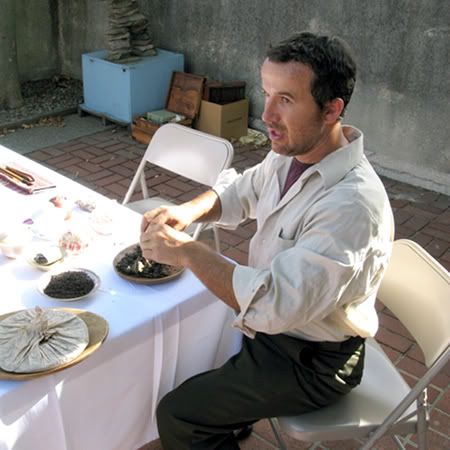
 (Brian S. Kirbis, the researcher - host of the event. Photo by Will Yardley, posted with permission.)
Blogs that have chronicled the event:
Tea Nerd -- by Brent Hughes
...still awaiting for Jason's version of the day in his blog.
(Brian S. Kirbis, the researcher - host of the event. Photo by Will Yardley, posted with permission.)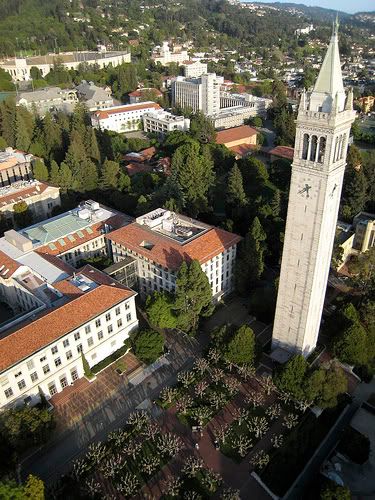


Unexpectedly, however, this old tea was highly astringent. I asked if astringency (rough, pucker-y texture in the mouth and on the tongue) is commonly found in aged oolongs. Apparently, yes. I have always assumed that the older a tea gets, the smoother it should be. My expectation for a silky-smooth mouthfeel was clearly misplaced. This was an education for me.
The Wuyi Gu Shu Cha was decidedly delicious, although unfortunately, I had to leave the party after the second or third brew in order to tend to my daughter, who suddenly developed a fever. This is a tea brought over by Will and Louise from their trip to Wuyi Shan, China, last year. This sample was sourced from a vendor whose teas Corax (of Chadao blog) was so impressed with during his visit to the same locale (click here to read Corax's account of meeting the vendor, Ms. Yu). By the time I had to leave, we had (only) been drinking for about three and a half hours.
Also worth noting was the use of a certain mineral (volcanic?) rocks placed in the fairness cup. Danica and Will swore by the rocks' potent contribution in softening the water, and thus the tea. MarshalN was skeptical at first, but later on admitted to a certain softening of the old oolong he was brewing when the rocks were involved. I remain largely a skeptic, but willing to be open minded about it.

 ^ The morning after the Event and a long dinner party, we dimsummed in Chinatown. Mary and Robert Heiss joined us. After the dimsum brunch, we visited the famous Huntington Library in San Marino for some Afternoon Tea. I had a most pleasant and eye-opening conversation about olive oils with the Heisses. They are the quintessential experts in everything olive (and other gourmet foods too). What true gourmands they are! (The Heisses are the proprietors of Cooks Shop Here, a culinary shop in Northampton, Massachusetts).
 ^ After a sumptuous late dinner at a Greek fusion restaurant, Danica, Helen, Chen Zhi-Tong and I went to Danica's home for some tea (Mr. Liang and his wife retired to their hotel room). The tea session stretched until 4am in the morning! We brewed the stash that Chen Zhi-Tong brought along from Taiwan: 1930's sheng, 1950's sheng, 1960's sheng, and many recent vintages of his own Chen Guang He Tang Yiwu Chawang (2002 - 2007). Chen was most generous for leaving behind his Yiwu Chawang teas for the LA Tea Group.

^ After that late night / early morning tea party, we headed home for a few hours of sleep. Then, we drove to the beautiful Santa Barbara County wine country. There are basically 2 wine trails that we could choose from: Foxen and Santa Ynez. We trailed the latter by car, stopping at wineries along the way. The picture above is from our visit to the Zaca Mesa winery, where we sampled the wines in a very spacious tasting room.
 ^ We also visited the Fess Parker Winery (featured in the Sideways movie). After a flight of wine in the tasting room, Chen and I relaxed in the patio where he offered me a stub of his Montecristo No. 5 Cuban cigar. We had a nice conversation in broken English (him) and broken Chinese (me) about tea, wine, the Pasadena Event and future potential event in the United States. He was impressed by the people he met in Pasadena and by the great turnout. While Chen and I conversed, the others sat or napped in the field of green grass next to the vines. All in all, it was a very relaxing day with a perfect weather to boot.
 ^ Fast forward to Wednesday, June 20th. On Chen's last day before he left for Taipei, a few of us members of the LA Tea Group took him to a Californian BBQ ribs restaurant (Mr. Cecil's CA Ribs on Pico Boulevard) for one of the best and authentic Americano red-meat dishes. Will and I brought 4 bottles of excellent red zinfandel to down the meat and fat with. Though we managed to finish a lot of perfectly bbq-ed ribs, corn bread and hush puppies, the six of us were prudent enough to only consume 3 bottles of zin (most of us drove separately that day). Then at 11pm we said our goodbye's with Mr. Chen before I drove him to the LAX airport.
To be continued - Part VI: Tasting the 2007 5th International Pu'er Appreciation Memorial cake...
 I thought I’d delve a bit more into the details of the party, from my own point of view.
 A hot seat it was where I sat. Questions were peppered out shortly after I rinsed the 2006 Taiwan Expo Ji Nian Cha tea. The first question had to do with how many times the leaves can be re-steeped. Other questions forthcoming were about caffeine level of a young pu'er, on whether older pu'er has more caffeine, on ideal storage condition, on pu’er tea processing steps, on types of water, and on others that I can’t quite recall. Perhaps my traditional Chinese shirt was a tea-question magnet. Our table was a chatty and friendly one, and I thoroughly enjoyed my time brewing for everyone.

 As such, savory sustenance was provided in abundance. They were catered by well-known Los Angeles area bakeries. From the famous Porto’s Bakery, a family-owned Cuban style establishment, were beef croquettes, pastel del carne (meat pies), guava & cheese strudels and apple strudels. Imen Shan of the Tea Habitat tearoom kindly sponsored apricot-almond shortbread bars, raspberry-chocolate shortbread bars, and a variety of other mini desserts. (as I have mentioned in Part I of my installment).
 The teacups were chosen to be small, rather flat and with a wide rim on the top. They were obtained from Wing Hop Fung. All other essential tea utensils were brought over from Houston by Guang. Well, almost everything else. Apparently, Guang was forced to relinquish 2 tea trays and 2 kettles to alleviate his overweight luggage at the Houston airport. Fortunately, Imen came to the rescue and replaced these unexpected needs with her own store’s equipment.
Part II: Prior to the Event
On February 27, I received an email from Guang titled “Need Your Opinion”, in which he asked for my recommendation on places to host the first USA Pu’er Tasting Event at. I told Guang that the better place to hold such a cultural event, in my honest opinion, is in San Francisco for many obvious reasons. While uttering that, however, I also thought that Los Angeles could potentially be a great place. So I suggested that he contact his SF acquaintances for their recommendations while I turn my wheels for the venues in Los Angeles.
A day later I came up with four ideas (alpha, in no order of preference):
1. The Chinese American Museum in downtown Los Angeles (C.A.M.)
2. The Descanso Gardens in La Canada (D.G.)
3. The Huntington Library in San Marino (H.L.), and
4. The Pacific Asia Museum in Pasadena (P.A.M.)
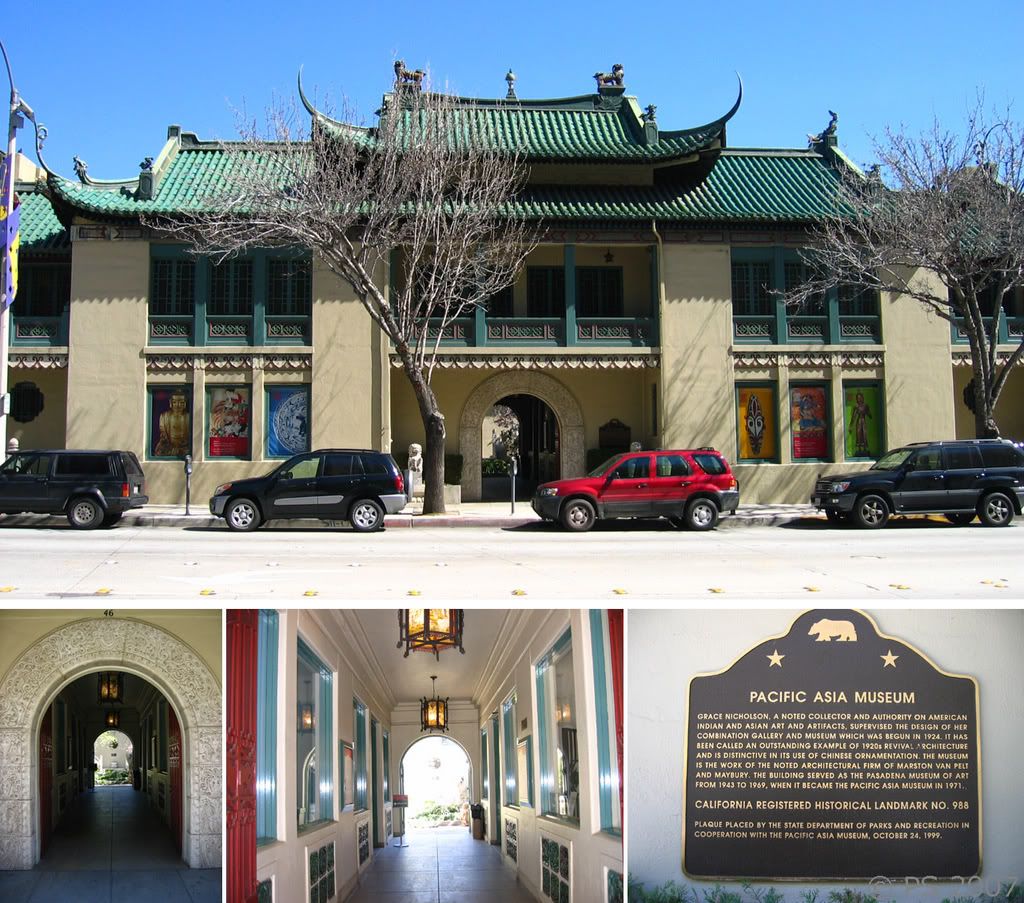
The P.A.M. was available to host us in mid-June. It was unclear whether or not C.A.M. has the facility to host a third-party function (they never returned my calls). The D.G. and the H.L., unfortunately, were already fully booked in June. My heavy favorite at the time was the D.G. for its beautiful outdoor settings. However, when I scouted the P.A.M, I was very pleased with how the museum's courtyard feel and look. I immediately told Guang that the P.A.M. would be the perfect venue to hold his pu’er party at should he commit to having it in Los Angeles.
After Guang received many photographs and videos of the museum from me, and after he found out that such a beautiful Qing-dynasty style courtyard can be rented for only a fraction of the price of another Asian oriented museum (forgot which) in SF, he finally made his decision and booked the P.A.M. for the June 16th engagement. Well, it was just my luck, I thought…I wouldn’t have to travel far after all! The P.A.M. is practically a 10-minute walk from my office.
Thereafter, Guang and I were out of contact for a few weeks. I was under the assumption that he knew someone else who could organize the party on his behalf. I mean, after all, he only asked for my suggestions about the venues.
In mid-April I contacted Guang to ask if everything was underway. His reply, to my surprise, was that he hoped I could help with the organization of the event. I was hesitant at first, although I was also quite piqued by the challenge. Besides, the event was still 2 months away from then, so the preparation could still be done at a somewhat leisurely pace. He and I immediately took on the project together and we consolidated our vision.
During the ensuing 2 months, we slowly and carefully planned the project. Among other things, I selected the tables, chairs, linens, bowls, trays, utensils, umbrellas, etc. from the rental company’s wide selections. We wanted it to be understated yet elegant. Guang was in charge of inviting the guests and announcing the event to the public. We also figured out the logistics on how to get the tea utensils from Houston to Los Angeles.
My meetings with Gabriella Karsch, the Director of Events at the P.A.M., were always constructive and pleasant. Through her, I was introduced to vendors that P.A.M. had prior satisfying experiences with. She also made sure that I did not forget the little details that may have been unintentionally omitted, such as knowing the power limitations of the museum. This was resolved by renting an extra power generator to make sure that all 5 power-hungry electric kettles could run concurrently without blowing any fuse. My gratitude towards Gabriella is overflowing.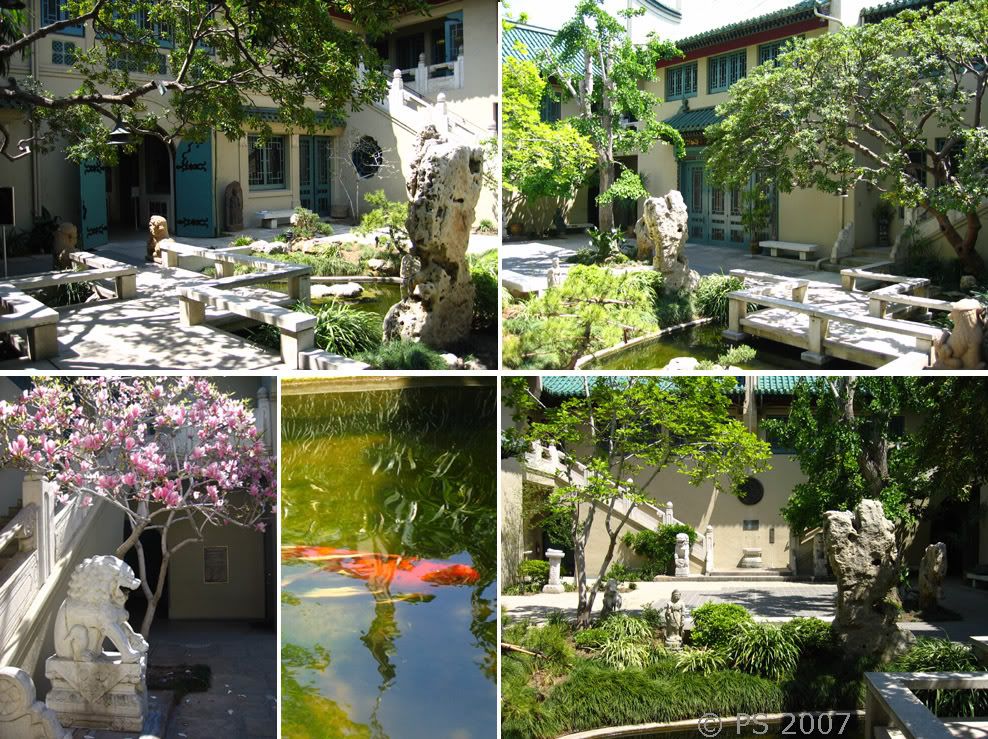
Everything was under good control…that was until the day before the event itself. Crises ensued on June 15th due to the fact that FedEx failed to deliver the six poster-sized pictures that I had ordered for enlargement. To make matter worse, on that same day and at the time when I should be sprinting to a nearby Kinko's to get the posters re-printed, Aaron Fisher called to let me know that he was stuck at the Greyhound bus station on Alameda and 7th Street (not a good part of our city). Apparently, his bus from SF to LA had broken down on the way, and so he missed his connecting bus that would have taken him from downtown to Pasadena. The two crises were resolved eventually, but not without much angst and cash. It costs 4 times more expensive to re-print the posters at Kinko’s than at Snapfish (an online photo vendor).
After picking Aaron up at the downtown bus station, we immediately headed towards the Hilton Hotel in Pasadena. We chatted and got to know each other better while waiting for Guang, Liang, Apple and Chen to arrive at the hotel. It was not until about 10pm that they finally showed up. This was to be my first meeting with Guang, the man who I have corresponded with for the past year or so, but only through emails and phone until that day. We were mutually happy to have finally met each other in person.
I was invited to Aaron’s and Guang’s room to further plan the next day’s kick off. To whet our tired and dry beaks, Aaron brandished his small silver teapot (“Such an ugly teapot,” Guang said jokingly) and started brewing his stash of 1930’s sheng pu'er that is made entirely of small gong-ting buds. We used one of Guang's electric kettles to boil some bottled water.
While sipping on this extremely smooth, rounded and naturally sweet tea, we talked about what was going to happen tomorrow. Everyone was anxious, and especially me because there were still many important errands on my to do list that I had to accomplish before arriving at the museum.
I left their hotel room at around half past midnight and reached my home at around one o'clock. I was exhausted by then and no longer had the energy to be anxious any longer. But I remember that I was still enjoying the aftertaste of Aaron's 1930's pu'er. The sweet taste in my throat lingered for a long time and I felt as if my esophagus all the way to my stomach was coated in a light mint-y sensation. It was quite a pleasant feeling.
Tomorrow (well, that same day to be exact, since it was past midnight) was going to be a long, exciting day…that was if I could manage to complete my long list of tasks before 12 noon!
To be continued...
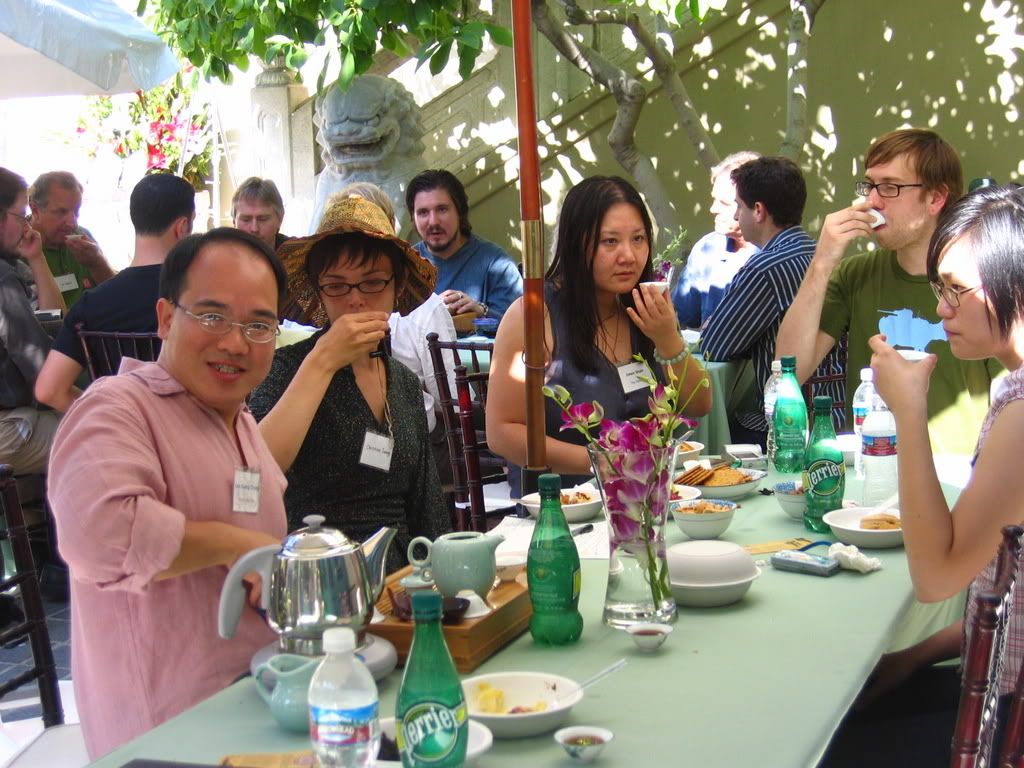 [Guang, in pink shirt]
Mr. Liang Chun-Chih of Wu Shing Publication – for taking a chance with the tea enthusiasts in the USA. If it wasn’t for his entrepreneurial gamble, the Event would not have materialized, let alone considered in the first place. The US market in general, by relative measure, is still in its early stages of fine tea appreciation, and most especially pu’er appreciation. This Pasadena Event and the continued publication of the Art of Tea magazine lay the necessary ground works from which more interests will grow out of. I hope that his actions and vision will bear him fruits in the future, sooner or later.
Mr. Chen Zhi-Tong, Tea Master/Maker and author of the “The Profound World of Chi-Tse" – for his boundless passion, in-depth understanding and generosity with sharing with us, laymen, his knowledge on pu’er. What he shared was perhaps less than the tip of the iceberg, but I believe he had done a swell job at encouraging the audience’s interest in pu’er tea.
Aaron D. Fisher, Sr. Editor, The Art of Tea – for his indomitably creative spirit and his focused mindset on how to promote pu’er tea and the magazine. His presence at the Pasadena Pu’er Event gave us the opportunity to meet the person who plays a large role in our enjoyment of the Art of Tea magazine, from cover to cover. It was only appropriate that he stepped out from behind the curtain. Those who sat at the tasting table with him must have learned a lot that day.
Gabriella Karsch, Director of Events, Pacific Asia Museum – for her enthusiastic support of the Event and her crucial connection with reliable contractors and vendors. It was through a positive karmic affinity that the pu’er event should be held at her museum. Gabriella is a pioneer of the tea industry herself with years of experience running the China Indo Tea Company, a company that she founded in the early 1990’s. No one could ask for a better host who understands the significance of our function!
Robert Williams of Partyline Events (a party rental company) in San Gabriel, CA – for his top-notch professionalism and for executing an excellent blitz of a set up on D-Day. His tenacity and insistence on perfection made the day! I was a demanding client and Robert was always gracious under pressure and time constraints. I can not recommend him and his company enough for any large or small party projects. Bravo sir!
The L.A. Tea Group members:
Imen Shan of Tea Habitat and Tea Obsession blog – for her support and sponsorship of the desserts and some crucial tea equipment. Her contributions and support ensured that all tasting tables were functional.
Danica Radovanov – For her acceptance to host one of the tasting tables at last moment’s notice. I could only wish to be at her table drinking the tea that she brewed.
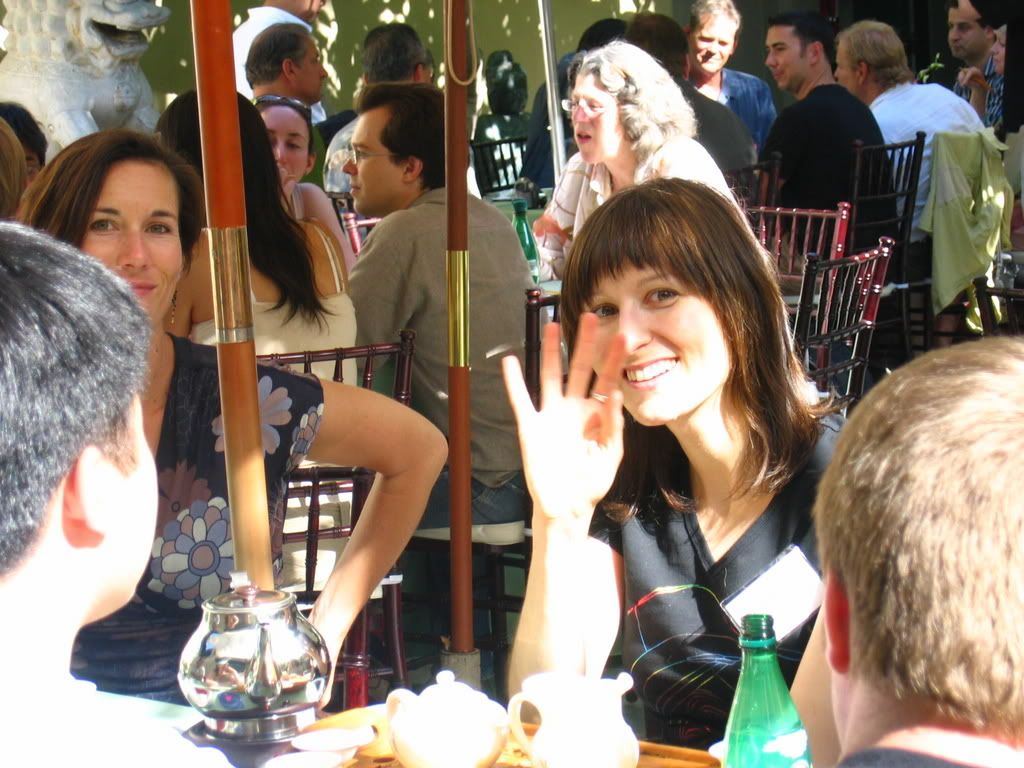
[Danica waving at the camera]
And others of the LA Tea Group for their detailed assistance such as music selections and other useful ideas.
Last and definitely not least, the 50 plus attendees! What can I say? The event would have meant nothing without you, ladies and gents! My immediate thanks go to those who were at the table which I led (with much perspiration). I hope I had been able to deliver decent teas and provide relevant information to those who asked me questions. I am by no means an authority of the teas that we drank together or to pu’er tea in general. I did my best to answer your questions, however, but I hope you will take my words with a grain of salt in mind. It was an honor to have drunk tea with you. I hope we can be better acquainted in the future, near or far.
Thank you all, again. It was an honor and the pleasure was all mine.
 6 Halved and the resulting loose leaves.

 6 The resulting initial pieces. Uneven sizes. To be evened out later.
 6 After the sample sizes have been evened out, into thick sealed mylar bags they went. 12 bags total (2 are going to some other friends -- unsolicited). On Monday they will travel to San Diego, San Francisco, Illinois, Georgia, Missouri, New York, Kentucky, Kansas, Oregon, Maryland, Czech Republic, and Slovakia.
 6 My leftover from a whole beeng. Lots of loose leaves were produced in the process.

To the 10 - 12 people who are going to receive the samples: Enjoy! I look forward to hearing what you think of the tea when you get a chance.
 My prayer and thoughts go out to the families and friends of those who were senselessly slain at Virginia Tech. I am particularly moved by the braveness of Professor Liviu Librescu who went towards and blocked the deadly threat in order to save many and sacrificed his own life. May they rest in peace and be remembered lovingly forever.
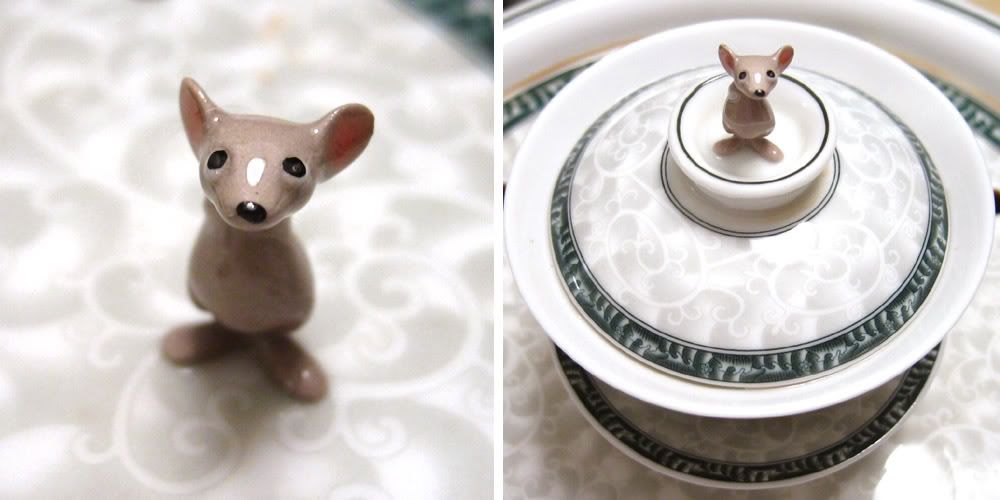
Sunday March 25th. I arrived late to be greeted by Danica, Jonathan, Louise and Will. They were already in mid-session of tasting a Wuyi rock oolong called the Thousand Sweet Miles. Feeling comfortable, I immediately slinked right in and joined the fun at the table. The tea was sweet smelling, floral and honey. It was also mellow and smooth with only a bit of roast. I liked it. This sample came from Best Tea House’s British Columbia (Canada) branch and costing C$112 per 100gr. Quite steep. We couldn’t figure out what this Thousand Sweet Miles is called in its original Chinese tea nomenclature (anyone?).
And then there is Stéphane Erler’s silver teapot -- Now Danica's. Danica unleashed the silver beauty from its original packaging only moments before I showed up. It was its own feature debut! One side of it is embossed in dragon. The other side’s embossing is of a phoenix. Rather surprisingly to me, it felt very solid, thick, substantial and balanced! From all the pictures that I’ve seen in Stephane’s blog, I (incorrectly) assumed that the teapot is thin and light. A lot of sterling silver (995) went into the making of this pot. When I brewed a tea with it, the pour was smooth and it did not drool or leak from its lid. It is an excellently made teapot overall. Well, for the precious material used and the high price one has to pay for it, it better be.
Tieguanyin Tea: Silver vs. Clay
Having never been used before, Danica rinsed its inside – which looked matted and resembled more of white oyster pearl than silver – with boiling water straight from her tetsubin. Then she asked Will to take over the helm. Will decided to brew a Tea Gallery’s qingxiang tieguanyin. Nosing the first brew (second after rinsing), Louise’s sensitive nose detected a certain metallic smell and taste. Others concurred. Jonathan said it could be psychosomatic. We asked each other whether the pot ought to be washed thoroughly first under the sink. We decided not to, unless somebody dropped on the floor writhing in pain. The second brew did not have as much of that metallic taste. Probably it’s the tea.
After 3 or 4 rounds, we decided to brew the same tea using a hongni clay Yixing pot. The result was noticeably different, although Louise again detected some metallic smell in the first brew. Must be the tea then. Coming out of the silver teapot, the tieguanyin had a hard and crisp edge to it. From the Yixing pot the tea felt more rounded and, well, not crisp. I remember Jonathan sharing this opinion and liking the tea from the Yixing better. So did I.
As an amateur photography hobbyist, an analogy that I can think of is that of a person being photographed with a direct, undiffused strobe light vs. with a bounced and diffused strobe light. The former is what the silver pot would produce in a manner of speaking. If this analogy is correct, then only model teas can withstand the unflattering effect of this silver being and come out beautifully. In my opinion, this tieguanyin test suggests strongly that a Yixing or a gaiwan is not replaceable by a silver unless one only brews exceptional tea every time. It is a teapot that you whip out to showcase your best teas and/or to impress and honor your guests with. It works well as a status symbol, too. You get instant credibility as a tea connoisseur brewing with it.
A Beautiful Oriental
After Will, Danica gave me the high honor of sitting on the brewer’s chair to handle a very special tea. I politely declined but she insisted, so I relented. A gift from Stéphane to Danica was 4gr of a rare Oriental Beauty oolong, which he himself was only allocated a mere 25gr. Allow me to summarize by saying I would kill for his 21gr. I kid you not it’s that good. I would rate it 5 stars. It’s so exotically perfumed with an aftertaste to die for. An hour after my last cup I could still taste it in my mouth. Stéphane said in his email to me:
“It was made by a farmer in Nantou: only 1.2 kg, if I remember well. It is the most precious tea from that farmer (a tea he did to push the limits of quality, not a tea made for sale). Extremely high quality and very expensive to make. A rather low oxidation for OB. The tea vendor I got it from said it was a white tea, but several tea friends/experts had a look at it and we all agreed it was an Oriental Beauty with low oxidation.” I was actually surprised by how greenish-white the resulting liquor was. I never had an Oriental Beauty with such a color before. The tea has a vivid spicy floral perfume and a lasting aftertaste. Looking at the leaves inside the silver pot, they were entirely made of dark green-colored buds (one flag, one spear).
After only 3 cups of this memorable tea, I had to excuse myself and leave to pick my family up for a meeting at the Descanso Gardens with some relatives and friends. Any day I learn and experience something new is a good day. That Sunday was one of them. The only thing infinitely better than brewing with this exquisite shiny pot and tasting the special Oriental Beauty tea was the company I enjoyed them with.
My huge thanks go to Danica and Jonathan for hosting the meeting and for the special memory of that day. I feel very fortunate and privileged.
[Photo of wet leaves by Will]
 Ongoing Winexiles wine tasting: Tonight! 2003 or 2004 E. Guigal Crozes-Hermitage wine from the Rhone Valley, France. (as mentioned in my March 8 post). Post away your tasting notes in this thread.
 It was a hot hazy day in Los Angeles as we made our way to one of the city's trendiest and coolest neighborhoods, Echo Park. Taking Sunset or a very crowded freeway through the colorful neighborhood of exotic crafts and trendy fashion, we made our way into the hills where we found Will's apartment tucked away in a cute mid-last-century apartment complex.
 espresso-like flavor. Will was a little bit competitive but up for a good time. Jonathan and Louise had distinct and strong opinions about the teas. It was a great group!
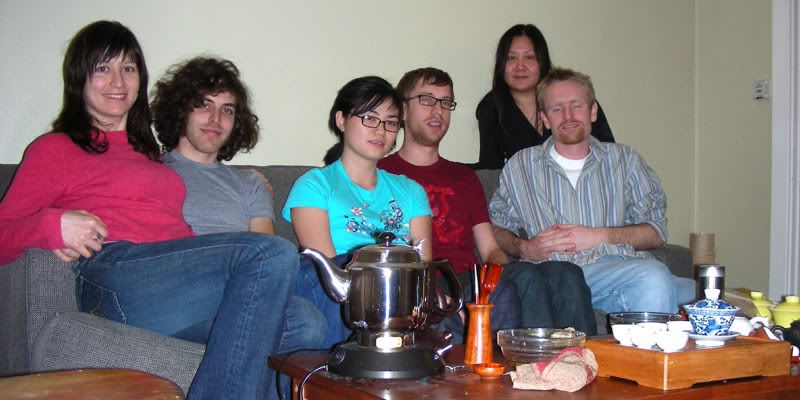
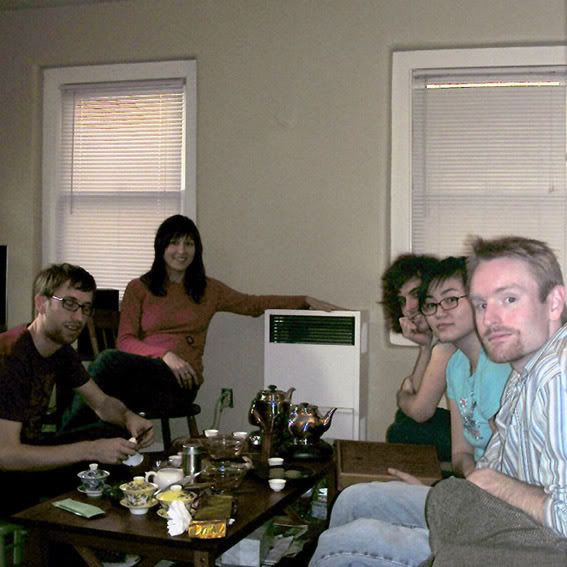
Left to right: Danica, Jonathan, Louise, Will, Imen and Nick
The tasting moved along at a leisurely pace, lasting from around 2 PM to just after 7 PM. We had some snacks (mostly northern Chinese breakfast foods from Yi-Mei in Monterey Park - vegetarian Fan Tuan (chinese doughnuts with preserved cabbage, nuts and rice wrapped around them), mung bean pastries, and lu dou gao (mung bean tea-cakes), By the end of the evening, my hands were a little shaky from all the caffeine.
We brewed mostly in large 6-7 oz gaiwans, as well as a few smaller teapots. We used my little ~ 1 oz cups, so surprisingly, even the small ~ 4 oz teapots seemed to make enough tea for everyone. We probably did at least 5-7 infusions for each tea, so maybe 50-80 oz of tea each.
TASTING NOTES
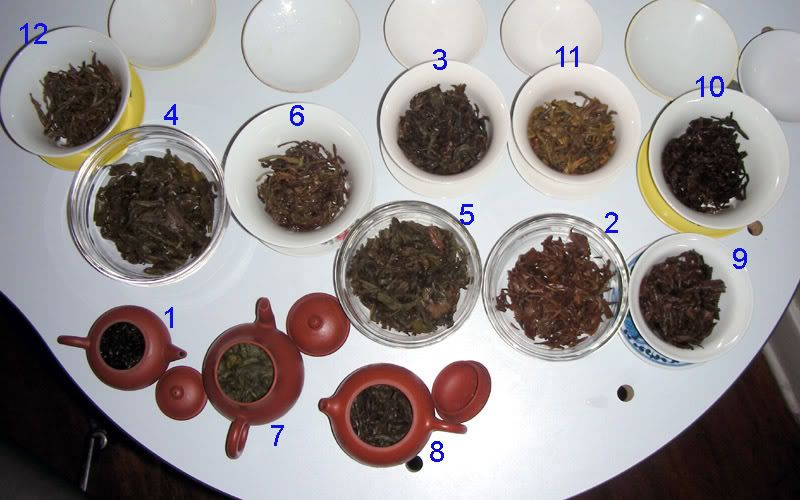
TEAS:
1) Roasted TGY (Tea Gallery) - Will
2) Bai Hao (ITC) - Will
3) Qi Dan Da Hong Pao (Golden Tea House) - Danica
4) Bai Ji Guang (Tea Gallery) - Will
5) Bai Sui Xiang (Golden Tea House) - Danica
6) Milan Dancong (Wing Hop Fung) - Imen
7) He Huan Shan High Mountain Oolong (2k-3k meters) (somewhere in Taiwan) - Nick
8) Rou Gui (Golden Tea House) - Danica
9) "88" dry stored Ching-Beeng #7542 (circa 1989) (Hou De) - Will
10) Mystery Menghai ~ 20 yr old sheng / shou mix (Nick's friend) - Nick, brewed by Imen
11) Song Zhong Dancong (Tea Gallery) - Will
12) '05 Song Zhong Dancong (from China via Imen) - Imen
Houde Fine Tea (Houston, TX): www.houdeasianart.com
Imperial Tea Court (SF): www.imperialtea.com
Tea Gallery (NYC): www.theteagallery.com
The Golden Tea House (Canada): www.goldenteahouse.com
Wing Hop Fung (LA): www.winghopfung.com
1) Roasted TGY
Will: When I ordered stuff from Tea Gallery, I had them send me a couple samples, and I let them include something they thought was particularly good. It seemed serendipitous that they sent a low fired Wu Yi tea when we were looking for something like that to drink at our tasting, and that it arrived the day before. My memory is kind of blank in this part of the tasting. This was my first time brewing this tea. Maybe I'll brew some more and come up with notes. I think it was pretty good and that people liked it.
5) Bai Sui Xiang (100 Years Fragrant)
Photo: Left, Bai Ji Guan; Right, Bai Sui Xiang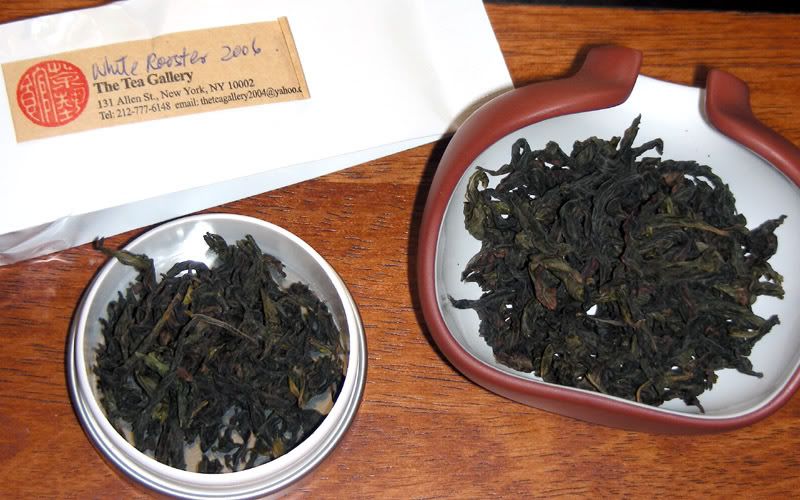
Danica: Louise or Imen said the flavor reminded them of vegetable soup. It has a very grassy, vegetal flavor with notes of hay. I later brewed it much lighter, per Imen's recommendation, and got the same grassiness but with more floral overtones.
Will: At first, we thought this was another Bai Ji Guang we had some interesting discussions about the correct Chinese name)... and the dry leaves were very similar in smell / appearance. This one was very grassy and kind of unpleasant at first. However, the later infusions (after the leaves opened up a bit) were better, brewed a littler stronger. Still, not really one of my favorites.
6) Milan Dancong
Danica: A very strong-roasted tea. This one had tremendous honey fruit floral flavor that lasted for many brews. It wasn't complex like the Song Zhong dancong but it was an excellent tea.
Will: I'm suffering from dancong overload what with this week and last week... this one was pretty nice - though I liked the ones we tried later a little more. Maybe a little less in your face fruity than some of the other ones, more of what Imen described as a "honey" flavor.
7) High Mountain
Danica: A vegetal, green, masculine high mountain tea. Nick brewed it strong. It wasn't as complex as some high mountain teas I've had but it opened up in the fourth steep and gave some floral notes.
Will: I don't really like this style of tea. I've had some really nice quality teas of this variety (including this one), and I just really don't care for them, for the most part. I liked the later, longer, stronger steeps better, but still not really my cup of tea (hah). Seemed to work pretty well in a ~ 4oz zhuni pear pot - and surprisingly, there was enough for all of us still.
8) Premium Rou Gui
Danica: This is an unusual tea that drew my attention for its smoky, sweet, caramelly flavor. It's a well composed, if unusual, interpretation of a traditional Wu Yi tea.
Will: I didn't quite know what to make of this tea. I didn't dislike it, but I don't know how to describe the taste in words - the smoky taste is different from the other smoky teas I've had. It reminded me of Spanish paprika (which has a smoked flavor) - not the paprika taste itself, but the smoky overtones. Smoky without being burned or charred. I didn't really taste the sweet / caramel taste that Imen and Danica tasted - maybe just a touch of it in the aftertaste. I think I'd have to try it another time or two, and maybe brew it myself, to decide how I feel about it.
 9) 88 Ching Beeng Pu'er
Will: I was sad that Phyll wasn't here to try this one, since he didn't like the one he tried. I tried this sample from Guang twice, and while I don't have a lot of experience with aged pu'erh, I like the taste. It's hard to describe, but mellow. I should note that by this point, my hands were starting to shake a little when moving the gaiwan lid. We went a bunch of rounds with this one, and could have probably gone on for quite a while.
Danica: This tea had an 'off' rinse steep, which Imen and the rest of us rejected on the basis of an unpleasant earthy flavor. The subsequent steeps were rich, flavorful, woody, earthy, with hints of fruit moving to sweet in later infusions. I think we went 8 or 9 with this one, primarily because I kept insisting we keep going. It was a great tea.
Phyll: Click here for my tasting note of this tea
10) Menghai mixed pu-erh
Danica: This tea was very mellow and easy to drink, with signs of good aging. You could taste the cooked, but the tea was powerful and Imen felt it could keep going for at least 20 infusions. In truth, cooked puerh is not usually my cup of tea, but this was quite easy to drink.
Will: Well I'm kind of proud of myself for suggesting that maybe it was a sheng / shou mix, since I guess that's what it turned out to be. We didn't think it was quite an aged sheng pu'erh, but it wasn't super heavily "cooked" either. Without knowing much about the tea or its origins (maybe a good thing), and without a ton of experience with pu'erh, I liked it. Smooth, earthy. The first brews had maybe a bit of a watery taste or feel, but towards the end it started getting nice and dark. I think we did at least 6-7 rounds. We could have brewed this one for a bunch more rounds also.
11) Song Zhong Dancong (Tea Gallery's)
Will: We probably could have stopped before here, but I thought it might be nice to end up back where we started - on a "sweet" note. After tasting the BTH Song Zhong Dancong, I thought their former students at Tea Gallery might have something similar with theirs. However this one (so far) to me doesn't seem anywhere near as complex. It's closer to the Milan Dancong from Jing that I brewed last time. Lots of lychee or maybe peach notes. The dry leaves look more highly roasted, but it's still pretty light and fruity. It's very nice and all that, and does get more complex after the leaves open more (and of course I may still learn to brew it better), but to me, it's not quite as good. Anyway, it's good, and cheaper than the BTH stuff (though more expensive than the Jing Milan Dancong) - just didn't completely blow me away. Probably if I hadn't had so much Dancong in the past few weeks, I'd like it more.
Danica: Very up-front fruity characteristics that developed more complexity with later brews. As Phyll noted in our other tasting, sometimes the Song Zhong Dancong takes a while to open up and get going. This one did around the fourth brew and was quite nice, although not as exceptional in aftertaste as the tea Phyll brought last week.
12) Song Zhong Dancong (From China)
Danica: for a tea from 2004 stored double bagged in a freezer we got tremendous flavor. Fruity and what could be called 'haunting' in the aftertaste, it really was 'wow' in the later (7th or 8th?) steeps, with an excellent kick. However it gave up its flavor soon after, which Imen attributed to the fact that we weren't using enough leaves.
Will: This was a nice one to end up on. Similar to the previous one, maybe a bit smoother and nicer. Someone said the leaves smelled like strawberries after they went into the hot gaiwan, and I kind of agree... maybe a little hint of this in the rinse and first steep or two as well. I have a hard time describing the mix of tastes in the later brews.
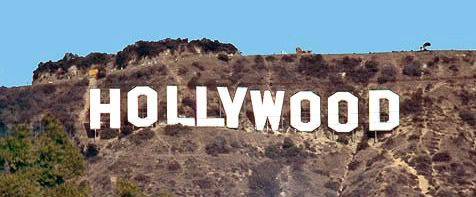 As I turned left onto Beachwood Drive, I glared at the H-O-L-L-Y-W-O-O-D sign boldly emblazoned up on Mt. Lee dead ahead of me. A local landmark that I usually take for granted, that day it was being shoved in my face and it was quite a sight! It reminded that no matter where I came from, I am now a subject of this little kingdom…this Tinseltown. And our king-elect is Arnold Schwarzenegger.
But I am not about to bore you with such stories…I’d rather talk about our tea gathering.
Sunday last, I was invited by Danica (Dah-nee-tsa), a film producer and a serious teahead, to her charming home for some tea. Also joining us were Jonathan, Will, Louise, and Danica’s black pug. The dog, judging by its color, is probably more of a coffee drinker. Did I just color-profiled Danica’s puppy? Somebody sue me!
The camaraderie developed almost instantly. It’s amazing to think how ol’ Ms. Camellia sinensis can bring different people together. I always say that friendship is the healthiest thing that comes out of tea – good friends are probably going to make you live longer than that EGCG-XYZ anyway.
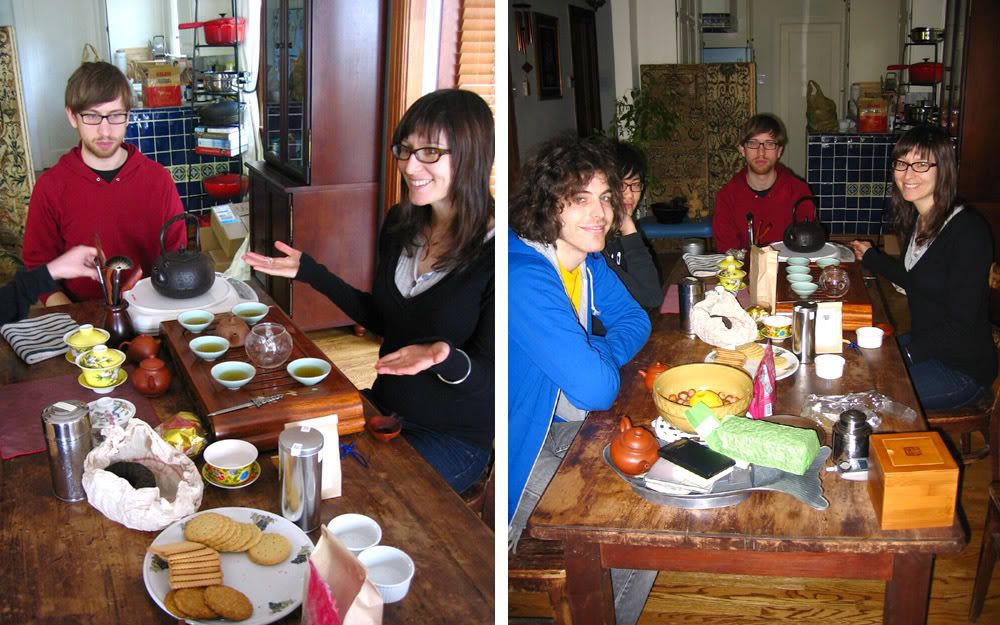
Right Photo (clockwise from left): Jonathan, Louise, Will, and Danica in charge of tea.
5 people, 1 dog, 4 solid hours, 6 teas, ~42 infusions, ~210 cups, no sweat!
1980’s Zhong-Cha (Menghai) #7532 Xiao Huang Yin Sheng Pu’er
Source: Houde Fine Tea
Danica: Very strong tea, with great cha qi lasting many steeps. Forceful woody quality that is balanced by earth and forest, with some astringency. Surprisingly young feeling, although the leaves look aged and the liquor shows signs of age. Becomes floral at the 9th steep; would have continued but I ran out of desire.
Will: I liked it - maybe a little on the young / bitter side for my taste still. I'm a little hesitant to talk about teas having strong qi, but this one did seem to have a kick beyond just caffeine.
Phyll: I remember this tea as tasting quite young and green still for an 80’s sheng. A lot of cha-qi and caffeine. The leaves are still quite young looking too, for a 20+ years old tea. I could feel myself feeling wired and tingly on my back after 4 cups or so. A lot of activity and taste there. This tea tastes like it’s been stored dry and clean. 4 stars (vg).
1985 Chan’s Tea House Sheng Pu’er Loose Leaves (stored for 20 years in Hongkong)
Source: Guangzhou
Phyll: Much older looking and tasting than the Xiao Huang Yin. Then again, I can say that this tea went through some mild wet storage period. The tea itself is earthy, woody, mellow and smooth. Not overly complex, yet there is something to be said about its subtleties. Calming and cooling, my body felt much better after this tea – it was like the XHY mentioned above created a fire and this loose sheng doused the fire. It is such a contrast to the 1980’s XHY. I rated it 3 stars before, and I still think it’s a 3 star.
Danica: Smooth liquor, comforting, with an earthy, mushroom note; possible wet storage or cooked (we didn't check the leaves!). Simple tea, easy to drink. Great for every day.
Will: This one was nice and mellow, in contrast to the other aged pu-erh. I liked it a lot. There was a weird flavor I couldn't quite put my finger on and certainly can't describe.
Highly Roasted “Monkey Picked” Tieguanyin
Source: Jing Tea of U.K.
Phyll: This tea has a wonderful aroma of nuts, caramel, honey, and various fruits. A complex tea overall, but the roast is (still) much too strong. Perhaps this was roasted fairly recently and it needs some resting time (months) to calm the fire. The charcoal aroma is too apparent. Otherwise, it is a wonderful tea. I loved it, despite. 3.5 stars (g – vg) due to too much charcoal. Otherwise it's 4 stars.
Danica: Very dark roasted appearance. The tea is strong and complex, dominated for the first 4 steeps by the roast. Leaves a wonderful caramel/ vanilla/ orchid/ complex scent in the cup that is quite revelatory. The caramel flavor begins to open up in later brews (I think it was #4); this could be in concert with the leaves opening in a very full teapot. Perhaps a longer brew time would also have given more flavor up front. Personally I found there to be a metallic note to the roast that reminded me of fuel, which may be a result of the charcoal. It made it less smooth and palatable for me. This note makes an otherwise 8.5 tea a 7.5 for me. Drinkable, interesting, but not perfect.
Will: This reminded me a lot of Stéphane's roasted high grade TGY (to be fair, that's the only other high-fire TGY I've tried). Slight differences, but the basic flavor is the same. I'm not sure which one I like better yet - maybe we should try a side-by-side. They both have a pretty strong taste of... I guess I'd call it caramel. The smell was very nice; Louise thought it had a bit of a sandalwood aroma. It looked a lot darker than the one in the picture I see on their site
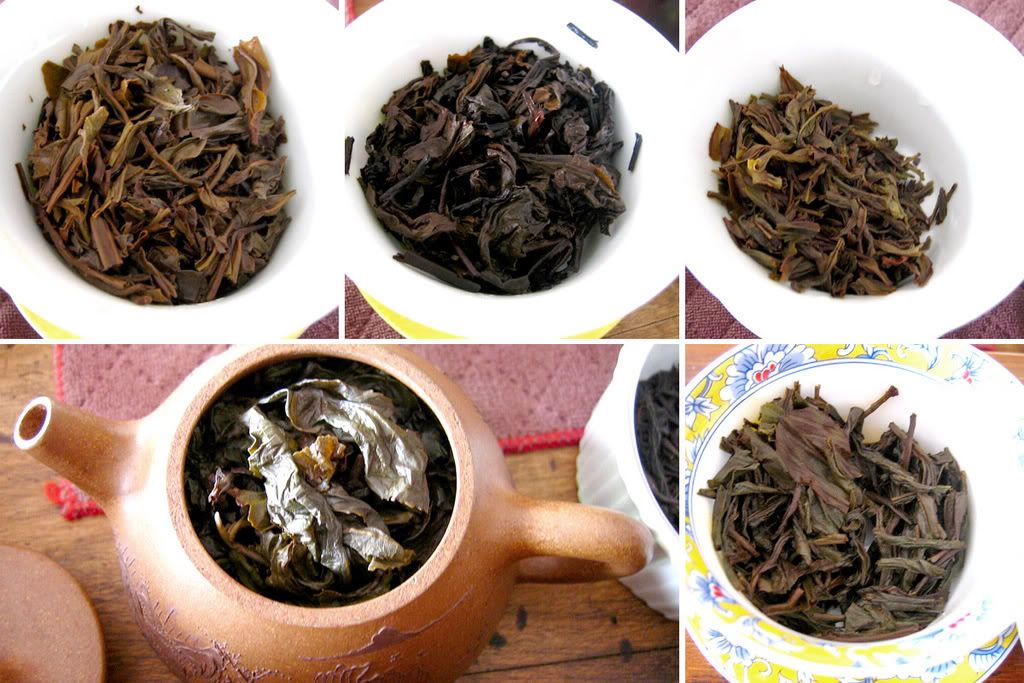
Clockwise from top left: 1980's Zhong Cha Xiao Huang Yin Pu'er, 1985 Sheng Pu'er, 2006 Milan Dancong, Song Zhong Dancong, Long-an Taiwanese oolong (pot). Not pictured: Monkey Picked TGY.
2005 Long-an Wood Roasted (Heavy Fire) Formosa Oolong
Source: Houde Fine Tea
Danica: Round and fruity scent of dry leaves, more roasted smell from dry leaf. This one brews up strong; it has a consistent, fruity flavor with a nice hint of roast. The roast is different from the monkey pick, it is less prominent and less complex, but the tea is clean and pleasant-tasting. Good durability--I got at least 7. After brewing the leaves showed some oxidization but were primarily a shiny dark green color, with some stems. I had it again and brewed it a little lighter; I think Will would have enjoyed it more.
Will: It's described on Houde's site as "heavy fire" (maybe for Taiwan), but I'd describe it more as a medium or low-medium roast based on the appearance of the wet leaf and the taste of the tea. As brewed, it was a little on the bitter side for my taste (though everyone else seemed to like it -- I'm just weak sauce). Memory is failing me in terms of other specifics right now.
Phyll: This tea is rather simple tasting with a pleasant woody – fruity aroma. Though regarded as “heavy fire” by the vendor, it is much less roasted tasting than the abovementioned Monkey Picked TGY. A nice change of pace after the TGY…the difference between a dark roasted oolong (with charcoal?) and a traditional Taiwanese wood-fired oolong is very clear when tasted one after another. 3 stars (g)
Spring 2006 Milan Xiang Dancong Oolong
Source: Jing Tea Shop of Guangzhou
Will: I like this tea... I feel like it's almost *too* accessible (like maybe I'd get sick of it if I drank it all the time) - the lychee taste is right there to the point where it's very fruity. I like to brew it withnot too much leaf so the bitter notes don't take over. It's very lightly oxidized, and the taste is very light. The wet leaves also have a strong lychee smell.
Danica: Really lovely fruity dancong tea, Will described it as a lychee or maybe passion fruit flavor. Brewed well with fewer leaves, there was hardly a hint of bitterness.
Phyll: This is simply lovely! It is highly perfumed with all sorts of yellow fruits and flowers, noticeably peach, apricot, and floral (orchids, as the name implies). The aromas are very upfront and expressive from the very first brew. If it were an opera singer, I would say it’s a mezzo-soprano. Simply charming. Will used less leaves than I usually would brew my Dancong, and it came out very nice. 4 stars (vg).
Song Zhong Dancong (Highly Roasted)
Source: Best Tea House of Hong Kong
Phyll: The 2 previous times when I brewed this tea at home, I ended up with too strong a tea. So after witnessing that Will successfully brewed the Milan Dancong with less leaves, I decided to follow suit (about 1/4 full in a 100ml gaiwan). I think for this tea, it needed a little more leaves than the Milan Dancong, but less than what I used at home (1/2 of a gaiwan). It’s a learning curve. Dancong is rather hard to get right.
A late bloomer. The first 3 or 4 cups were light and rather sleepy. Then it gradually opened up on the 5th brew, giving nice complexities. The perfume that comes off of the tea gave a warmer feeling than the Milan Dancong. Peachy, honey, and floral. Very good aftertaste. 4 stars (vg)
Danica: This was an interesting tea with a wonderful and special aftertaste. It was complex and floral with a fruity main note. I can imagine if it was brewed stronger it would be extraordinary.
Will: This was very nice. Would have been nice to try it without knowing exactly what it was, since this tea's reputation precedes it. That said, I thought it was very nice. Similar notes to the Milan Dancong from Jing (lychee, peach), but a little less up front (I think Phyll made that point), more complex, and with a great lasting finish. You hear people talk about teas with a good finish / aftertaste, but this one really had a lot going on there. I'm glad we didn't skip this one, especially to taste right after the Jing one. Despite being fairly high-fired, the tea didn't have a strong oasted taste.
We are planning to meet again in a few weeks time, and hopefully Imen and Nick can join us.
 Come join an online tasting event that is being organized by T Ching.