Saturday, September 6, 2008

Elevated Expectations?

Last night, after drinking Toki's yancha oolong brew du nuit (steeped from 9am to 9pm), I decided to look for another yancha tea among my stash to do a comparison tasting, sort of. Aha! I found a pack of vintage 2007 Baishuixiang (100 years fragrance -- BSX) oolong, still vacuum-sealed in its little mylar bag.

This tea, among others, was generously given to me by Will and Louise, two of my LA Tea Affair buddies. While visiting Wuyishan last year, they obtained a variety of teas from the local producers and vendors to be brought back to Los Angeles for their personal enjoyment. I am sincerely grateful to them for the potpourri of samples of their acquisitions.

My thinking was to drink Will's BSX and use my recent (and ongoing) tasting of Toki's Shuixian (SX) as a frame of reference for taste, quality and, most especially, firing technique. Granted that BSX tea is not the same variety as SX, I hope they are more or less comparable on the general level, as far as my tasting experiment is concerned.

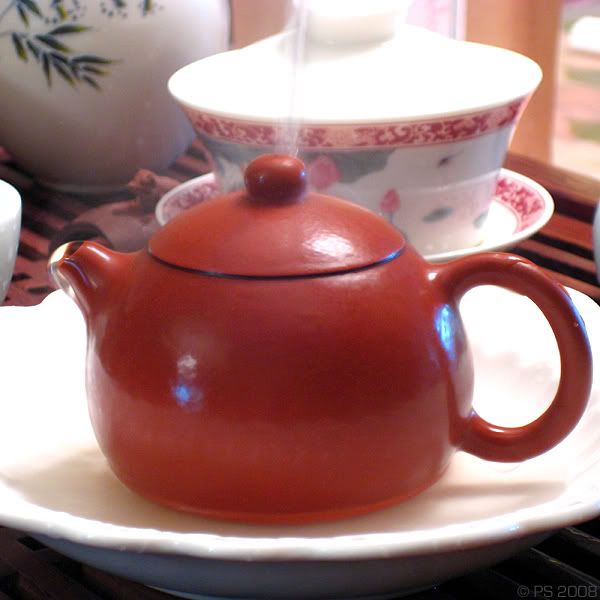
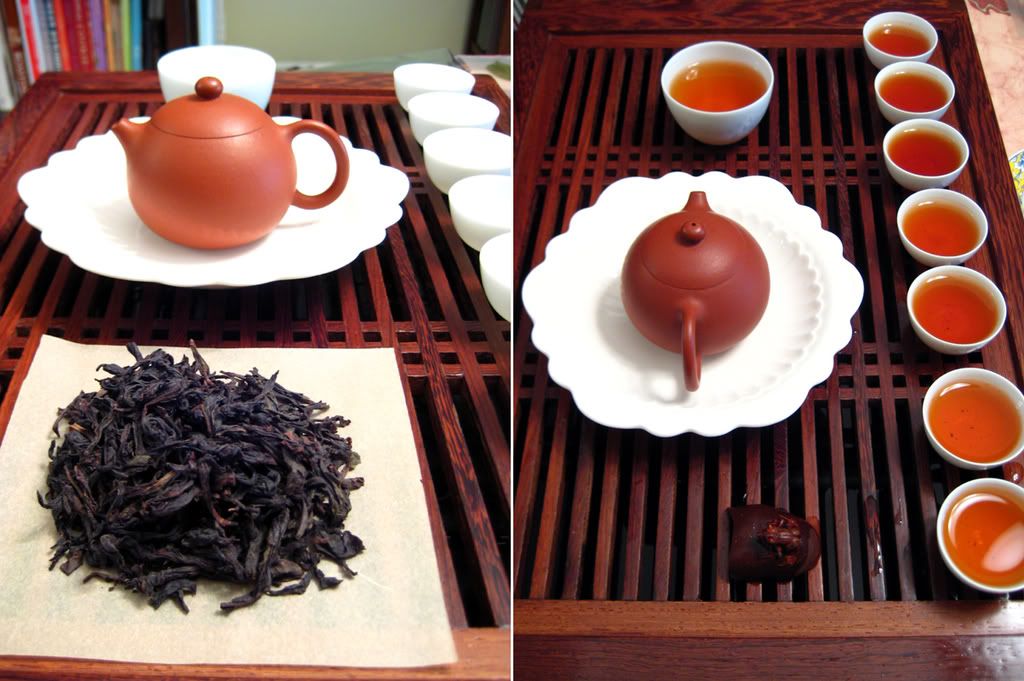
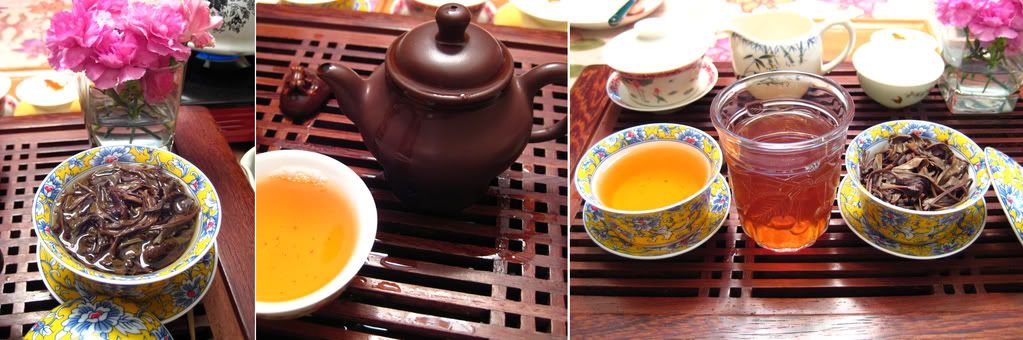
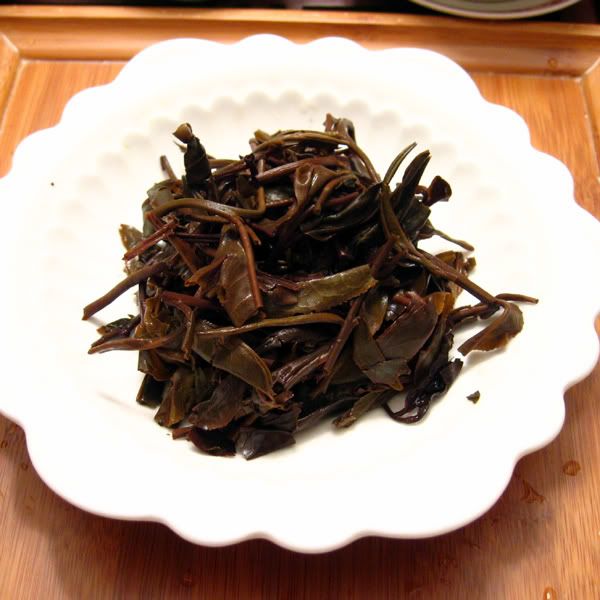
So, as with Toki's tea, I placed about 3/4 full of the BSX, tightly compacting the leaves by tapping the pot's side gently, into my 80cc 1970's hongni shuipin Yixing pot. With boiling-hot water I flash-rinsed the tea once, and then flash-steeped the tea for 6 infusions. After the 6th cup, I felt that I've had enough impression of the tea for the night (will continue in the morning).


The differences between the two teas were strikingly noticeable. Although both teas have been deeply roasted, the SX managed to give out an upfront yet balanced sweetness and roastiness. The BSX, on the other hand, was skewed much more towards its roasty characteristics. It had thin layers of green and floral characters underneath all the strong, toasty flavors. Also, the BSX tasted rather chaotic in the mouth: burnt toast, some greenness, a bit floral, but highly astringent. I felt that the qi of this tea was also chaotic, giving me an uneasy feeling overall. The aftertaste lingered for quite a while, though unfortunately, it was sour and drying to the throat. I felt more thirsty than before I drank this BSX.

Should I not put as much leaves when brewing BSX tea? Or has my expectations been elevated somewhat by Toki's tea? If my overall expectations has indeed been elevated, then I reckon that I am doomed to spend a large sum of money whenever I shop for a decent Wuyi tea -- that is if I could find such high caliber teas to begin with.

[My utmost thanks again to Will and Louise! Despite my criticism, I am grateful for the lesson I learned from tasting your tea.]

Friday, September 5, 2008

Into The 6th Day of Tasting...

Today, I enter into my 6th day of tasting Toki's Wuyi oolong, which according to his blog was harvested from a 200+ years old Shui Xian bush, and then fired 4 times between May and September of 2004 by a talented tea master in Wuyishan, Fujian Province, China.

For the first 3 days (Sunday to Tuesday), I brewed this tea with regular gongfu methods until such point that I had to infuse the tea for 15 minutes or longer. From then on, I began to infuse it for hours on end. These are the steps I am taking, as suggested by Toki:

1. After concluding the last short-brew steep, pour boiling-hot water into the teapot up to the rim. Place the lid on, and pour hot water over the lid to "water-seal" the teapot.

2. After about 6 or more hours, pour the tea out (to be enjoyed). Then, pour boiling water into the teapot for about 5 - 10 secs before pouring the brew out into a cup (to be enjoyed). The purpose of this short steep is to re-heat the leaves in order to prepare them for the next extended steeping. The leaves must be as hot as possible. Then, I immediately pour boiling-hot water into the teapot again, up to the rim, put the lid on, and water seal it. I let it stand again for hours on end.

3. Repeat step 2. Increase steeping time as necessary, up to 12 hours.

The liquor from yesterday morning's 11-hour steeping was smooth and flavorful. It no longer had the roastiness and the astringency that this tea exhibited during the first 3 days. Rather, it tasted and smelled floral and subtly complex. I can't find the words to describe it. Somehow, it reminded me of drinking an old, top-notch Cognac.

I wonder if an extended tasting session that goes on for weeks is best (or better) done with a heavily-roasted tea. Since roasted tea had to go through the firing process, I would assume that the end product is "clean"...less bacteria, fungi and other creepy microscopic crawlies. Also, the fact that the leaves are always submerged in water inside a sealed teapot probably minimizes mold growth and other nasties from developing. Further, after the tea is poured out, re-steeping the leaves with boiling-hot water maybe helps kill any chances of unwanted stuff from growing too much, too quickly or at all. Lastly, perhaps the fact that tea has antiseptic properties helps keep it clean and safe to consume for much longer.

These are just hypotheses...I'm not sure.

Wednesday, September 3, 2008

Negative Outlook By a U.S. Tea Wholesaler

I always welcome with delight the latest quarterly catalog from Upton Tea Imports when it arrives in my mailbox. Even though I rarely order from them, the catalog itself is a good read. It is written like a gazette on tea history accompanied with a broad list of tea and accessory selections.

What caught my attention in the Fall 2008 catalog is the short note to the customers on page 3. As a well-established wholesaler and mail-order tea company in the US, their view on the tea industry -- though understandably it may not be free of subjectivity due to their position -- let us peek into the changes and the current condition within the trade. The note reads as such, and I quote:

(Bold format by me)

"A Note to our Valued Customers:

We continue to see challenges in the procurement of top-quality teas from virtually all of the major producing countries. A late start to the growing season was followed by rather warm weather, adversely affecting the quality of the teas from northern India, China, and Japan. With few choice lots being produced, and with sustained pressure on the value of the U.S. dollar, the best teas fetched record prices once again. For the first time we have seen select Assam teas selling at prices formerly attainable only by the best Darjeeling teas!

China Yunnan teas continue to be disappointing. There is hope that the late season will produce better teas than last year's selections, but the proof will be in the samples, yet to arrive."


It's followed by a more upbeat tone...

"But rather than focus on the negative, I must say that we have been enjoying some outstanding new arrivals here at Upton Tea Imports, and we will be receiving several excellent teas over the coming weeks. And even as loose tea prices have been increasing by leaps and bounds, we note that the world's finest teas are still an affordable luxury.

As always, new arrivals are posted on our website as soon as they have been received and checked for quality."

Then it mentions about 3 recent arrivals from Taiwan, which I am leaving out, before the note is concluded.

Altogether, it's realistic but not an inspiring note for tea drinkers, if you ask me.

Left out by the writer of the short note above is any mention of the recent political unrest in Darjeeling (also here) and the effects on the quality of the region's teas. Also, the writer gave no hint as to the causes of Yunnan teas' poor quality, which in the case of Pu'er it was most likely from overproduction, a lack of standard control and the rampant speculation of the commodity. But there are other types of tea produced in Yunnan. What causes the poor quality of non-Pu'er teas from that province remains elusive for now.

As consumers, we are already being pummeled by high gas prices, increasing food costs, weak U.S. dollar, and the poor economy as a whole. Unfortunately, in the scheme of things, what goes on with tea is not at all surprising. We are being forced to pay more and settle for less.

Monday, September 1, 2008

...And It Continues On

Parameter: dry leaves 3/4 pot full , compacted by tapping the pot gently to settle the leaves down. Flash rinse. Gentle stream of boiling-hot water (99-100' C). All time measurement is an approximation, decided by the previous cup's taste and strength.

Day 1: brew # 1 - 4 flash steeped. Brew #5 +2 sec. Brew #6-7 +5 sec.

Day 2: brew # 8 (flash steeped to heat leaves). Brew #9 +5 sec. Brew #10-11 +7 sec. Brew #11-12 +10 sec. Brew #14-15 +15 sec.

...still going strong, ready for day 3!

Per Toki's instruction, keep brewing normally until the tea has to be pushed for up to 3 minutes. Thereafter, each steeping for hours on end will begin.

By the way, I'm not alone -- thank goodness! Salsero is in this, too.


All this tea made me thirsty for some wine...

2003 Saxon Brown Zinfandel
Casa Santinamaria Vineyards
Sonoma Valley
($25, 15% alc.)

Dark purple, almost opaque. Ruby on the rim. Very intense black and red berries, dark cherries, and coffee. Powerful and concentrated, without feeling too heavy. The finish has a roasted oak, coffee and a slight glycerin sweetness. Its high alcohol level (15%) is beautifully balanced by the just-right acidity level, which gives the wine a lively zing and dimension. For a zinfandel lover (me), I love it!

4 stars (vg)

Sidenote: Saxon Brown winery and the Casa Santinamaria vineyards are precious jewels of the Sonoma Valley. The vines in these vineyards are dry farmed, head-pruned and have low-yield (~1/2 ton per acre). Under the talented hands of Winemaker Jeff Gaffner. You've got to love Mr. Gaffner's wines!

Sunday, August 31, 2008

The Marathon Has Begun...

...a tea tasting marathon session, that is.

I am conducting my first drawn out, detailed tasting session, which may last for weeks (one tea) if I do it correctly. The tea is a vintage 2004 high-roast Wuyi oolong of undoubtedly top pedigree.


Today I brewed the tea for 7 times. It was lovely and full of energy! The vibrancy of the 7th cup left me with little doubt that this tea can endure the long haul. I'm reserving my tasting notes for later.

We hit the beach in the afternoon. It was cloudy and a bit chilly, though the water was nice and warm.

Saturday, August 30, 2008

Durable Morning Tea

While reading the woes of the world and the bleak financial news on the papers this morning (not to mention Sen. John McCain's puzzling choice for VP), I sipped on what most likely the 20th infusion of 2005 Yichanghao "Ji Pin" sheng pu'er (Houde). Maybe it was the 19th or the 21st brew...I lost count. This last cup was steeped for a good 12 to 13 hours from the evening before. Its aroma and taste were still enjoyable, and the tea was drunk at room temperature.

For a vintage 2005, the dry leaves of this Yichanghao look interestingly darker than most other -- if not all -- 2005 sheng pu'er I have or tried. The beeng gives off a mild whiff of floral and straw notes. It made me wonder: is this one of those '04 - '05 Chang Tai tea that went through, as Danny Samarkand mentioned on CHA DAO, a "slight pre-processing fermentation"? [click here for the excellent 2nd installation on proper storage consideration for pu'er teas, written by Mr. Samarkand and MarshalN, as well as the ensuing discussion in the comment section, which touched briefly on the subject of Chang Tai teas]. Unless I misunderstood Danny's meaning, this '05 Yichanghao fits his opinion: the leaves are darker compared to similarly young teas, and the liquor is orange.

A very pleasant fragrance emanated from the tea liquor, which reminded me of straw, bamboo shoot, and of sweet smelling flowers. It's so fragrant that it almost felt unnatural for a young raw pu'er. Again, it made me wonder: is this more oolong or more pu'er? I couldn't be exactly sure.

The taste was smooth and astringency was hardly present, unless I pushed the steeping time exceedingly long. It's sweet-ish in the mouth and throat from the get go (as in no ku -- bitterness that turns to sweet sensations that one might expect from some young pu'er). The chayun and the huigan were all rather weak, but the overall package was very pleasant, actually.


On its chaqi: I felt a certain energy flow that first warmed my lower back and then it moved towards my stomach area, shoulders, chest and neck. The effect was calming and relaxing.

Conclusion: For a young pu'er, it is already approachable and ready to be enjoyed. I would think that anyone who hasn't acquired a taste for young raw pu'er should find this tea pleasant [enough].

Ageability, however, is hard to predict. There was not much strength or concentration of taste, aroma, chayun and huigan, all of which are necessary attributes that every candidate for a long-term storage should possess (or so I read). Certainly not lacking, however, is its good brewing durability. Therefore, it will be interesting to see what this tea has in store a few years from now. I should think that an investment in a few beengs could be warranted...some for immediate enjoyment and a few for a bit longer down the line.

Good compression -- not too tight or too loose. The wet leaves are healthy and intact.

What do you, dear readers, think about its aging prospect given my long-winded descriptions above?

Friday, August 29, 2008

Beautiful Morning Tea

I make it a point to obtain some freshly produced Oriental Beauty oolong every summer. This seductive tea is one of my favorite seasonal indulgences. It's quite easy to fall in love with it. The best example that I ever tried made me swoon in adoration as she sang all the low, mid and high notes in symphony.

I think the mark of a superior Oriental Beauty oolong is the presence of acidic nose / taste (the high notes -- fruity, sweet and sour) that is the signature of summer, insect-bitten teas. At the other end of the scale, the high degree of oxidation should lend the tea its mid and lower notes (honey, floral, caramel). When all is well, the effect can be euphoric.

This 2008 summer harvest is among my recent purchases from Houde. I seemed to have underestimated the leaves' density in dry form, and as a result may have used too much leaves this morning. To compensate, I employed flash steepings in the beginning and add mere seconds to later infusions.


Floral and honey notes are more prevalent here, with only a hint of the high sweet-sour notes, which I was craving after. There is a slight bitter undertones, too. I still need to "play around" with it. For now, it lacks the higher notes. Next time I will use less leaves and longer steeping time to, hopefully, coax out its fruitier personality.

Wednesday, August 27, 2008

Fresh Morning Tea

The Yeoman Warder (a.k.a. Beefeater gin) from last night played a drum in my head. It was imperative that he left immediately before I leave for office. So I resorted to the fresh Baozhong (spring 2008 harvest, Pinglin township, Taiwan), which was generously included by Guang among my recent purchases.

Floral and silky smooth. A wonderful morning refreshment. The Yeoman still lingered, though much calmer by now. Ready or not, it was time to brave the 405 freeway, again.

Tuesday, August 26, 2008

Ngaben Ceremony at Besakih Temple


Note: Besakih Temple, Bali, Indonesia. Ngaben (cremation) ceremony per the Balinese Hindu religion. Ending procession began from the restricted upper area of the temple passing into the public area. Quite fortunate to witness it as this doesn't happen every day (such solemn ceremony is not staged or open to outsiders).

Monday, August 25, 2008

Crab's Feet Pu'er

Drinking tea in a Guangzhou (Canton) teashop, one is bound to be shown many novelty teas by the shopkeeper. I was a newbie at Pu'er back in 2005 (still am today). It was in November of that year during a visit to the old city when I first got introduced to Crab's Feet Pu'er at a teashop on Yue Hwa Road.

I was a soft target: a tourist, even though I wear the skin of a Chinese man. Furthermore, my command of the Mandarin language was flaky, probably the level of a native 3rd grader at best. I got by, though barely. A conversation ensued, more or less, as such:

"This crab's feet tea is popular with the Taiwanese people," the lady shopkeeper said.

"Oh, how come?" I asked.

"They find the taste appealing, and the crab's feet supposedly have good medicinal properties for the stomach," she explained.

"What is it, actually?" I inquired curiously.

"It grows on Pu'er trees as a parasite. It gives a slight suān (酸 -- sour) taste to the tea. Here, let's try it, shall we?" I didn't have "parasite" in my Mandarin vocabulary at the time, so I went "huh?"

She then broke an ample amount from the beeng and brewed the curio with a gaiwan. I still remember her rather well to this day because, in addition to being young and pretty, she was very adept and gracious with the gaiwan. Watching her hands move about and pour tea out of the gaiwan was quite hypnotic in itself.

I was a very soft target.

By the time I left the shop, I owned 2 beeng's of this Crab's Feet Pu'er, which according to my records I paid RMB 150 per (~ USD $19 at that time). Back in Los Angeles, I chucked them, along with some other pu'er I obtained during the trip, in my off-site cellar cabinet. They have been sleeping in cool darkness ever since until their retrieval yesterday.

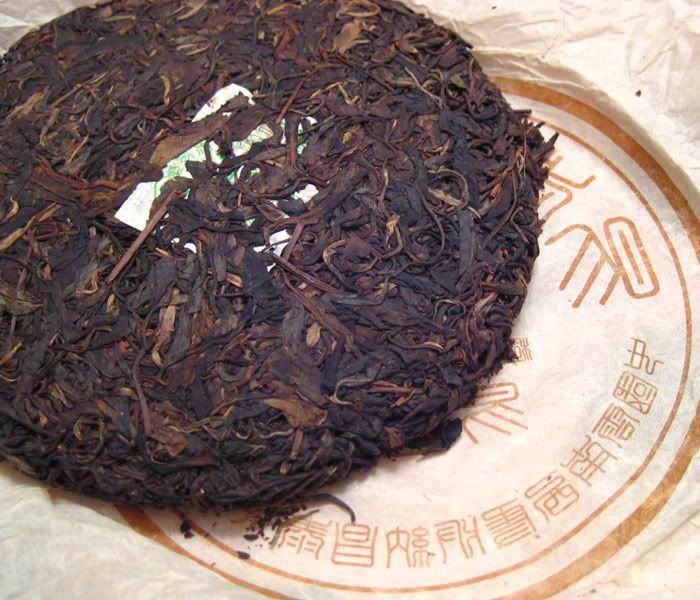
On the tea's wrapper and the inner ticket, the characters 螃蟹脚 (pángxiè jiǎo) are written, which literally translates as "crab's feet". I am not quite sure why some refer to it as crab's "claw", because as far as I know (and that's not much, mind you), the character jiǎo (脚) literally means foot / feet. Toki of The Mandarin's Tea blog has pictures of this parasitic vines growing on an old Dancong tea tree.

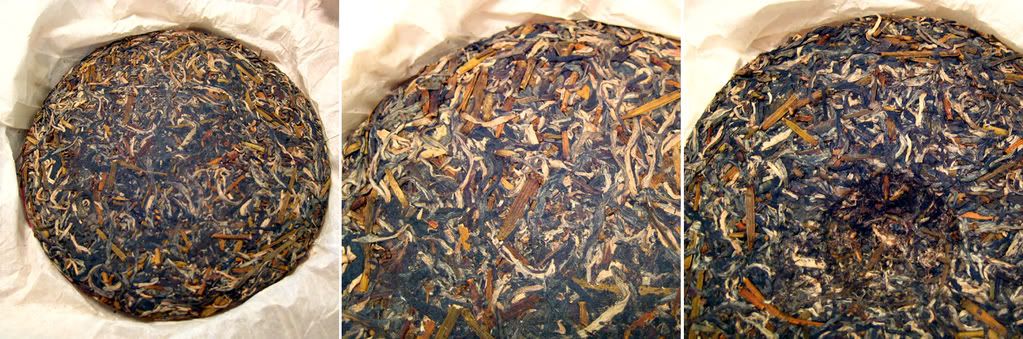
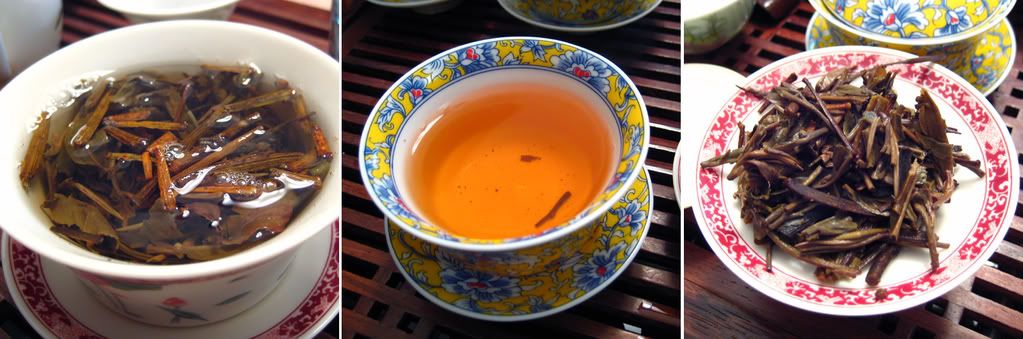
The tea is a vintage 2002 made by Spring City Tea Factory in Menghai. As you see from the pictures below, the beeng was compressed with leaves of different colors. The orange-brown things, which are more like stems than leaves, are the crab's feet.

The tea itself was ordinary tasting. It had sour plum and dried wood notes. Overall its taste was rather boring, lacking any character or depth. Its brewing durability suffered, too, when its taste began to subside significantly after a mere 5 rounds or so. Had I been offered this tea today, I would never have bought it (except if the shopkeeper was Gong Li, perhaps).

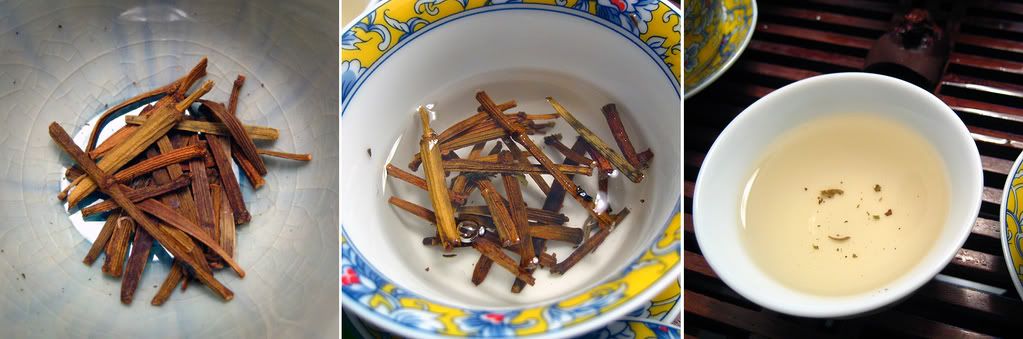
Curious about the crab's feet, I separated the orange stem-like substances from the compressed tea and was able to obtain enough for a tasting experiment. I brewed the small amount of the crab's feet in just-boiled water (98-100' C) for about 2 minutes. The liquor was almost colorless with a light tinge of orange. It almost had no taste at all. What it had, however, was a creamy mouthfeel and aftertaste...almost milky (edit: umami is the word I've been looking for to describe the taste of the crab's feet liquor). It's quite interesting by itself, actually. However, it did not taste sour at all, as the shopkeeper had claimed. I should note again that this pu'er seems to be mixed only with the stem-y part of the crab's feet, and it does not contain any of the leafy parts. Maybe it's the leaf of this parasitic vine that is sour tasting?


Conclusion: For this particular Pu'er specimen, I think it serves the purpose of satisfying my curiosity, but largely a waste of time and money.

Light and Shadow

(Light, shadow, and a girl running)

Note: taken at the J. Paul Getty museum on Sunday, August 24th, 2008. About 5pm. The running child: Sophia, my ever hyper daughter.

Thursday, August 14, 2008

Centipede On a Stick, Anyone?

Caught this NBC segment today of Al Roker and Chef Ming Tsai snacking in Beijing. Makes me think that I should be on a strict centipede diet in order to lose a few unwanted pounds...because I wouldn't eat any of it! I'd chew down most of the stuff there without a second thought, although I'm a bit hesitant about the scorpions. Not the centipedes, though...uh uh, no thanks. *shaking my head*


These are all kid's meal compared to the things this guy has eaten.

Tuesday, August 12, 2008

A Promising Prospect -- 2001 Mengku Yuanyexiang

The one tea that I've been drinking quite often lately is the 2001 Shuangjiang Mengku Yuanyexiang (YYX), thin paper version. It is now 7 years of age, which supposedly marks the end of the 1st and the beginning of the 2nd stage of its fermentation process. At least that's what they say, although I haven't really grasped the theory behind this concept.

The more I drink the YYX, the more I feel how promising this tea has become as it ages a bit more. The redness of the liquor and its clarity is great. The taste is complex, lively and "active". It may not be as smooth as an older sheng, but I think given enough time it will acquire that characteristic eventually. One can only hope. What I like best about this tea, though, is the way it makes me feel after drinking it -- it rejunevates and focuses my mind, and it soothes the stomach, too.

The cake / beeng that I've been breaking from has been stored in a closed book cabinet at home with an un-capped bottle of water to help with the moisture level. Generally, however, the storage environment at home is much drier than the off-site cellar where I keep most of my wines and teas. This makes me wonder if the several cakes of YYX (thin and thick paper versions) that I keep off-site have progressed differently than the ones I have at home. I should like to fetch some and do a taste comparison soon.

Saturday, July 5, 2008

A Greek Feast, 2005 Amethystos & 2006 Kouros

Whipped Caviar Tarama, Yogurt Tzatziki, Eggplant Melitzanisalata, Fassolia Beans, Manestra Pasta, Kalamaria, Dolmathes, Keftethes, Spanakopita, Pastitsio,…

These were some of the wonderful Greek dishes I had with my family in the later half of yesterday. Not exactly a traditional Independence Day fares, which usually involve lots of BBQ’s, beers and red Californian zinfandel. Let's just say we celebrated the 4th of July the Greek-American way at a popular local Greek restaurant not more than 5 minutes from where we live, called The Great Greek.


A bottle of Veuve Clicquot Champage got our appetite going as a starter beverage. And then a red 2005 Amethythos and a white 2006 Kouros accompanied the sumptuous Greek feast we had.

The non-vintage Veuve Clicquot Ponsardin is a nice standard fare Champagne…toasty, yeasty, with fine bubbles. It hit the spot well.

The 2006 Kouros, a white wine made from Rhoditis (aka: Roditis) grape variety, is from the southern part of Greece near Patras. This wine tasted dry and a bit citrussy, which went very well with the first course dishes of Greek salad, various creamy, whipped dips and other meze. It reminded me of a simple but pleasant Californian Sauvignon Blanc table wine. 2 stars (quite good).

The 2005 Amethystos from Adriani, Drama, is a blend of local Cabernet Sauvignon, Merlot, and Limnio, an indigenous Greek red wine grape variety. This wine apparently was aged in large, 225 litre French Limousin oak barrels for a year before being released. Lots of blueberry, some earthiness, talcum, and a bit of good funk. The tannin is quite pronounced, and the oak soft and judicious. Quite delicious. 3 stars (good, recommended).

I ended the meal with a plate Galaktobouriko, which personally was a bit too runny and salty for a dessert. A cup of super concentrated Greek coffee with a side of sticky sweet compliment called Loukomi ended the meal.

But what is a Greek feast without some live music and dance…

Friday, July 4, 2008

1950's Shui Xian Oolong

Happy 4th!

Something special deserves its own moment. When it comes to a unique tea, it means finding a calm and casual window of time to savor it. The morning of July 4th was such that I decided to open a small package from The Tea Gallery containing 25gr of 1950’s Shui Xian oolong. I’ve been meaning to try this old tea out since it arrived 2 weeks ago, but a calm enough morning has been a rarity these days.

Upon opening the packet, I dived my nose into the mylar bag and took a few short, successive sniffs. There wasn’t much to nose about, however. Whatever mild scent present was reminiscent of old parchments with a hint of something sweet.

The leaves were quite broken, with about equal amount of larger-sized ones and the small bits. Five or six decades of handling and storage tend to do that to lightly rolled tea leaves. There were also about an equal amount of brown and black leaves in the mix. The black ones have some sheen about them.

This was to be the oldest Wuyi oolong that I’ve ever tried to date.

I filled my small, thin-walled 75ml Yixing pot half-full of dry leaves (1/2 full is a personal preference when it comes to Wuyi teas). I did everything carefully, as one would when handling something so old and fragile. I poured the water gently, in small stream, aimed at the rim of the pot’s opening so as not roil the leaves within.

The pre-rinse was done in a flash, and the resulting liquor was muddy, dull dark-brown…not pretty, but it reinforced the perception of its antiquity somehow. I drank the pre-rinse and it felt clean, light and airy, with a taste of old parchments (again). It was very smooth, though not much else.

The next infusion yielded a less muddy tone, and subsequent infusions thereafter would yield redder and clearer tea soup. By the second brew (third, including the pre-rinse), I suddenly felt quite woozy. The force was strong with this tea, and so I stopped to take a bite of sustenance before proceeding further.

On the third brew, suddenly this tea seemed to have awakened from its long slumber. The liquor became tastier and the aftertaste more pronounced. Though I wouldn’t regard it as complex tasting, in its simplicity and straightforwardness hid something pleasant, and that is the chaqi and its ability to leave a lasting aftertaste. With each sip, after the liquor slid down the throat smoothly, the ghost of it produced an intense salivation effect that left a long, sweet aftertaste. It’s a wonderful sensation altogether.

As with the pre-rinse, all subsequent infusions remained light, airy and extremely smooth. Its subtle perfume was not found in the liquor, but rather on the bottom of the empty cup...there lies a treat for your nose!

The packet of 25 grams doesn’t go a long way. There is only enough left for 1 more session. Is it worth the price? Insofar discovery is concerned, I think so.

4 stars (VG. Good chaqi and lasting aftertaste)